
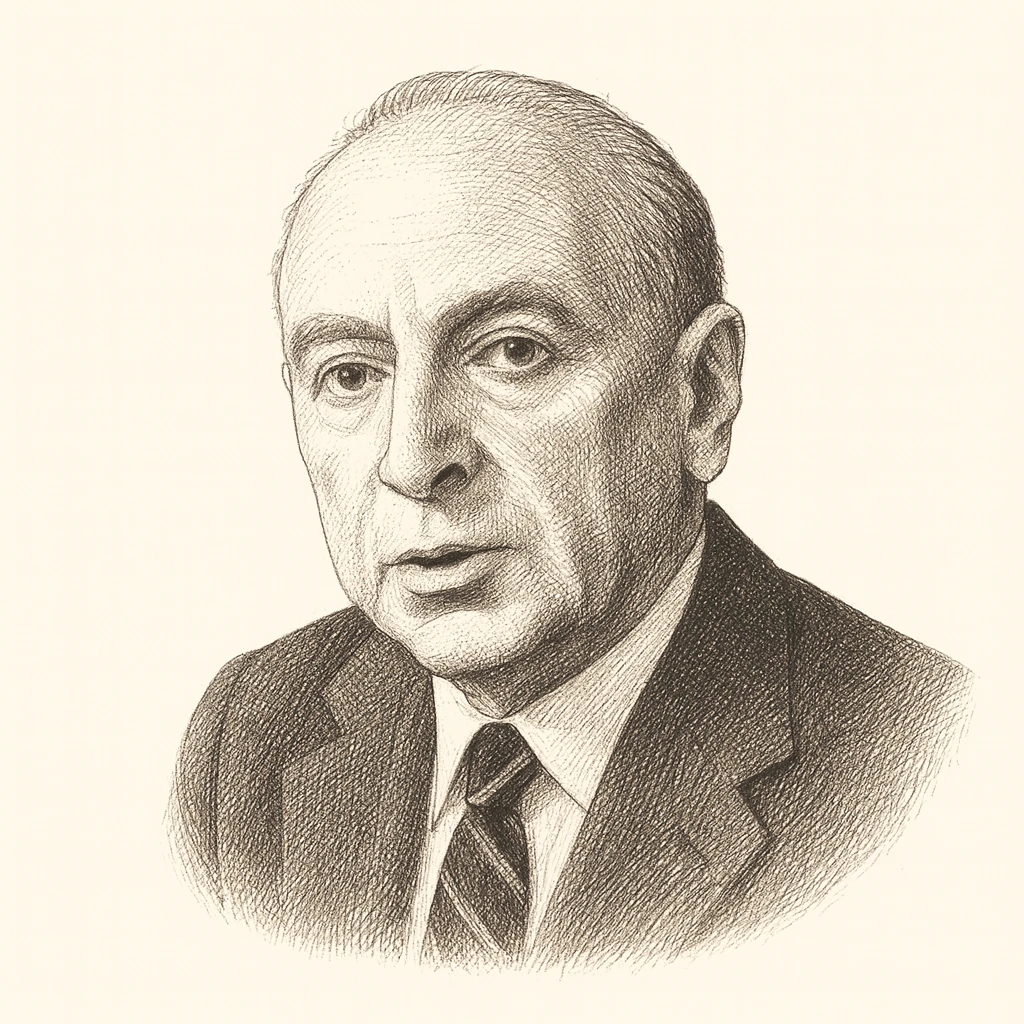
Hans Morgenthau was born in Coburg, Germany, on 17 February 1904. He trained in law and served as acting president of the labor law court in Frankfurt. As a Jew he remained in exile once the Nazis took power; he taught in Geneva from 1932 to 1935 and in Madrid from 1935 to 1936, and reached the United States in 1937. After posts at Brooklyn College and in Kansas City, he joined the University of Chicago in 1943 and taught there until 1971, later holding appointments at City College of New York and, from 1975, at the New School for Social Research.
His first major work, Scientific Man vs. Power Politics (1946), drew on Reinhold Niebuhr to dispute the belief that science could solve the problems of politics. Politics Among Nations (1948) turned that view into a theory of international relations. "International politics, like all politics, is a struggle for power," its chapter on political power opened. "Whatever the ultimate aims of international politics, power is always the immediate aim." Later editions opened with six principles of political realism, which described politics as governed by "objective laws that have their roots in human nature" and located its central concept in "the concept of interest defined in terms of power."
From that premise Morgenthau drew rules of restraint. The 1948 edition set out rules for diplomacy, among them that "Diplomacy must be divested of the crusading spirit" and that a nation should "Never put yourself in a position from which you cannot retreat without losing face and from which you cannot advance without grave risks." He pressed the same case in In Defense of the National Interest (1951) and The Purpose of American Politics (1960), and he advised the State and Defense departments. He was also a long-time adviser to, and trustee of, the Carnegie Council.
By the mid-1960s he had become an early and public critic of the war in Vietnam. His essay "We Are Deluding Ourselves in Vietnam" appeared in an April 1965 pamphlet published for the university teach-ins, and he expanded the argument in Vietnam and the United States (1965). He collected a decade of essays in Truth and Power (1970), and in later writing he criticized the growth of the national security state and the unaccountable exercise of executive power. He died in 1980.
Hans Morgenthau is associated with Pragmatic Centrist. See the archetype