
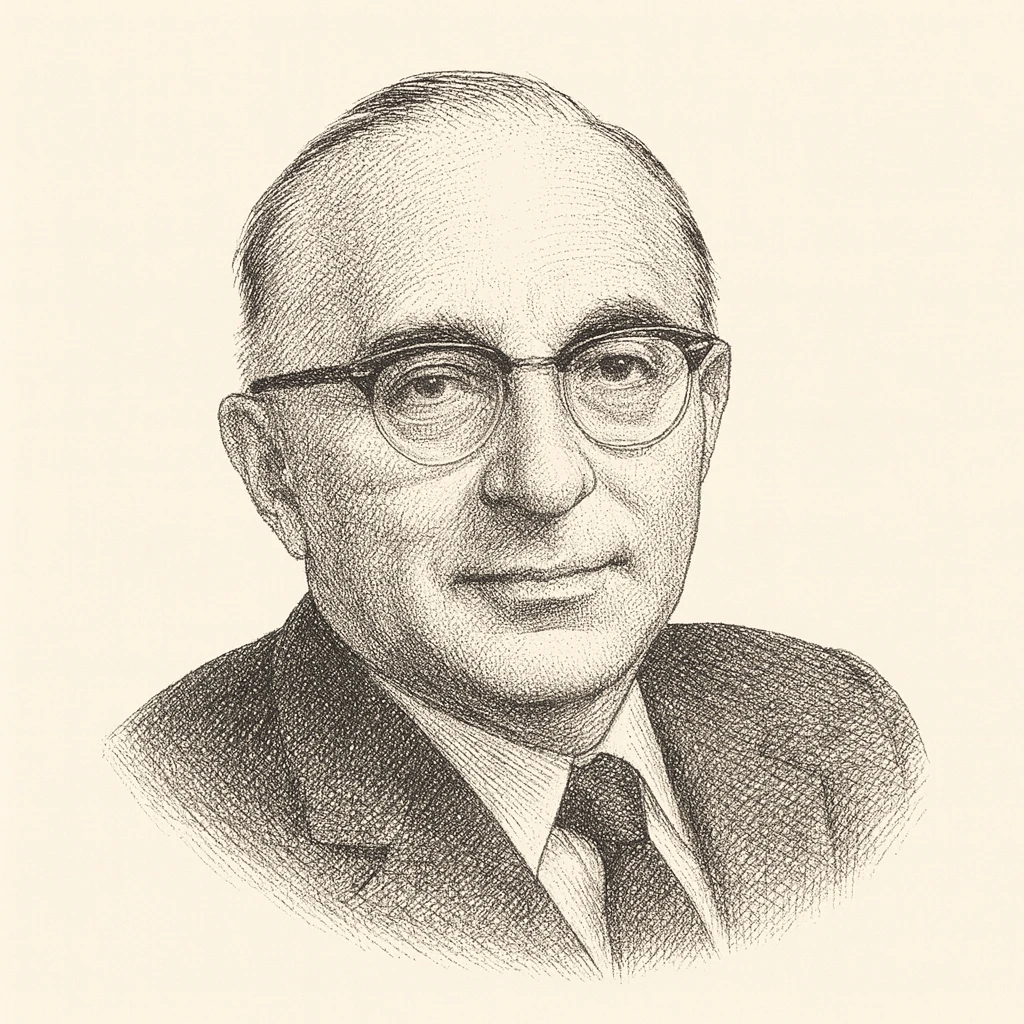
Eric Voegelin was born in 1901 in Cologne, the son of a civil engineer, and grew up in Vienna, where his family moved when he was nine. He was educated at the University of Vienna in political science, studying under Hans Kelsen, the positivist legal theorist, and Ludwig von Mises, the economist, in the remarkable intellectual culture of interwar Vienna that was simultaneously producing logical positivism, psychoanalysis, and the Austrian School of economics. He did postdoctoral work in the United States, England, and France in the early 1920s, encountering American pragmatism, British common-sense philosophy, and the French philosophical tradition, and he worked briefly with Leo Strauss in Berlin in the early 1930s — a parallel intellectual trajectory that would produce similarly ambitious and similarly controversial work.
He was teaching political science in Vienna when he published two early works critiquing the theoretical foundations of Nazi racial theory — The Race Idea in Intellectual History (1933) and Race and State (1933). These were serious scholarly critiques, analyzing the biological and historical claims of racial theory on their own terms and finding them wanting, and they made him a marked man in the new political environment. When Germany annexed Austria in March 1938, the Gestapo came to arrest him the same day. He escaped through a combination of luck and preparation — he had been warned and had his papers in order — and left for Switzerland, then England, and finally the United States.
He held positions at Harvard and Alabama before settling at Louisiana State University in 1942, where he spent sixteen years teaching political philosophy to Southern students while working on the vast project that would eventually produce Order and History. The LSU years were productive precisely because they were isolated: removed from the academic centers where fashionable positions were enforced, Voegelin had the freedom to develop positions that deviated sharply from both the positivist social science that dominated American universities and the Straussian revival of natural right that Strauss was simultaneously developing at Chicago. He returned to Europe in 1958, taking the chair in political science at the University of Munich, and then ended his career at the Hoover Institution at Stanford.
The New Science of Politics (1952) was his first widely read work and announced his central thesis with unusual clarity. Modern totalitarianism — Nazism and Communism — was not a deviation from the Western political tradition but an expression of tendencies within it. Specifically, it was a manifestation of what he called Gnosticism: the ancient heresy, recurring throughout Western history, that held that salvation was achievable in history through knowledge — that the elect few who possessed true understanding could transform the world into the Kingdom of God on earth. The totalitarian movements were secular Gnosticisms: they claimed to possess the truth about history's direction and the identity of its enemies, and they pursued the construction of an earthly paradise with the fanaticism that such certainty licensed.
His most consequential phrase was the one he used to characterize this impulse: "immanentizing the eschaton" — trying to bring about in historical time what properly belonged to transcendence, attempting to construct the Kingdom of God through political action. The phrase was picked up by William F. Buckley Jr. and became a slogan of American conservatism in the 1950s and 1960s, giving Voegelin's abstruse philosophy an unexpected popular currency. His argument was more subtle than the slogan suggested: he was not simply defending traditional religion against secular modernity, but analyzing how the specifically Christian experience of transcendence had produced, through a series of historical transformations, the secular political religions that claimed to deliver through politics what Christianity had promised through faith.
Order and History — his five-volume work published between 1956 and 1987 — was the full expression of his philosophical ambition. Tracing the development of political order from the ancient Near East through Israel, Greece, the Roman Empire, and medieval Christianity, he argued that the ordering of human existence required an orientation toward the transcendent ground of being — what he called the "divine ground" — and that political orders which lost this orientation deteriorated into the various forms of immanentism that he had identified in modern ideological politics. His method combined close reading of historical texts with a phenomenology of consciousness derived from Husserl, and the resulting work broke new ground even where it was sometimes impenetrable.
He was less widely read than Strauss and less politically influential than either Strauss or the neoconservatives, but his influence on the intellectual conservative tradition — particularly on the religious conservatives and traditionalists who found Strauss's secularism insufficient — was significant. The argument that modernity was spiritually deficient in ways that neither liberal nor Marxist political philosophy could diagnose or remedy, and that genuine political order required genuine orientation toward the transcendent, provided conservative Christianity with a philosophical vocabulary for its political commitments that went beyond simple appeals to biblical authority.
Eric Voegelin is associated with National Conservative. See the archetype