
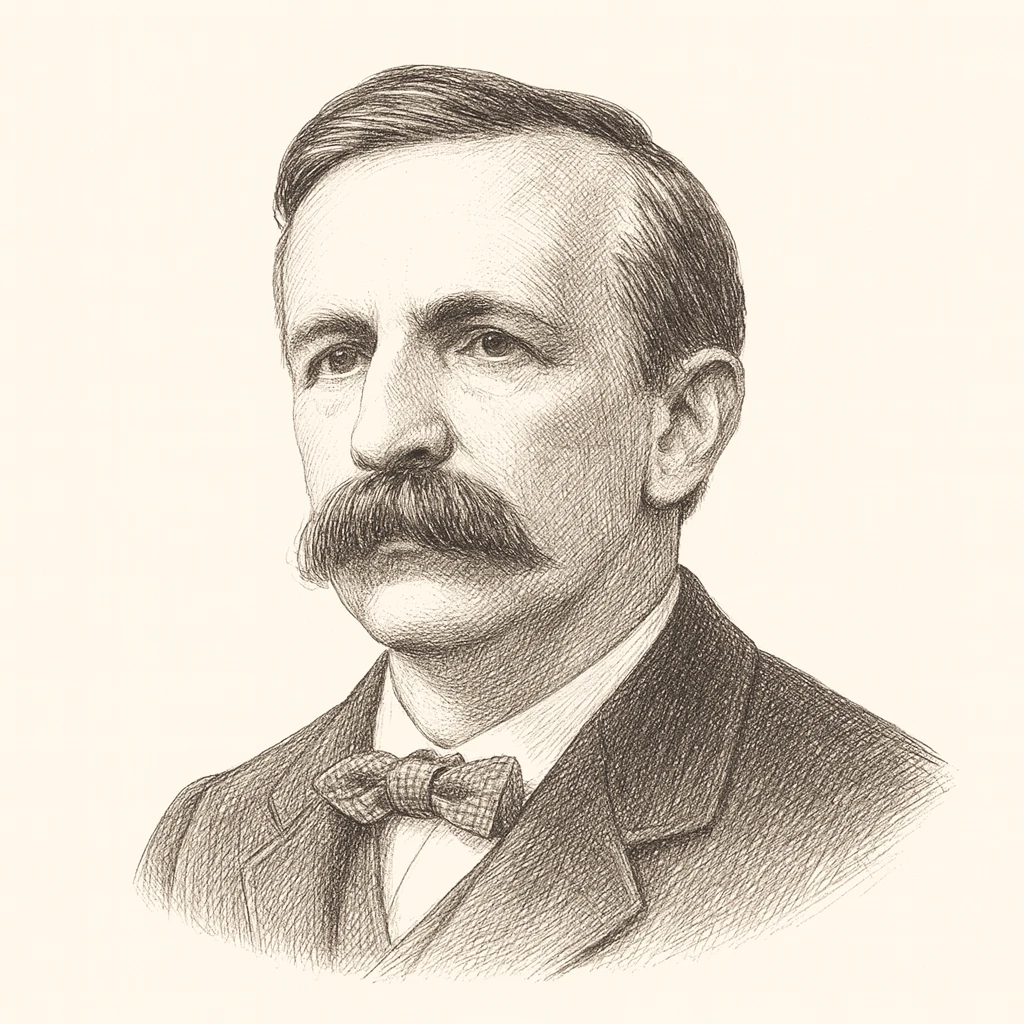
Edward Bellamy was born in 1850 in Chicopee, Massachusetts, where his father was a Baptist minister, and he spent most of his life there. After a brief stint at the New York Post he returned home to work for the Springfield Union. He wrote three novels that failed before Looking Backward, 2000–1887, published in 1888, became the third-best-selling American novel of the nineteenth century, behind only Uncle Tom's Cabin and Ben-Hur. Within a decade it had sold more than half a million hardbound copies in the United States and a quarter million in Britain.
The novel's narrator, Julian West, a well-off Bostonian, falls into a hypnotic sleep in 1887 and wakes 113 years later in a country without money, competition or poverty. His host, Dr. Leete, explains that the trusts kept consolidating until "The epoch of trusts had ended in The Great Trust": industry had been "intrusted to a single syndicate representing the people, to be conducted in the common interest for the common profit." Each citizen receives the same credit, a share of the nation's annual product drawn on with a credit card. Work is organized as an industrial army. Citizens are mustered into service at twenty-one and mustered out at forty-five, and less desirable jobs carry shorter hours.
Readers took the book as a program. At least 165 Nationalist or Bellamy Clubs formed across the country; Bellamy used "nationalism" for a system in which the nation collectively owned all resources. Boston's first Nationalist Club began publishing The Nationalist in 1889, a monthly dedicated to the "nationalization of industry and the promotion of the brotherhood of humanity." It was succeeded in 1891 by a weekly, The New Nation, which Bellamy edited. The clubs grew into a Nationalist Party that influenced the Populist Party. Mark Twain, Upton Sinclair, Samuel Gompers, Eugene Debs and Elizabeth Cady Stanton were among those who championed the book.
Bellamy wrote a sequel, Equality (1897), to answer questions and objections the first book had raised. He died of tuberculosis in 1898, at the age of forty-eight. Progressive Era and New Deal reformers cited Looking Backward as an influence, and abroad it inspired reforms, among them those of New Zealand's Liberal Party.
Edward Bellamy is associated with Democratic Socialist. See the archetype