
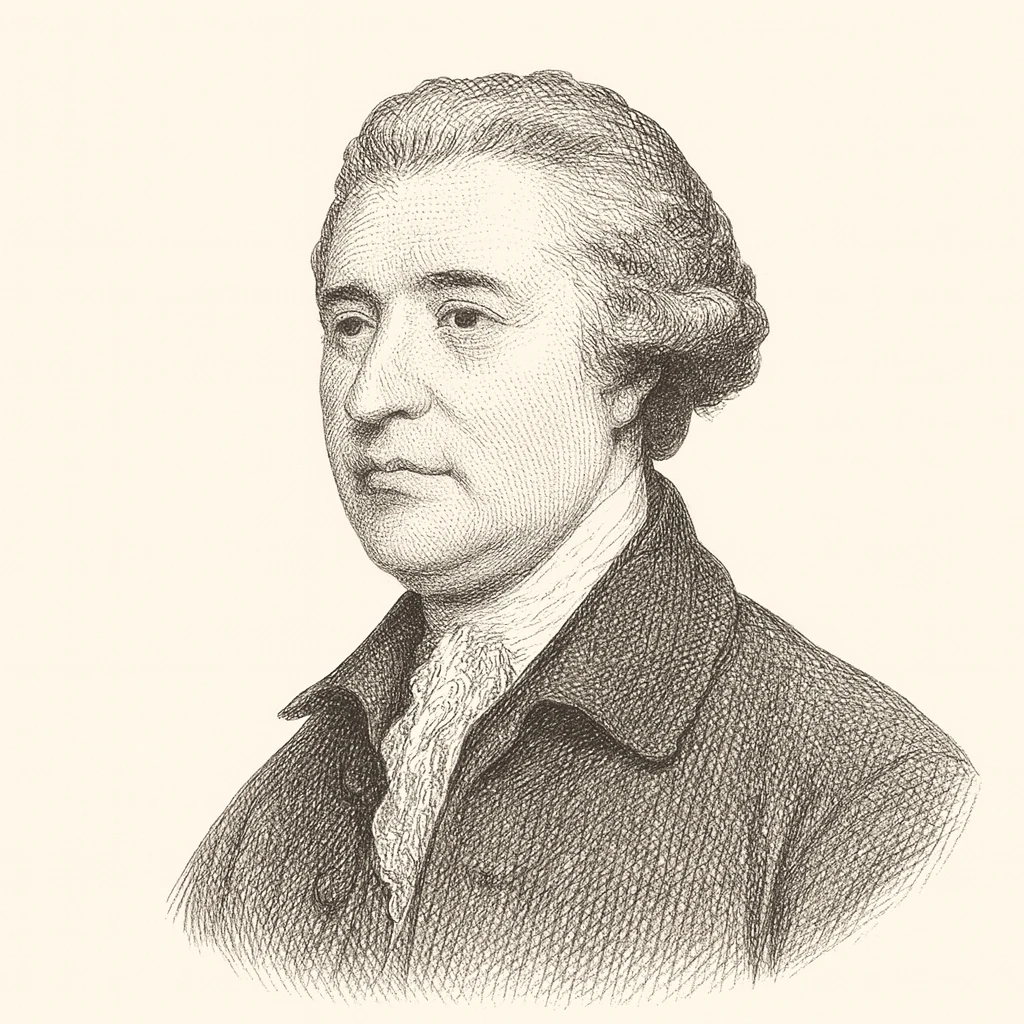
Edmund Burke is the founding father of modern conservatism, which is a strange thing to say about a man who spent most of his political career as a Whig — the more reformist of the two major British parties of his time. Burke supported American independence. He spent fourteen years prosecuting Warren Hastings for crimes committed by the East India Company in India. He fought for Catholic emancipation in his native Ireland and against the slave trade. By the standards of his contemporaries, he was a reformer. By the standards of later conservatism, much of what he believed would be hard to recognize. The reason he became the founding figure of conservatism anyway is that in 1790, in response to the French Revolution, he wrote one book that changed everything.
Burke was born in Dublin in 1729 to a Protestant father and Catholic mother — a religiously mixed marriage that shaped his lifelong concern for religious tolerance and his sensitivity to how political institutions could either accommodate or destroy the social fabric they rested on. He moved to London to study law, abandoned it for literature, and eventually entered Parliament in 1765, where he became one of the most celebrated orators of his generation. His speeches on conciliation with America in the early 1770s — arguing that the colonies should be allowed to govern themselves rather than be coerced by force — are still studied as masterpieces of political rhetoric.
When the French Revolution began in 1789, almost everyone in Burke's intellectual circle celebrated it. The fall of the Bastille, the Declaration of the Rights of Man, the dismantling of feudal privilege — these looked to most observers like the dawn of a new era of human freedom. Burke saw something different. He saw an attempt to remake an entire society from first principles, sweeping away centuries of inherited institutions in the name of abstract reason, and he predicted (correctly, as it turned out) that it would end in tyranny and bloodshed. His Reflections on the Revolution in France (1790) was published before the Terror began, before the guillotine had become the symbol of the revolution, before Napoleon had emerged. Burke saw what was coming because he had a theory about why it was coming.
The theory, which became the foundation of modern conservative thought, was this: human beings are not abstract rational agents who can rebuild society from blueprints. They are creatures formed by the institutions, traditions, customs, and inherited wisdom of their particular time and place. These inherited structures — the family, the church, local communities, the laws and habits passed down from previous generations — are the result of accumulated experience and contain forms of practical wisdom that no individual rational thinker could replicate. When revolutionaries try to sweep all this away in the name of pure principles, they don't free human nature; they unleash chaos, because they have removed the very structures within which human beings learn to live well together. Reform should be possible and even necessary, Burke thought, but it should be slow, organic, and respectful of what is being reformed.
The book made Burke famous and split his political world. Many of his old Whig allies turned against him; he died in 1797 estranged from much of the political class he had served. But his arguments outlived him. Every subsequent thinker who has tried to defend tradition against rationalist schemes of social engineering — from Joseph de Maistre to Russell Kirk to Roger Scruton — has worked in the shadow of Burke. The interesting question is whether the contemporary right wing that claims Burke's name actually inherits his actual positions, or only the conservative temperament he gave the world. He supported American independence, religious tolerance, parliamentary reform, and the prosecution of imperial atrocities. The contemporary movements that invoke him don't always look like the ones he would have joined.
Edmund Burke is associated with Traditionalist. See the archetype