
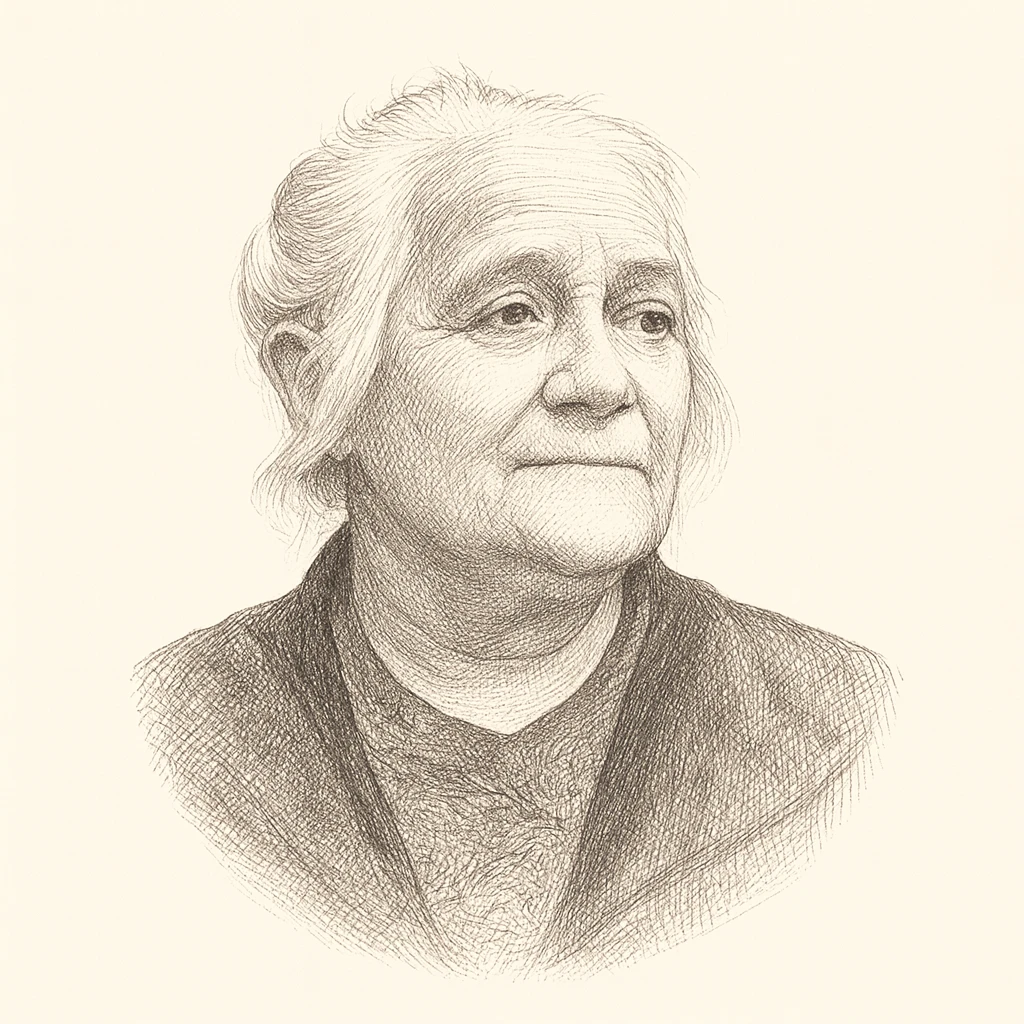
Clara Zetkin was born Clara Eißner on 5 July 1857 in Wiederau, Saxony. She trained as a teacher in Leipzig from 1874 to 1878 and in 1878 joined the Socialist Workers' Party (SAP). In 1882 she moved to Paris, where she lived with Ossip Zetkin, took his surname, and raised their two sons. At the 1889 Paris congress that founded the Second International she spoke on the proletarian women's movement, calling for women's full occupational and social equality and opposing socialists who wanted women kept out of paid work.
Back in Germany she founded and edited Die Gleichheit, the socialist women's paper, from 1892 until 1917, and sat on the national executive of the Social Democratic Party (SPD) from 1895. Her position set socialist women apart from the middle-class women's movement. At the party's Gotha congress in 1896 she argued that "the liberation struggle of the proletarian woman cannot be similar to the struggle that the bourgeois woman wages against the male of her class." In 1907 she was elected to lead the International Women's Secretariat, and at Copenhagen in 1910 she proposed an International Women's Day.
She opposed the SPD's wartime political truce, the Burgfrieden, convened an international socialist women's conference in Bern in 1915, and was imprisoned afterward. She joined the Spartacists, co-founded the Independent Social Democratic Party (USPD) in 1917, losing her editorship as a result, and entered the Communist Party of Germany (KPD) in 1919. From 1920 to 1933 she sat in the Reichstag as a KPD deputy, and on 2 July 1920 she spoke there calling for solidarity with Soviet Russia. From 1921 she was on the Executive Committee of the Communist International, and from 1924 she lived mostly in Soviet Russia. She wrote an account of her conversations with Lenin in the autumn of 1920 on the women's question, and a 1923 resolution she wrote for the Comintern's executive described fascism as "an amalgam of brutal, terrorist violence together with deceptive revolutionary phraseology."
On 30 August 1932, as the Reichstag's oldest member, she opened the newly elected chamber, calling for united resistance to fascism and expressing the hope that she would one day open the first congress of a Soviet Germany. She died on 20 June 1933 at Arkhangelskoye near Moscow.
Clara Zetkin is associated with Vanguard Collectivist. See the archetype