
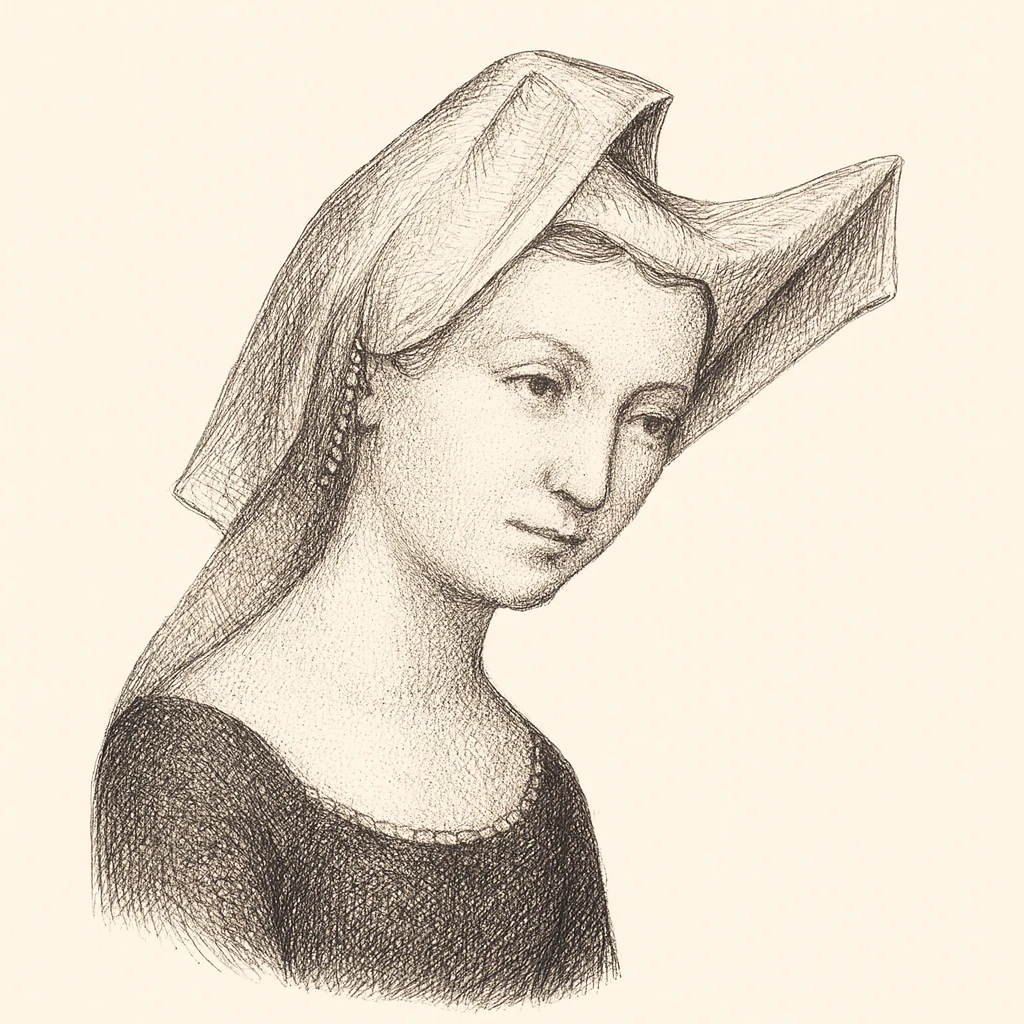
Christine de Pizan was born in Venice in 1364. Her father, an Italian, became astrologer to Charles V of France, and she spent a studious childhood at the French court. At fifteen she married Estienne de Castel, who became a court secretary. Widowed after ten years of marriage, she turned to writing to support herself and three young children, and found patrons at court, among them Louis, duke of Orléans, the duke of Berry, Philip the Bold, and Queen Isabella of Bavaria.
Her first public argument concerned the way learned men wrote about women. L'Épistre au Dieu d'amours (1399) defended women against the satire of Jean de Meun's Roman de la rose. In The Book of the City of Ladies (1405), the narrator, troubled after reading Matheolus, asks why so many learned men insult women; three allegorical ladies, Reason, Rectitude and Justice, help her build a city populated by virtuous women from history and legend. The book answers the charge that women should not be taught: not all men share that opinion, it says, "but it is very true that many foolish men have claimed this because it displeased them that women knew more than they did." Its companion, The Book of the Three Virtues (1405), offered what Britannica calls "a classification of women's roles in medieval society and a collection of moral instructions for women in the various social spheres." She also wrote a life of Charles V (1404) at Philip the Bold's request and an allegorical autobiography, L'Avision de Christine (1405).
The Book of the Body Politic, written in 1406–07 for the dauphin Louis of Guyenne, belongs to the mirror-for-princes genre. Its first part is addressed to princes, its second to knights and nobles, and its third to the common people, whom it treats as "the belly, legs, and feet" of the realm. The body politic, she wrote, "cannot be perfect, whole, nor healthy if all the estates ... are not well joined and united together." The book presses the prince toward peace and reconciliation and defends hereditary monarchy.
After the French defeat at Agincourt in 1415 she withdrew to a convent. Her Ditié de Jehanne d'Arc (1429) celebrated Joan of Arc's early victories; Britannica describes it as the only such French-language work written during Joan's lifetime. She died around 1430.
Christine de Pizan is associated with Reform Conservative. See the archetype