
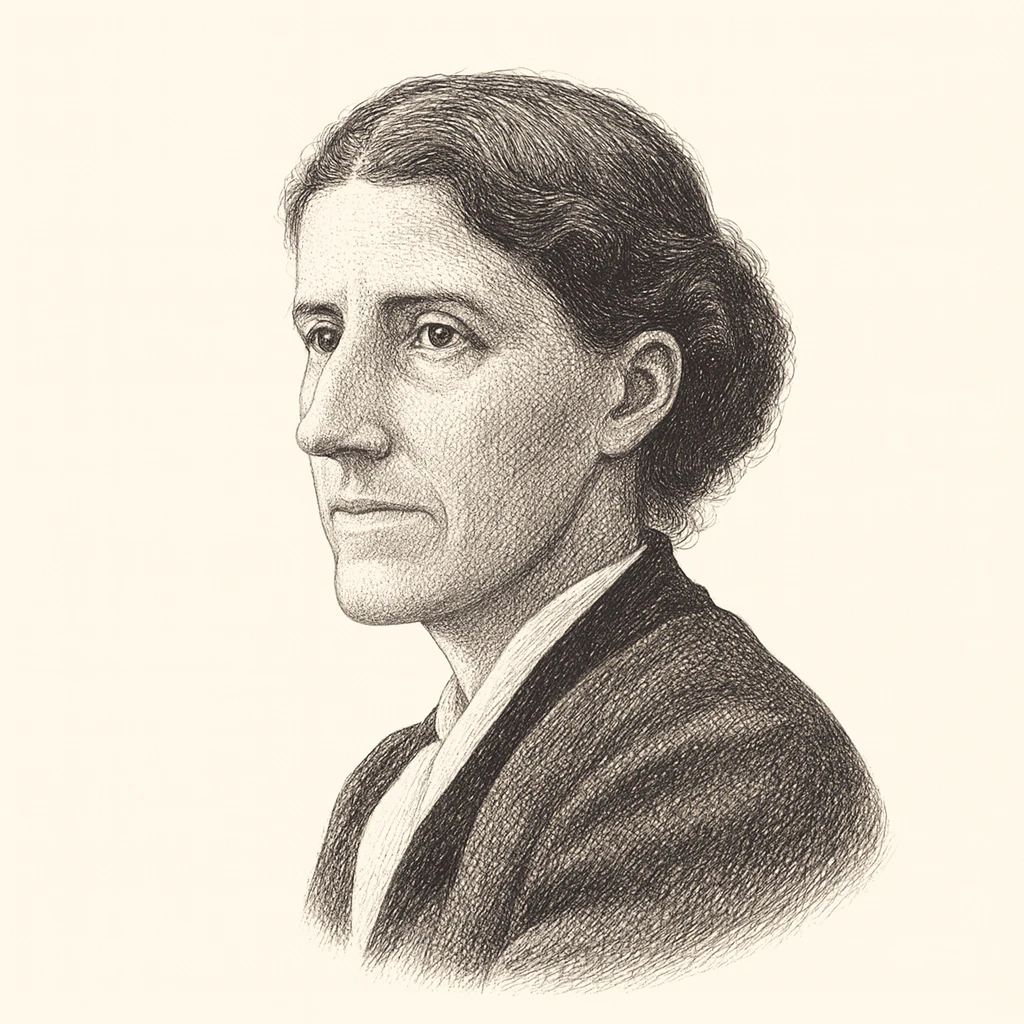
Charlotte Perkins Gilman was born in Hartford, Connecticut, on July 3, 1860, a great-granddaughter of the preacher Lyman Beecher and a grandniece of Harriet Beecher Stowe. Her father largely left the family, and she grew up poor, attending the Rhode Island School of Design for a time. She married Charles W. Stetson in 1884 and afterward suffered what Britannica calls a complete nervous collapse. She moved to Pasadena in 1888 and divorced in 1894. Her story "The Yellow Wall-Paper" appeared in The New England Magazine in January 1892.
Her politics took shape in the Nationalist clubs, built on the ideas of Edward Bellamy, the author of the utopian novel Looking Backward and an advocate of nationalizing public services. She stayed at Jane Addams's Hull House in 1895 and in 1896 went to London as a delegate to the International Socialist and Labor Congress. Women and Economics (1898), translated into seven languages, made her name. "We are the only animal species in which the female depends on the male for food," she wrote, "the only animal species in which the sex-relation is also an economic relation." She called this the sexuo-economic relation and proposed ending it through women's paid work and a kitchenless home, with cooking, cleaning and child care handled by trained professionals.
She married her cousin George H. Gilman in 1900 and kept writing: Concerning Children (1900), The Home (1903), The Man-Made World (1911). From 1909 to 1916 she edited and published a monthly magazine, The Forerunner, which serialized her novel Herland (1915), about an isolated country of women who reproduce without men. In 1915 she co-founded the Woman's Peace Party with Addams.
Her writing also advanced eugenics and racial hierarchy. In "A Suggestion on the Negro Problem," in the American Journal of Sociology in 1908, she described Black Americans as "a race widely dissimilar and in many respects inferior" and proposed that each state "organize in every county and township an enlisted body of all negroes below a certain grade of citizenship," children to be schooled and adults put to work, starting on farms. The National Endowment for the Humanities' Humanities magazine describes her 1911 novel The Crux as promoting white supremacy on the frontier, and in 1923 The Forum published her essay "Is America Too Hospitable?" Writing in The New York Review of Books in 2019, Kate Bolick called Gilman a xenophobe who adopted the idea that some human populations are genetically superior to others.
Diagnosed with inoperable breast cancer in 1932, she ended her life in Pasadena on August 17, 1935, by inhaling chloroform, leaving a note that read in part, "I have preferred chloroform to cancer."
Charlotte Perkins Gilman is associated with Democratic Socialist. See the archetype