
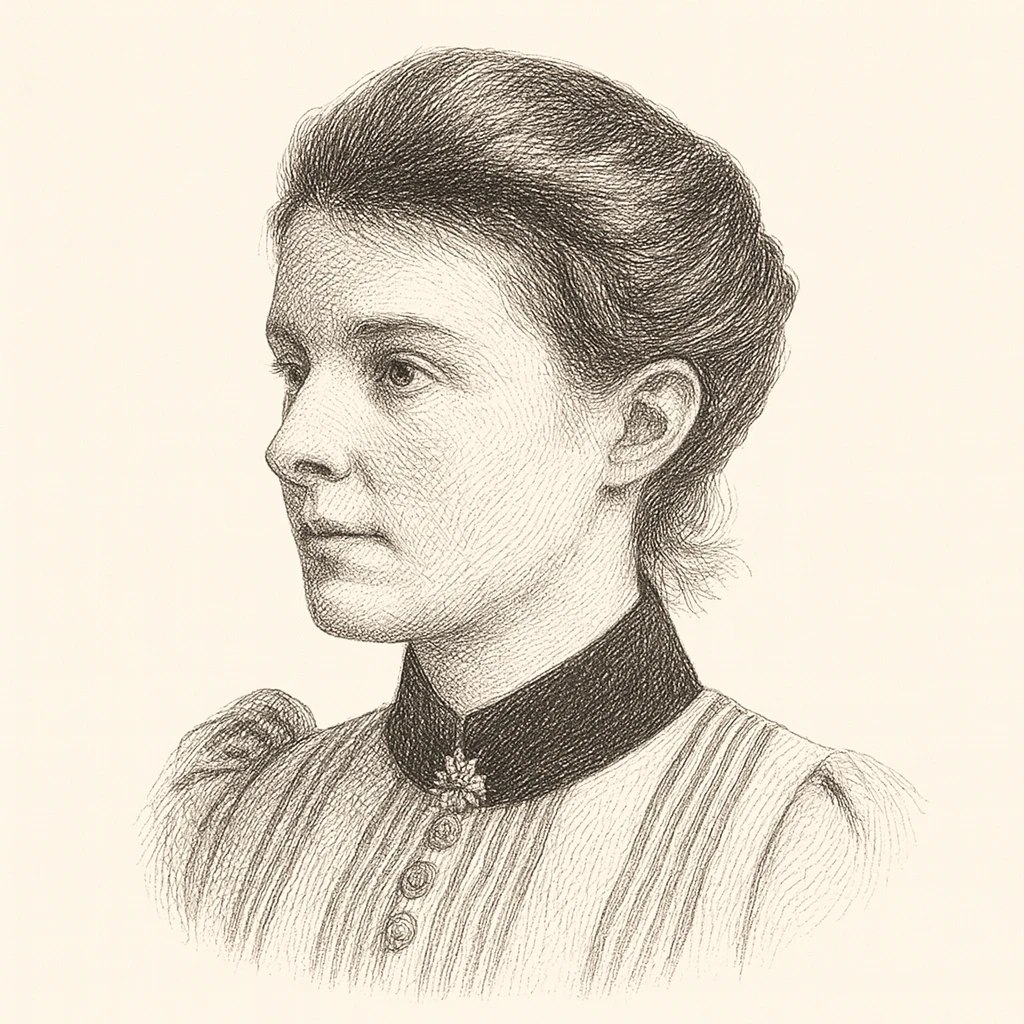
Beatrice Webb was born Martha Beatrice Potter in Gloucester on January 22, 1858, the eighth daughter of the businessman Richard Potter; Britannica names the philosopher Herbert Spencer as the strongest intellectual influence on her. She began in 1882 with the Charity Organisation Society and collected rents at Katharine Buildings in London; in 1887 she joined her cousin Charles Booth's survey of London life and labour, starting with dock work. She then took a job as a "plain trouser hand" in the sweated tailoring trade and gave evidence to a House of Lords select committee. The Co-operative Movement in Great Britain followed in 1891.
In 1892 she married Sidney Webb, a member of the socialist Fabian Society since 1885, and the two worked as a research partnership: The History of Trade Unionism (1894), Industrial Democracy (1897), and a ten-volume history of English local government. In Siberian exile, Lenin and Krupskaya translated their work into Russian. The London School of Economics opened in 1895; the school's own history calls it "the brain child of Sidney Webb, supported by his wife." Their early tactic, which they called permeation, was to win over powerful people of any party, Arthur Balfour and Lord Rosebery among them. After the Liberal landslide of 1906 they turned to the Labour Party, and in January 1918 she wrote in her diary that "the policy of permeation is played out."
Appointed to the Royal Commission on the Poor Laws in December 1905, she was the main author of the Minority Report of 1909, signed by her and three other commissioners. It called for the prevention of destitution rather than its relief, proposed breaking up the Poor Law and handing its services to local education and public health authorities, and made government responsible for organizing the labor market against unemployment. Britannica says it spelled out the outlines of the welfare state; William Beveridge, one of its researchers, later wrote that "the Beveridge Report stemmed from what all of us had imbibed from the Webbs." The Liberal government chose contributory national insurance instead. The Webbs founded the New Statesman in 1913.
In 1932 the couple spent two months in the Soviet Union. Her stated aim, noted in 1933, was "to give a vision of the Communist alternative to decadent capitalism," though she named "one dark spot": the lack of free expression for intellectuals opposed to the Communist creed. Soviet Communism: A New Civilisation? appeared in 1935; the 1937 edition dropped the question mark. The historian A.J.P. Taylor called it "the most preposterous book ever written about Soviet Russia." She died at Passfield Corner, near Liphook, on April 30, 1943, and in 1947 her ashes and Sidney's were moved to Westminster Abbey.
Beatrice Webb is associated with Democratic Socialist. See the archetype