
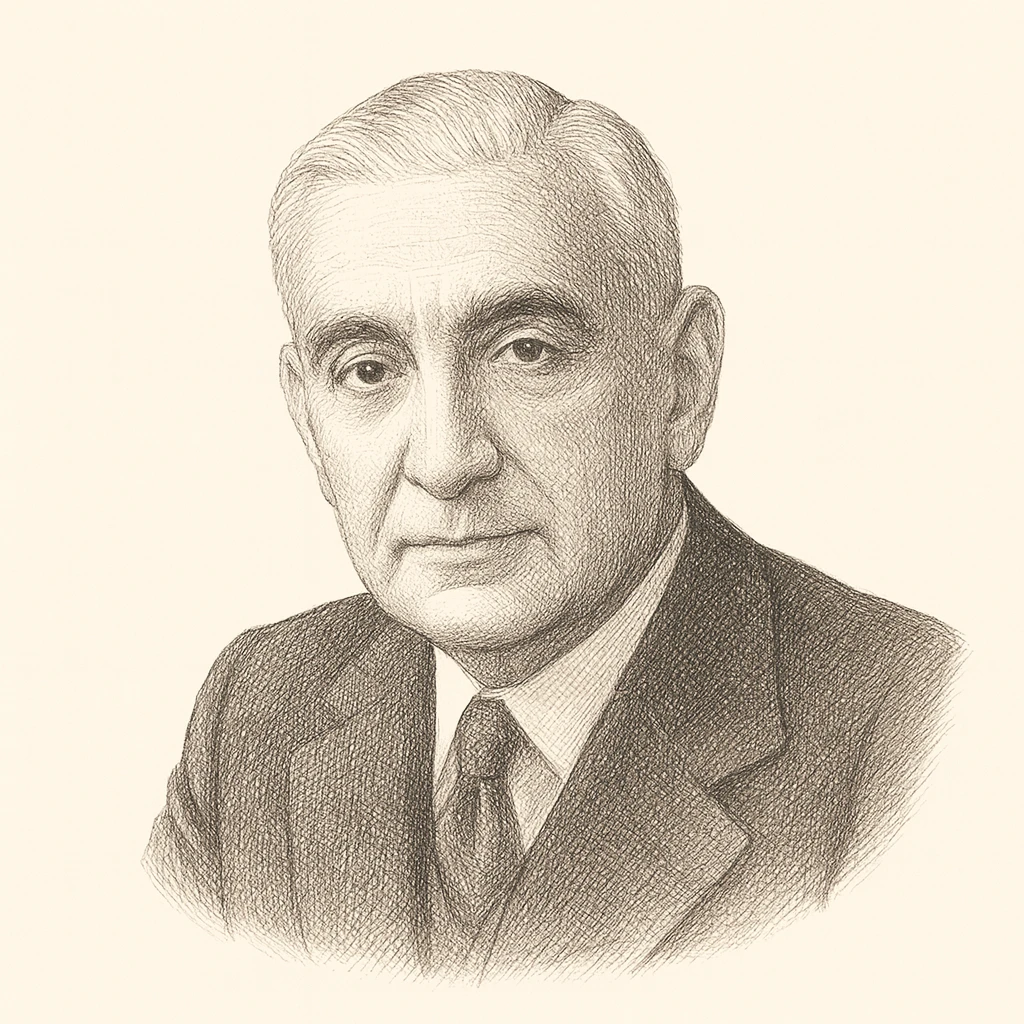
António de Oliveira Salazar was born on 28 April 1889 in Vimieiro, near Santa Comba Dão, Portugal. He studied at the seminary in Viseu and then at the University of Coimbra, where he took the chair of political economy in 1918. He was formed by Catholic social teaching, in particular the corporatist ideas of Rerum novarum, and in 1921 he was one of three Catholic deputies elected to parliament. After the military coup of May 1926 he refused office until 1928, when he joined the government with powers that made him its most important figure. He was prime minister from 1932 until 1968.
The constitution approved by plebiscite on 19 March 1933 created the Estado Novo, or New State, a corporative state in which the National Union was the only permitted party. In a 1936 speech he listed what the regime would not debate: "We do not discuss God and virtue; we do not discuss the Fatherland and its history; we do not discuss authority and its prestige; we do not discuss the family and its morality; we do not discuss the glory of work and its duty." A national propaganda office under António Ferro, a state youth movement, the Portuguese Legion, and prior censorship of the press supported the regime. Salazar himself preferred the radio to public rallies and avoided crowds.
The political police, created in 1933 as the PVDE and renamed the PIDE in 1945, held prisoners without charge and used torture, including sleep deprivation. Detention could be extended indefinitely through so-called security measures. The official commission for the fiftieth anniversary of the 1974 revolution counts almost 17,000 PVDE prisoners between 1933 and 1945 and, by the two counts it cites, between about 6,000 and 12,000 PIDE prisoners between 1945 and 1960. From 1936 the regime held political prisoners at the Tarrafal camp in Cape Verde. In 1958 the opposition candidate Humberto Delgado won about a quarter of a million votes in the presidential election; on 13 February 1965 a PIDE squad killed Delgado and his secretary, Arajaryr Campos, in Spain near Olivenza.
Salazar recognized Franco's government in Spain, signed the Iberian Pact in 1939, kept Portugal neutral in the Second World War while granting the Allies bases in 1943, and joined NATO in 1949. From 1961 he fought wars against independence movements in Angola, Guinea and Mozambique; by the war's end in 1974 some 150,000 men were under arms. In a speech of 18 February 1965 he said Portugal fought "without spectacle and without alliances, proudly alone." A brain hemorrhage in September 1968 incapacitated him, and Marcelo Caetano replaced him that month. He died in Lisbon on 27 July 1970.
António de Oliveira Salazar is associated with Reactionary Strongman. See the archetype