
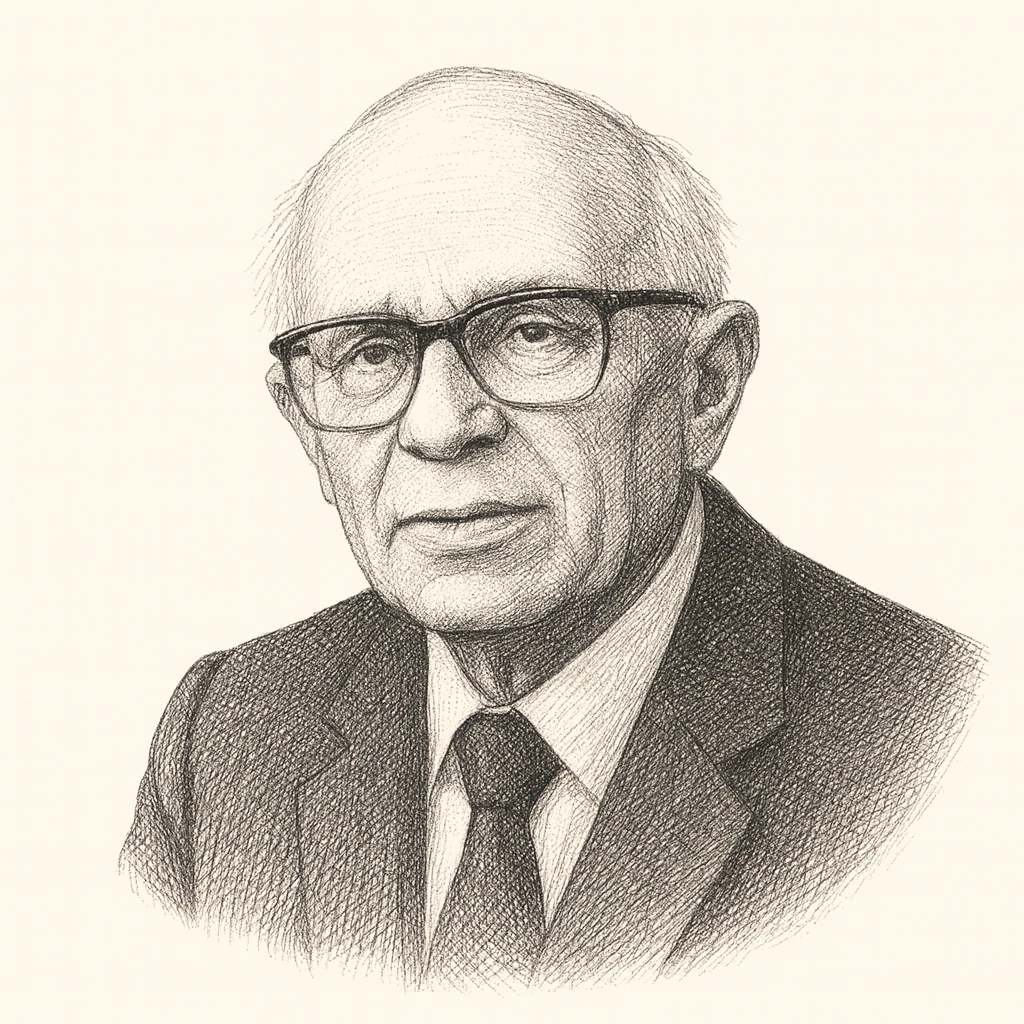
Andrei Sakharov was born in Moscow on 21 May 1921 and graduated in physics from Moscow University in 1942. He spent the rest of the war as an engineer in a munitions factory, and in 1945 he joined the Lebedev Physical Institute under Igor Tamm. From 1948 he worked in the Soviet nuclear weapons program, where he spent two decades in secret research and became known as the father of the Soviet hydrogen bomb. From the late 1950s he warned about the dangers of the arms race.
In 1968 he wrote "Reflections on Progress, Peaceful Coexistence, and Intellectual Freedom." He first sent the manuscript to the Soviet leadership; it reached the West, where The New York Times printed the full text on 22 July 1968. After its publication abroad he was removed from secret work. The essay argued for intellectual freedom and for cooperation between the rival blocs. "I argued for convergence, for a rapprochement of the socialist and capitalist systems," he later wrote. In 1970 he founded the Committee for Human Rights with Valery Chalidze and Andrei Tverdokhlebov.
He received the Nobel Peace Prize in 1975 "for his struggle for human rights in the Soviet Union, for disarmament and cooperation between all nations." The authorities refused him permission to travel, and his wife, Yelena Bonner, accepted the prize. His lecture, read in Oslo, was titled "Peace, Progress, Human Rights" and argued that "these three goals are insolubly linked to one another." It rejected violent change: "We need reform, not revolution. We need a pliant, pluralist, tolerant community." He described himself as "no professional politician" and held that "only moral criteria, coupled with mental objectivity, can serve as a sort of compass" in public questions.
Early in 1980, after he denounced the Soviet invasion of Afghanistan, he was exiled to Gorky. Bonner later joined him there, and he went on hunger strikes to secure medical treatment for her. In 1986, after Mikhail Gorbachev came to power, the couple were allowed to return to Moscow. In 1989 he was elected to the new Congress of People's Deputies, where he was a critic of Gorbachev. He died in Moscow on 14 December 1989.
Andrei Sakharov is associated with Civil Libertarian. See the archetype