
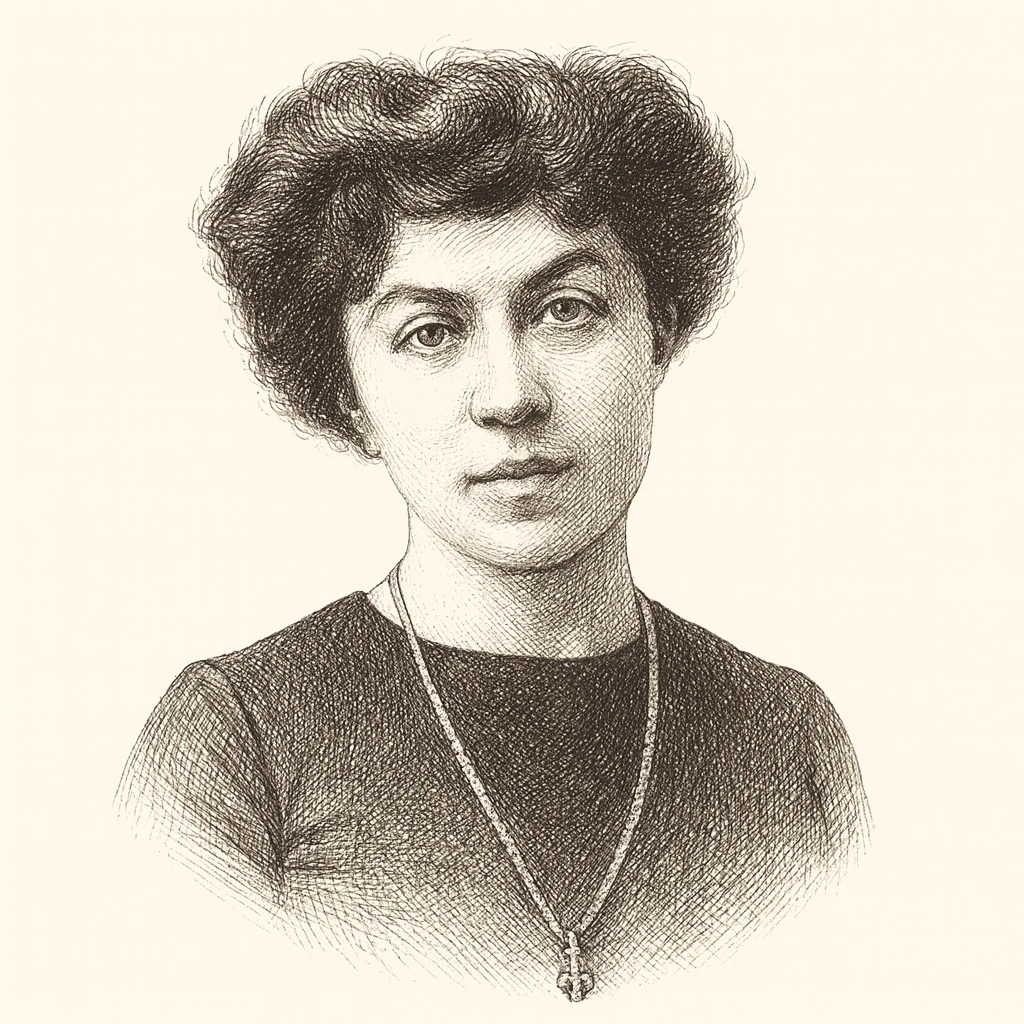
Alexandra Kollontai was born in St Petersburg on 19 March 1872 (31 March in the modern calendar) into a wealthy family. In 1898 she left her husband and young son to study in Zurich. She spent the years from 1908 to 1917 in exile, aligned for a period with the Mensheviks before joining the Bolsheviks in 1915; accounts of her earlier alignment differ. She was in Norway when the February Revolution broke out.
After the October seizure of power, the Second All-Russian Congress of Soviets made her People's Commissar of Social Welfare. One reference account credits her commissariat with full state funding of maternity leave and with abolishing the legal distinction between legitimate and illegitimate children. She resigned in 1918 in protest at the Treaty of Brest-Litovsk. From November 1920 she headed the Zhenotdel, the party's department for work among women. Her writing set out a program for the household under communism. In Communism and the Family (1920) she wrote that "the family is withering away not because it is being forcibly destroyed by the state, but because the family is ceasing to be a necessity," and in Make Way for Winged Eros (1923) that "the morality of the proletariat demands all for the collective."
In December 1920 she joined the Workers' Opposition and became its best-known voice. Her pamphlet The Workers' Opposition, first published in Pravda on 25 January 1921, argued that "the building of Communism can and must be the work of the toiling masses themselves" and that "working class collectives, represented by the unions" should build its new economic forms. In March 1921 the Tenth Party Congress passed a resolution on party unity that ordered "the immediate dissolution of all groups without exception formed on the basis of one platform or another," naming the Workers' Opposition first.
From 1922 she served abroad, first as an adviser to the Soviet legation in Norway and then as head of missions in Mexico (1926–27), Norway (1927–30), and Sweden (1930–45). In 1944 she led the Soviet diplomats in Stockholm who encouraged Finland toward the armistice talks held in Moscow that year. She survived the Stalin terror; a study of her diaries published in Slavic Review argues that she did so by cultivating a friendly relationship with Stalin while privately recording the regime's failure to build what she called communist humanism. From 1946 she advised the Soviet foreign ministry, and she died in Moscow on 9 March 1952.
Alexandra Kollontai is associated with Vanguard Collectivist. See the archetype