
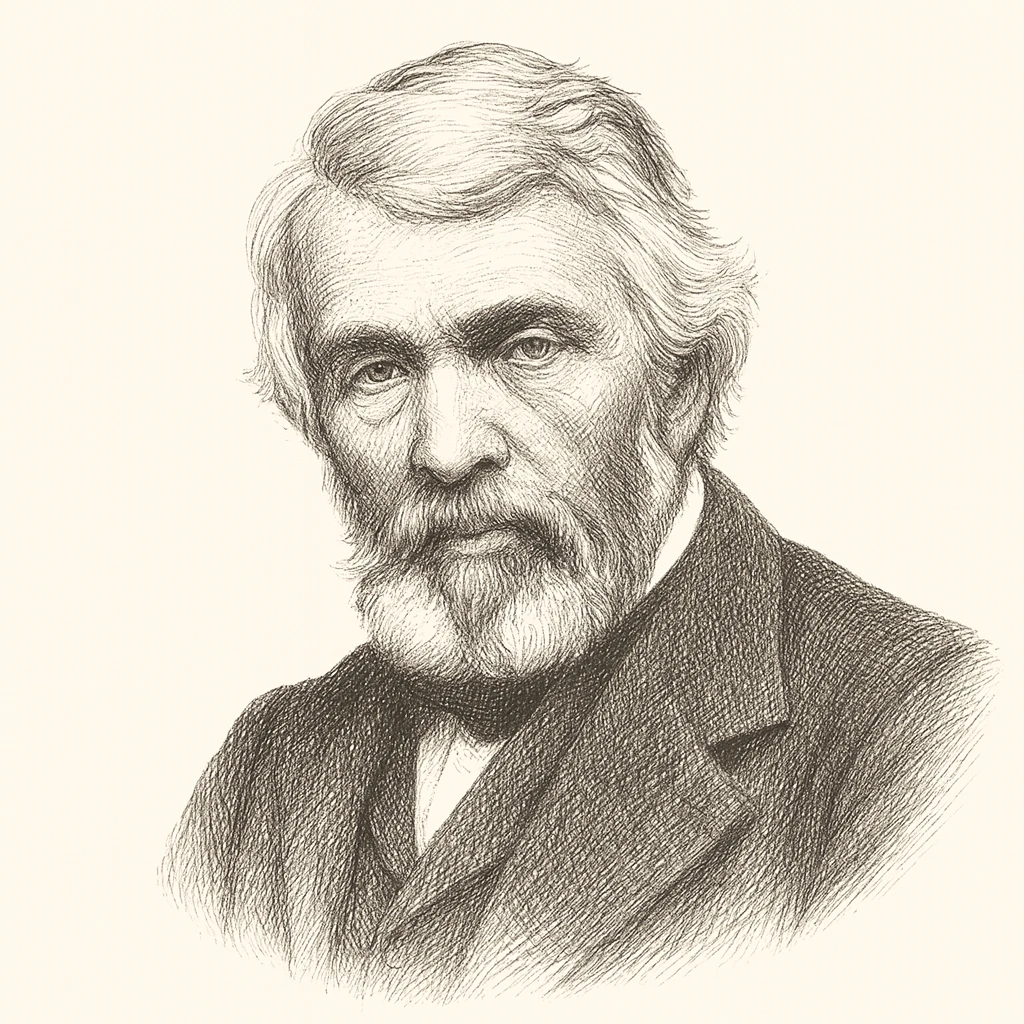
Thomas Carlyle was born in 1795 in Ecclefechan, a small village in Dumfriesshire in southern Scotland, the son of a stonemason and later farmer named James Carlyle — a man of fierce Calvinist piety, absolute honesty, and granite moral seriousness who became one of the presiding moral presences in his son's imagination. The elder Carlyle believed in hard work, direct speech, and the irrelevance of comfort; he regarded frivolity as a form of blasphemy and treated the acquisition of money as no substitute for genuine character. Thomas absorbed all of this and spent his career applying it as a critical instrument to the industrial civilization that was being constructed around him, finding it wanting on every count his father would have recognized.
He attended Edinburgh University, intending to become a minister, and lost his faith without losing the moral intensity that faith had organized. The loss left him with what he later described as a spiritual crisis of absolute bleakness — the sense of being alone in a universe stripped of meaning — that he overcame, in the experience he dramatized in Sartor Resartus as the "Everlasting Yea," through a willed affirmation of life and work as their own justification. This was not a return to Christian theology but a reconstruction of its moral demands on new foundations: the universe might be indifferent, but the human response to this indifference was the obligation to work, to serve, to build something real against the void.
He married Jane Baillie Welsh in 1826, a woman of considerably higher social origin and considerable intellectual gifts, who became both his most devoted reader and the most acute observer of his considerable failings. Their marriage was difficult — she was often lonely, he was often intolerable — but intellectually productive: her letters are among the finest in the Victorian era, and his knowledge that she would read everything he wrote with unsparing intelligence kept him honest in ways that admiring disciples could not. He established himself in Edinburgh and then London, writing reviews, translating Goethe (his Sartor Resartus made Goethe's thought accessible to English readers for the first time), and working through the ideas that his first major original works would express.
The French Revolution (1837) was his first major work and established his reputation. It was history written as drama — passionate, visionary, deliberately non-analytical in its method — and it presented the Revolution as the inevitable consequence of an aristocracy that had become hollow, a church that had become hypocritical, and a monarchy that had lost the capacity for genuine leadership. The Revolution's violence was not a scandal but a judgment: the old order had failed, and what failed was swept away. The book made him famous. Chartist audiences read it as a warning to the English ruling class; conservative readers read it as a defense of order against the mob; both readings were partial, as Carlyle intended them to be.
On Heroes, Hero-Worship and the Heroic in History (1841) stated what he took to be the fundamental truth of political life: that history was made by great men, that societies were organized around their capacity to recognize and follow genuine greatness, and that democracy's leveling tendency — its reduction of all authority to majority opinion — was a civilizational catastrophe. The hero appeared in many forms: prophet, poet, priest, man of letters, king; what they shared was genuine inner conviction, the capacity to see what was true and necessary and to impose it on circumstances regardless of opposition. The mass could not govern itself; it required to be governed, and governing was the work of genuine men rather than parliamentary procedures.
Past and Present (1843) applied this framework to the crisis of industrial England with the most direct social criticism he produced. He contrasted the organic community of a medieval monastery — where genuine authority was exercised by genuine men, where the community was organized around real purposes rather than the cash nexus, where the abbot governed through character rather than mechanism — with the chaos of industrial England, where workers starved in the midst of abundance because the market had replaced all human obligations with the single relation of wages and labor. The "condition of England question" that he raised became the organizing frame for Victorian social criticism, and his account of the cash nexus as the dissolution of all genuine human obligation was absorbed by Marx, by Ruskin, by William Morris, and through them into the socialist tradition.
His trajectory after 1848 was increasingly authoritarian and increasingly isolated. The Latter-Day Pamphlets (1850) attacked democracy, parliamentary government, philanthropy, and virtually every form of liberal reform with a contempt so total that it alienated most of his previous admirers. His "Occasional Discourse on the Negro Question" (1849) and subsequent work on slavery and colonial governance expressed a racism so unambiguous that it has permanently complicated his legacy. He died in 1881 having outlived his literary reputation and having seen the industrial capitalism he attacked become more powerful than ever, and the democracy he despised becoming more extensive.
Thomas Carlyle is associated with National Conservative. See the archetype