
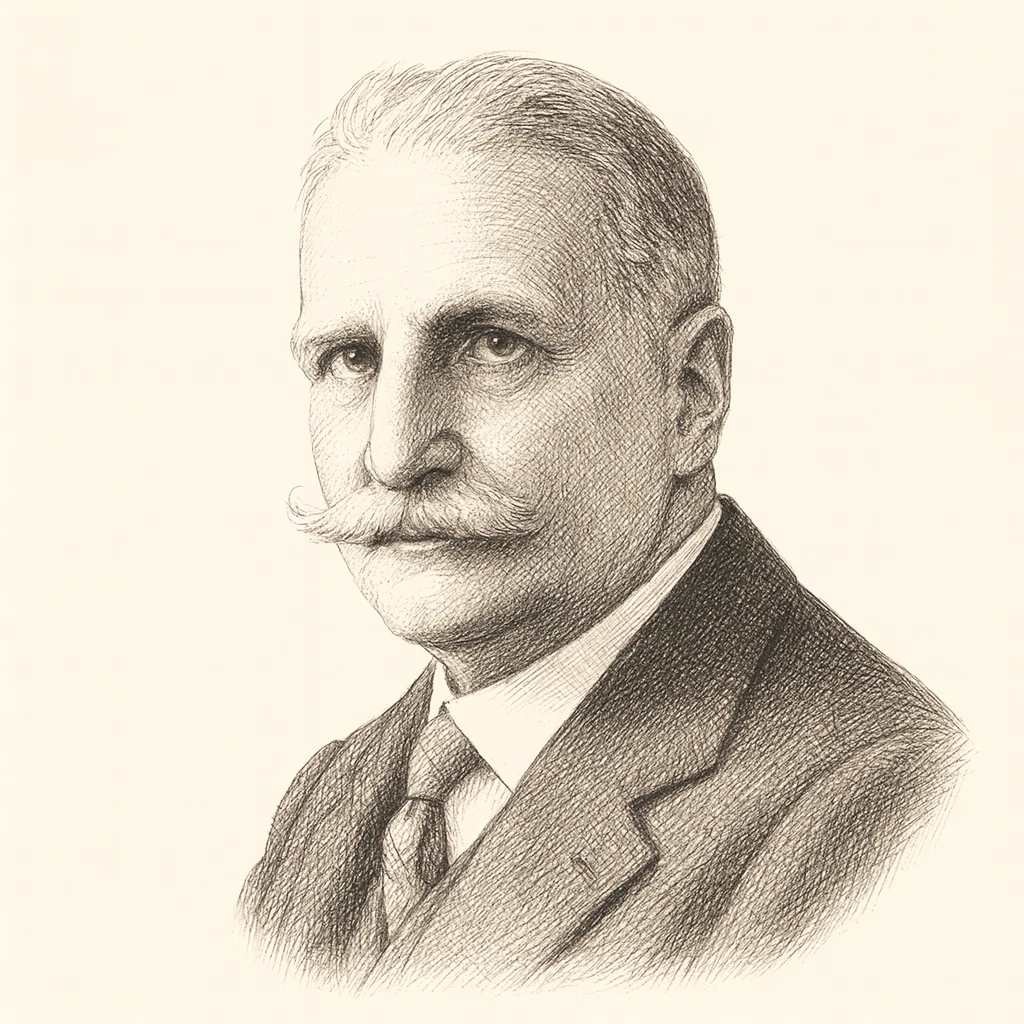
Roberto Michels was born in 1876 in Cologne, the son of a prosperous merchant family, and was educated in Paris, Munich, Leipzig, and Turin — the polyglot intellectual formation that reflected his own multiple identities, since he was German by birth, French by education, and eventually Italian by adoption and citizenship. He began his academic career as a committed socialist and member of the German Social Democratic Party, which seemed in the early years of the twentieth century to be the most democratic and scientifically organized mass political party in the world — a model of what working-class self-organization could achieve.
His years of close observation of the SPD produced a paradox that he could not explain within the terms of socialist theory. The party was democratic in its formal structure and its ideology preached democratic values in earnest. It held elections, maintained accountability mechanisms, and attracted members who sincerely believed in working-class self-governance. And yet, Michels observed, power was consistently concentrating in the hands of a small leadership group — full-time officials who controlled information, managed the party's bureaucratic apparatus, and gradually developed interests distinct from those of the membership they claimed to represent. The formal democracy and the practical oligarchy coexisted without contradiction, the former legitimating the latter while the latter determined the actual direction of the organization.
Political Parties (1911) was his analysis of this phenomenon, and it formulated the "iron law of oligarchy" that has entered the permanent vocabulary of political sociology. The law was structural rather than psychological: it did not depend on the leaders being cynical or corrupt, though they might become so. It depended on the logic of large-scale organization itself. Complex organizations required specialization; specialization produced experts; experts possessed information that non-experts lacked; information asymmetry generated power differentials; power differentials enabled the leadership to perpetuate itself regardless of formal democratic constraints. The masses were susceptible to manipulation precisely because the technical complexity of modern organizational life exceeded their capacity to monitor and control it. This was not a failure of individual virtue but a consequence of scale.
The implications were devastating for orthodox democratic and socialist theory simultaneously. Democratic theory assumed that the people could in fact govern themselves through their representatives; Michels argued that representatives systematically developed interests distinct from those they represented. Socialist theory assumed that the working class could organize itself for its own emancipation; Michels argued that working-class organizations would inevitably be captured by their own leadership stratum. Neither bourgeois democracy nor proletarian revolution would produce genuine popular self-governance; both would produce oligarchy in different forms.
He drew on Mosca's concept of the political class and Pareto's elite theory, and Political Parties was understood immediately as part of the Italian school of political sociology that had developed these ideas. His own political trajectory was as disturbing as his theory: the man who had formulated the iron law of oligarchy joined the Italian Fascist Party in 1922, shortly after Mussolini's March on Rome, and remained a supporter of the regime until his death in 1936. He apparently concluded from his own analysis that since oligarchy was inevitable, the question was not how to prevent it but who would lead -- and found Mussolini's energetic assertion of will more honest than the democratic socialist pretense of popular self-governance.
This trajectory made him permanently uncomfortable for both the left and the liberal tradition to claim. His analysis of organizational dynamics was absorbed into political science -- the concept of the iron law of oligarchy appears in virtually every discussion of party organization, bureaucracy, and the gap between democratic theory and democratic practice. His politics were disposed of with the embarrassment appropriate to a sympathizer with fascism. The gap between the two is one of the more disturbing features of the sociological tradition he helped found.
Roberto Michels is associated with Pragmatic Centrist. See the archetype