
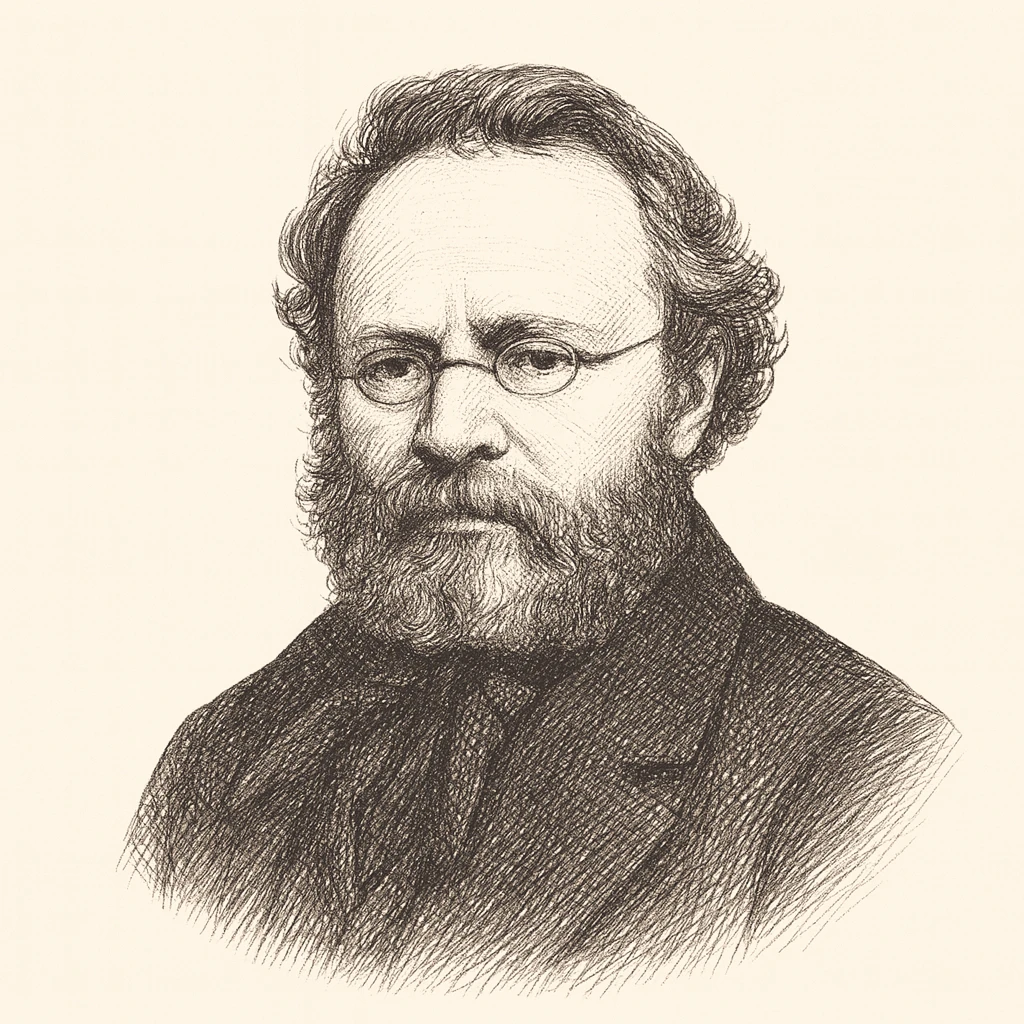
Pierre-Joseph Proudhon was born in 1809 in Besançon, in the Franche-Comté region of eastern France, into a working-class family of Burgundian peasant origins. His father was a barrel-maker and tavern keeper; his mother a domestic servant. He grew up in genuine poverty — the family's tavern failed, his father spent time in debtors' prison, and Proudhon worked as a cowherd in the summers to supplement the family income. He attended the Collège de Besançon on scholarship but had to withdraw before completing his studies when the family could no longer afford even the reduced fees, and he was apprenticed to a printing house at sixteen. The printer's trade proved decisive: it gave him access to books, manuscripts, and the intellectual life of the city without the social credentials that formal university education would have provided. He educated himself by composition, setting type for the works of scholars and theologians whose arguments he was absorbing and disputing as he worked.
He stayed in the printing trade through his twenties, working in Besançon and then in Paris, and won a scholarship from the Besançon Academy in 1838 that gave him three years to pursue independent scholarly work. He used it to write What is Property? (1840), the pamphlet that made him famous at thirty-one. Its opening was the most effective provocation in the history of political philosophy: "Property is theft." Three words that compressed a complex argument into an unforgettable slogan and guaranteed that no one who encountered them could remain indifferent. Karl Marx, reading in Paris, was electrified. He sought out Proudhon, began a correspondence, and spent several months in intense philosophical discussion with him. The relationship produced some of the most interesting intellectual exchange of the mid-nineteenth century before it ended in one of the most consequential quarrels in the history of the left.
The argument of What is Property? was more careful than the slogan suggested. Proudhon distinguished between property — the right of owners to collect rent, interest, and profit from resources they did not personally use — and possession — the worker's right to use and control the tools and land necessary for their labor. Property in the first sense was theft because it allowed non-workers to extract value from workers who had no realistic alternative but to labor on someone else's land or capital. This was exploitation, and the state existed primarily to protect it. What he opposed was not possession itself but the absentee ownership that gave non-laboring proprietors the power to appropriate the value others created.
He was the first major political thinker to describe himself as an anarchist — choosing the word deliberately as a provocation, knowing its pejorative connotations and insisting on it anyway. His anarchism was not the chaos of popular imagination but the principled rejection of all authority that could not justify itself on rational and ethical grounds. Government, which existed to protect property in the first sense, was authority that could not so justify itself, and its abolition was therefore not a utopian dream but a practical requirement of genuine human freedom. His alternative was mutualism: voluntary federation of producers organized through mutual credit and free contract, dealing with each other without the mediation of either capitalist owners or state authority.
The confrontation with Marx came in 1847 when Marx published The Poverty of Philosophy, a polemical attack on Proudhon's System of Economic Contradictions (1846). Marx's critique was that Proudhon had absorbed the dialectical method without understanding it, that his economics were amateurish, and that his vision of a society organized through voluntary exchange without central authority was a petty-bourgeois fantasy that failed to reckon with the actual mechanisms of capitalist power. Proudhon's response, in private correspondence, was that Marx was a doctrinaire who would substitute his own authority for the authority he claimed to oppose — a prediction that Bakunin would later develop into the foundational anarchist critique of Marxism.
He served briefly in the French National Assembly after the revolution of 1848, produced a steady stream of political journalism, spent three years in prison for his attacks on Louis-Napoleon Bonaparte, and continued writing through the 1850s and 1860s from a position of increasing poverty and ill health. His later work — The General Idea of the Revolution (1851), Justice in the Revolution and in the Church (1858), On the Political Capacity of the Working Classes (1865) — developed his mutualist alternative to both capitalism and state socialism with increasing sophistication, even as his personal life was characterized by the grinding material difficulty that he had analyzed so effectively in his political writings. He died in 1865, never having seen the anarchist movements his work inspired take organized form.
His legacy was carried forward primarily in the Latin world — the French and Spanish and Italian labor movements that developed anarcho-syndicalism as an alternative to both parliamentary socialism and Leninist vanguardism were Proudhonist in their organizational vision, even where they departed from his mutualist economics. The cooperative movement, the credit unions, the labor federations — these were practical expressions of his ideas in forms he would have recognized. He was also, as his critics never tire of pointing out, a figure of real limitations: his writings on women were strikingly reactionary for someone committed to universal human dignity, and his private journals contained anti-Semitic passages that cannot be defended. The tension between his principled opposition to domination and his own blind spots has made him a complicated figure to claim, but not one whose influence can be wished away.
Pierre-Joseph Proudhon is associated with Left Libertarian. See the archetype