
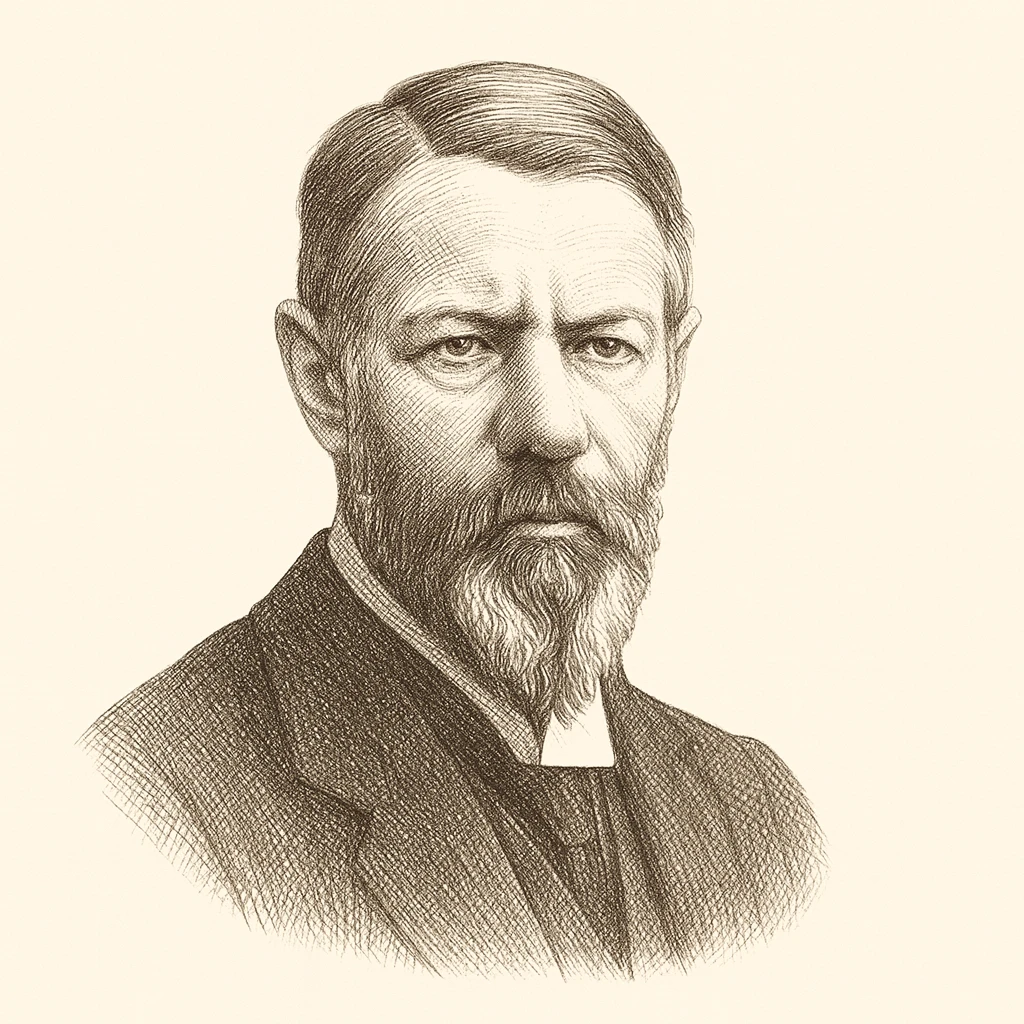
Max Weber was the founding figure of modern political sociology and one of the most important social theorists of the 20th century, even though he died in 1920 before the century had fully begun to absorb his work. His analyses of bureaucracy, political authority, the rise of modern capitalism, and the distinctive character of modernity itself have shaped nearly every serious attempt to understand modern political and economic life. His work is often read alongside that of Marx and Durkheim as constituting the founding trio of modern sociology, but Weber's political sensibility was quite different from either, and his insights into political authority remain especially valuable today.
Weber was born in 1864 in Erfurt, Prussia, into an upper-middle-class family that combined political connections (his father was a prominent National Liberal politician) and intellectual seriousness (his mother came from a family with deep Protestant theological commitments). He studied law, history, and economics at several German universities, earned his doctorate in 1889, and began an academic career that was repeatedly interrupted by severe mental illness. In 1897, Weber had a major psychological breakdown that left him unable to work for nearly seven years. When he finally recovered, he returned to work with enormous intensity and produced most of his major writings in a relatively compressed period before his death from pneumonia in 1920, during the global influenza pandemic, at fifty-six.
Weber's first major work after his recovery was The Protestant Ethic and the Spirit of Capitalism (1905), one of the most famous and most debated works of social theory ever written. Weber's argument was that the distinctive economic dynamism of modern Western capitalism could not be explained by material factors alone — by natural resources, climate, or technology. It required a distinctive cultural and religious orientation that had emerged from Calvinist Protestantism in the 16th and 17th centuries. Calvinists, believing in predestination, had no way to know whether they were among the elect whom God had chosen for salvation. Their response was to seek signs of election through worldly success: disciplined work, prudent investment, systematic accumulation, and a refusal to spend their earnings on luxury or leisure. This "Protestant ethic," Weber argued, had produced the distinctive "spirit of capitalism" — a cultural framework in which making money became an end in itself and economic activity was pursued with a religious intensity that no prior civilization had matched.
Weber's other major contribution was his theory of authority. In his massive, unfinished treatise Economy and Society, Weber distinguished three ideal types of legitimate authority: traditional authority (legitimate because it has always been), charismatic authority (legitimate because of the exceptional personal qualities of the leader), and legal-rational authority (legitimate because it operates according to explicit impersonal rules). Each type, Weber argued, tended to produce distinctive political and administrative institutions. Traditional authority produced patrimonial and feudal systems. Charismatic authority produced revolutionary movements and prophetic regimes. Legal-rational authority produced the bureaucratic state, which Weber considered the distinctive and unavoidable political form of modernity.
Weber's analysis of bureaucracy was particularly prescient. He saw bureaucracy as enormously powerful — more efficient, more predictable, and more impartial than earlier administrative forms. But he also saw that bureaucracy created what he called an "iron cage" of rationalization in which human beings became increasingly trapped by the impersonal procedures and calculative logics of modern institutions. The disenchantment of the world, the loss of meaning in a universe stripped of magic and religious significance, and the reduction of human beings to cogs in bureaucratic machines were all, for Weber, defining features of modern life. His analysis was pessimistic in a distinctive way: he saw that the rationalization of modernity had genuine benefits, but that it came at the cost of human freedom, meaning, and ethical seriousness.
Weber's political writings also addressed the distinctive ethical problems of political leadership. In his famous 1919 lecture "Politics as a Vocation," Weber distinguished between an "ethic of conviction" (which judges actions by their moral purity) and an "ethic of responsibility" (which judges actions by their consequences). He argued that political leaders must operate primarily within the ethic of responsibility, accepting that political action often requires difficult choices that cannot be reconciled with moral absolutism. This analysis has shaped nearly every subsequent treatment of political ethics.
Weber died in 1920 in Munich. Most of his mature work had been left unfinished or unpublished at his death, and was assembled by his wife Marianne and later scholars over the following decades. His influence grew steadily across the 20th century, and by now his vocabulary — charisma, bureaucracy, legitimacy, rationalization, disenchantment — has become inseparable from how serious scholars discuss modern political life.
Max Weber is associated with Independent Localist. See the archetype