
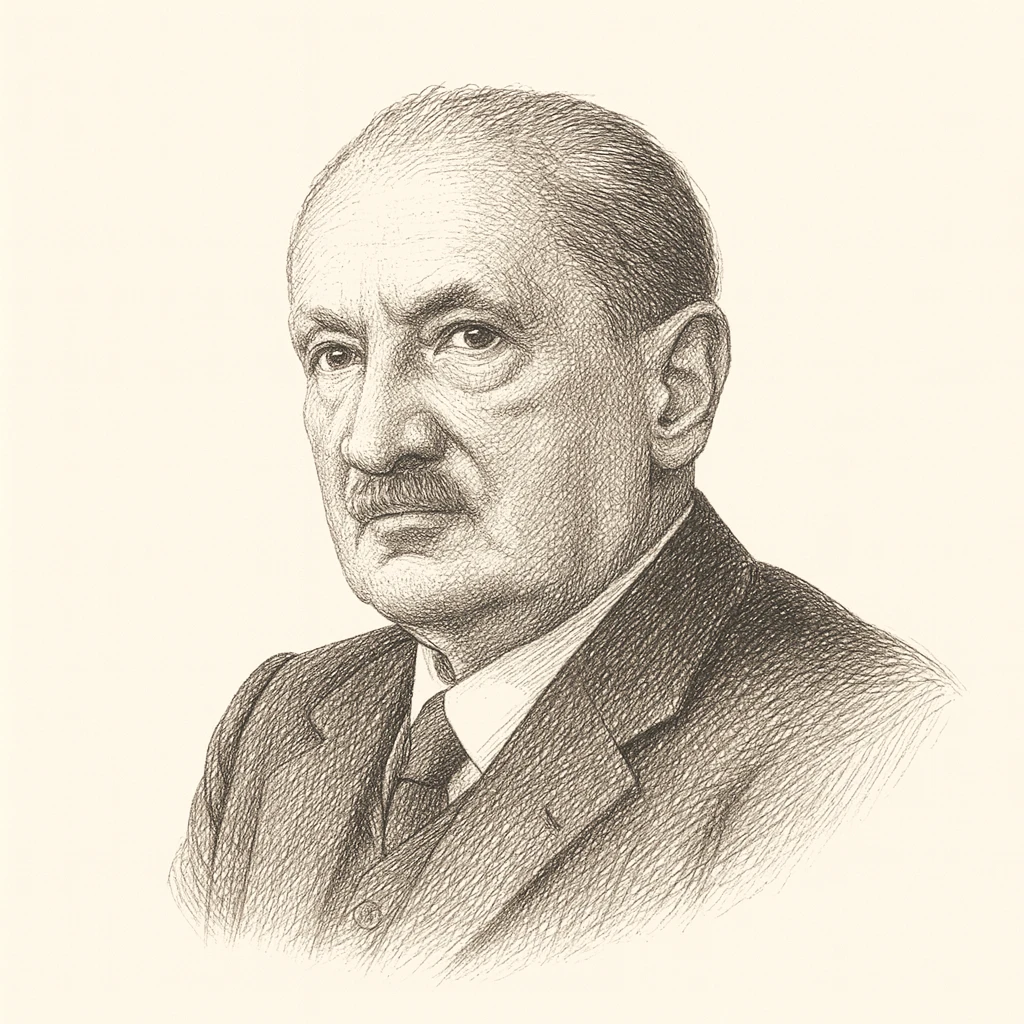
Martin Heidegger is one of the most influential and most troubling figures in 20th century philosophy, a thinker whose work reshaped continental philosophy, phenomenology, existentialism, theology, literary criticism, and eventually Anglo-American philosophy in the second half of the 20th century, and who was also a committed Nazi who joined the party in 1933, served as rector of Freiburg University under the new regime, and never meaningfully repudiated his role after the war. Reading Heidegger honestly requires holding both facts in mind at once. The philosophical contributions are real and enormous. The political commitments are not a biographical footnote but a serious question about the relationship between his thought and the movement he joined. Contemporary scholarship has increasingly refused to separate the two, and the question of what Heidegger's work means politically remains unresolved.
Heidegger was born in 1889 in Messkirch, a small town in Baden-Württemberg, into a Catholic family of modest means. He originally intended to become a Catholic priest, began theological studies at Freiburg University, and gradually shifted to philosophy as his theological certainties weakened. He studied under Edmund Husserl, the founder of phenomenology, and became Husserl's most brilliant student and eventual successor at Freiburg. Husserl was Jewish, and the irony of Heidegger's eventual Nazi commitments against the backdrop of his formative relationship with Husserl — whose emeritus privileges Heidegger would later strip away as rector of Freiburg under Nazi racial laws — is one of the most disturbing episodes in 20th century intellectual life.
His major work was Being and Time (1927), published when Heidegger was thirty-eight, and it reshaped philosophy immediately. The book was ostensibly a contribution to the question of being — the fundamental metaphysical question of what it means for anything to exist at all — but its actual impact came from its analysis of human existence, what Heidegger called Dasein (literally "being-there"). Heidegger argued that traditional philosophy since Plato had asked the question of being in the wrong way, treating beings as present objects to be described rather than as entities whose existence was always already situated in a context of practical involvement, temporal becoming, and mortality. Dasein, the specifically human way of being, was characterized by being thrown into a world not of its choosing, by being always involved in projects and concerns, by being toward death, and by being constantly challenged to choose between authentic engagement with its own finite existence and inauthentic drift through the conventional patterns of "the They" — the anonymous social expectations that allow individuals to evade their own genuine situation.
This framework became enormously influential. Sartre's existentialism, Merleau-Ponty's phenomenology, Hans-Georg Gadamer's hermeneutics, Hannah Arendt's political theory, Emmanuel Levinas's ethics, Michel Foucault's genealogies of power, and the entire tradition of continental philosophy in the second half of the 20th century all worked within categories Heidegger had established. His influence on theology, particularly through Rudolf Bultmann and Karl Rahner, transformed 20th century Protestant and Catholic thought. His impact on literary criticism and hermeneutics shaped the entire humanities across the century. Even analytical philosophers, who had generally been dismissive of continental philosophy, increasingly engaged with Heidegger in the late 20th century through figures like Richard Rorty and Hubert Dreyfus.
The political question is inseparable from the philosophical assessment. In 1933, shortly after Hitler came to power, Heidegger joined the Nazi Party and accepted appointment as rector of Freiburg University under the new regime. His inaugural address as rector, "The Self-Assertion of the German University," enthusiastically welcomed the Nazi transformation of German education and culture. He signed documents removing Jewish colleagues, including his mentor Husserl, from their academic positions. He gave public speeches praising Hitler. He remained a party member throughout the war. After the war, he was investigated by denazification tribunals, briefly banned from teaching, and eventually reinstated. He never publicly apologized for his Nazi period, never acknowledged the specific harms his cooperation had caused, and deflected questions about it with vague philosophical gestures. In a 1966 Der Spiegel interview published after his death, he said "only a god can save us" — a remark that his critics took as evasive self-pity and his defenders took as a serious reflection on the spiritual condition of modernity.
The question of what connection exists between Heidegger's philosophy and his Nazism has been debated ever since. Some scholars argue that the philosophy is essentially separable from the politics — that Being and Time is a great philosophical work that happened to be produced by someone who later made catastrophically wrong political choices. Others argue that the philosophy and the politics are deeply connected — that Heidegger's critique of modern technological civilization, his yearning for authentic rootedness in a particular people and soil, his contempt for liberal proceduralism and cosmopolitan universalism, and his framework of collective historical destiny all made his Nazi commitments philosophically continuous with his earlier work rather than a departure from it. The publication of Heidegger's previously secret "Black Notebooks" beginning in 2014 added new evidence to the debate by revealing that his private writings during and after the Nazi period contained explicit antisemitic material and sustained philosophical reflections on Jewish "worldlessness" that were clearly connected to his political commitments. The debate about how to read Heidegger continues.
Heidegger's later work, after Being and Time, shifted toward questions about technology, art, poetry, and what he called "the question of being" in more historical and meditative directions. He became increasingly critical of modern technological civilization, which he saw as the final working out of a metaphysical tradition that treated everything, including human beings, as raw material for calculation and control. His later essays on technology, on the artwork, on language, and on thinking itself have influenced contemporary environmental philosophy, critiques of technocratic rationality, and debates about the cultural consequences of technological transformation. Whether these later works succeed in distancing themselves from the political commitments of the 1930s or whether they extend those commitments in more philosophically sophisticated form is another dimension of the ongoing debate about his legacy.
Heidegger died in 1976 at eighty-six in Freiburg, having spent his final decades as one of the most discussed philosophers in the world while largely avoiding direct engagement with the political questions about his past. His influence on contemporary philosophy remains enormous, and serious engagement with his work continues to produce new scholarship, new arguments, and new disagreements about what he meant and what his legacy should be.
Martin Heidegger is associated with Traditionalist. See the archetype