
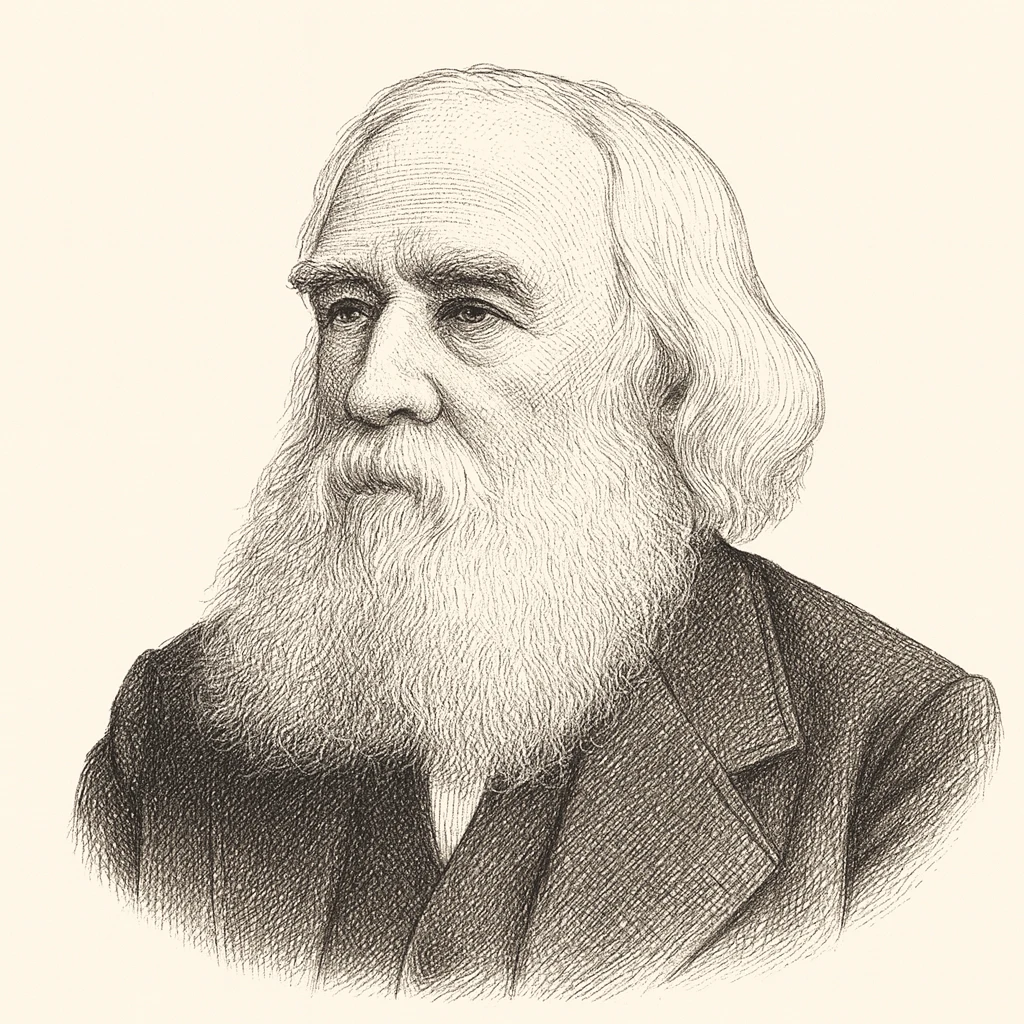
Lysander Spooner is the most original and radical American political theorist of the 19th century, a figure whose work connects the abolitionist movement directly to the contemporary libertarian and anarcho-capitalist traditions in ways that most histories of American political thought fail to acknowledge. He was an abolitionist who argued that slavery was already illegal under the Constitution properly interpreted, a legal theorist whose work on natural law anticipated much of contemporary libertarian political philosophy, a radical individualist who competed directly against the U.S. Post Office to break its mail delivery monopoly, and eventually an anarchist whose No Treason: The Constitution of No Authority (1867) argued that the U.S. Constitution had no legitimate authority over anyone who had not explicitly consented to it. His influence on the tradition that runs through Benjamin Tucker, Murray Rothbard, and contemporary anarcho-capitalism is substantial, and his rediscovery by 20th century libertarians has made him one of the most important 19th century American political thinkers for contemporary classical liberal and libertarian archetypes.
Spooner was born in 1808 in Athol, Massachusetts, raised on a farm, and essentially self-educated as a lawyer. He apprenticed briefly with lawyers in Worcester but could not afford to complete the full legal training that Massachusetts required before allowing someone to practice in the state's courts. Rather than accept what he regarded as an arbitrary and anti-competitive restriction, Spooner simply began practicing law in defiance of the requirements, publishing pamphlets arguing that the educational and training prerequisites were unconstitutional restrictions on the liberty of practitioners and the choice of clients. The state eventually abolished the requirements, partly in response to the political pressure Spooner had generated, which was probably the most practically successful victory of his career.
In the 1840s Spooner turned his attention to the legal status of slavery, which was then the central political question in American public life. The standard abolitionist position, associated with William Lloyd Garrison and the American Anti-Slavery Society, was that the Constitution was a pro-slavery document — "a covenant with death and an agreement with hell" — and that abolitionists should work for Northern secession from the Union as the only way to escape complicity with slavery. Spooner argued the opposite. In The Unconstitutionality of Slavery (1845), he made the detailed legal case that slavery had never actually been authorized by the Constitution, that the text properly interpreted prohibited rather than protected slavery, and that federal courts had both the authority and the obligation to strike slavery down as unconstitutional.
The argument was technically ingenious and politically consequential. It gave abolitionists a framework for opposing slavery within rather than against the constitutional order, which shaped the later political abolitionism of the Liberty Party, the Free Soil Party, and eventually the Republican Party that Lincoln led. Frederick Douglass, initially a Garrisonian, eventually adopted Spooner's constitutional interpretation and cited Spooner as the decisive influence on his own conversion to the position that the Constitution could be used as an anti-slavery document. Whether Spooner's interpretation was actually correct as a matter of legal history remains debated among scholars, but as political theory his framework provided abolitionists with an alternative to Garrisonian secession and helped shape the constitutional arguments that eventually produced the Thirteenth Amendment.
Spooner's most radical work came after the Civil War, when he concluded that the war's outcome had not actually vindicated the constitutional principles he had spent his life defending. The war had preserved the Union, abolished slavery, and strengthened federal power, but it had done so through massive violence and at the cost of a federal government that Spooner came to see as fundamentally illegitimate. Between 1867 and 1870 he published a series of six pamphlets under the collective title No Treason, whose sixth installment, No Treason VI: The Constitution of No Authority (1870), became his most important theoretical work and the text for which he is now best remembered.
The argument of No Treason VI was devastating in its simplicity. Spooner pointed out that the traditional justification for political authority in American constitutional theory rested on the claim that the Constitution represented an agreement among the American people to establish a government. But no such agreement had ever actually been made by the people currently living under the Constitution. The people who had signed it were all dead. The people alive today had never personally consented to it. The traditional argument for "tacit consent" — that by living under a government and receiving its benefits, people implicitly consent to it — was, Spooner argued, philosophically incoherent because it applied a standard of consent that would never be accepted in any other contractual context. No private contract would be legally binding on someone who had never signed it simply because they had received some incidental benefit from its existence. The Constitution, Spooner concluded, had no legitimate authority over anyone who had not personally and voluntarily agreed to be bound by it, which meant it had no legitimate authority over anyone living. The document was not a contract. It was simply the ideological cover for a system of organized coercion.
This argument became one of the foundational texts of modern American individualist anarchism and, much later, of anarcho-capitalism. Benjamin Tucker, the 19th century American individualist anarchist, republished Spooner's work and cited him as one of the essential figures in the American anti-state tradition. Murray Rothbard, developing anarcho-capitalism in the 1960s and 70s, treated Spooner as a direct intellectual ancestor and worked to restore his reputation among contemporary libertarians. The contemporary libertarian argument that political obligation requires explicit rather than tacit consent, that the state is fundamentally illegitimate rather than simply defective, and that the traditional justifications for government authority are philosophical rationalizations for coercion all trace back substantially to Spooner's work.
Spooner also wrote extensively on jury nullification (arguing that juries had the right and duty to refuse to convict under unjust laws), on economic questions (attacking banking monopolies and arguing for free competition in currency), and on the rights of labor (defending workers' rights to organize while rejecting socialism in favor of radical individualism). His 1844 attempt to compete with the U.S. Post Office by establishing his own private mail delivery company — the American Letter Mail Company — was an early and practical demonstration of his conviction that government monopolies existed to protect incumbents rather than to serve the public. The government shut his company down through legal harassment rather than by actually demonstrating its inefficiency, which Spooner took as confirmation of his broader analysis of how state power actually operates.
Spooner died in 1887 at seventy-nine in Boston, in poverty and relative obscurity, still writing pamphlets and still unwilling to compromise with what he regarded as the illegitimate authority of the American state. His reputation languished for most of the 20th century until libertarians rediscovered him in the 1960s and 70s. The Lysander Spooner Press was founded in 1971 to keep his works in print, and he has since become one of the most widely read 19th century American libertarian thinkers, particularly through the efforts of Murray Rothbard and the broader Mises Institute network. He is now recognized as one of the most original American political theorists of his century and as a direct ancestor of the contemporary radical libertarian tradition.
Lysander Spooner is associated with Anarcho-Capitalist. See the archetype