
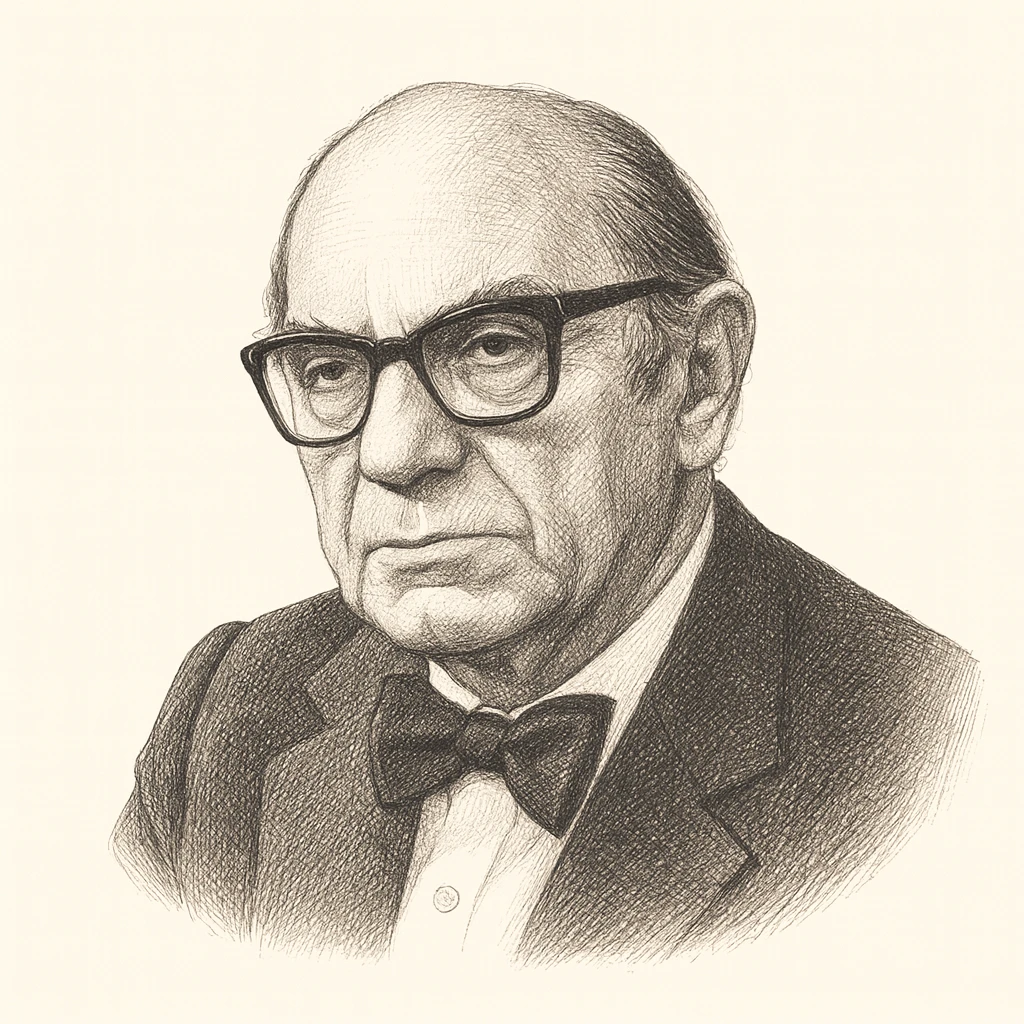
Isaiah Berlin was born in Riga in 1909, then part of the Russian Empire, into a comfortable Jewish family. He was eight years old when the Russian Revolution began, and he watched it unfold from St. Petersburg, where his family had moved. He saw a man being dragged through the streets by a mob and never forgot it; the experience shaped his lifelong horror of revolutionary violence and his commitment to forms of political life that protected individuals from being sacrificed to abstract ideas. The family fled Russia in 1921, eventually settling in England, where Berlin attended St. Paul's School and then Oxford. He spent the rest of his life at Oxford, becoming the most celebrated public intellectual in postwar Britain and one of the few academic philosophers whose work was read widely outside the academy.
Berlin made his reputation as a historian of ideas rather than as a systematic political philosopher. His early work focused on figures from the 18th and 19th centuries — Vico, Herder, Hamann, Tolstoy, Marx, the Russian populists — and his particular skill was bringing intellectual history alive by reconstructing the inner logic of past thinkers' worldviews. He could explain why someone like Maistre or Sorel found their views compelling, even when those views were politically alien to him, and he treated even the most uncongenial thinkers with sympathetic seriousness. This made him an unusually generous reader of difficult figures and an unusually penetrating critic of his own intellectual tradition.
The single most influential thing Berlin ever wrote was a 1958 lecture called "Two Concepts of Liberty." In it, he distinguished between two different things people had meant by "freedom" throughout the history of political thought. Negative liberty was freedom from interference — the absence of obstacles, coercion, or constraint. To be free in this sense was simply to be left alone, to have a sphere of personal action within which no one else could legitimately interfere. Positive liberty was freedom to — the capacity for self-mastery, self-realization, or genuine self-government. To be free in this sense required not merely the absence of interference but the active development of one's higher faculties or the participation in collective self-rule. Berlin acknowledged that both conceptions captured something genuine and important about freedom. But he warned that positive liberty had a dangerous tendency to mutate into something tyrannical: once you started defining freedom as the realization of someone's "true" or "higher" self, it was easy to conclude that people who didn't recognize their own true selves needed to be forced to be free, by enlightened authorities who knew what their true interests were better than they did. Almost all the great political horrors of the 20th century, Berlin thought, had emerged from positive liberty taken too seriously.
The lecture was controversial when it was delivered and remains so. Critics — particularly on the political left — argued that Berlin had loaded the dice, that positive liberty wasn't inherently dangerous, and that negative liberty by itself was insufficient to capture what mattered about freedom. Defenders argued that Berlin had identified something important about how grand projects of human emancipation kept producing tyranny in practice. The debate has never quite ended, and almost every contemporary discussion of liberty within liberal political theory still works with the framework Berlin established.
Berlin's other major contribution was the framework of value pluralism, developed across many essays. Berlin argued that the values human beings cared about — liberty, equality, justice, mercy, loyalty, courage, prosperity, security, beauty, truth — were plural all the way down and incompatible with one another in ways that no single rational system could harmonize. You could not maximize all of them at once. Choices among them required tragic sacrifice. The dream of a perfectly rational society in which all human values would be simultaneously realized was, in Berlin's view, the great philosophical mistake of the modern era — and the one most directly responsible for the willingness to sacrifice actual human beings to the supposed harmony of an imagined future. Pluralism was Berlin's answer: a recognition that the conflicts between values are real, that the best we can do is balance them imperfectly, and that this imperfect balancing is what political life actually requires.
Berlin spent his career at Oxford, eventually becoming the founding president of Wolfson College. He never wrote a single major systematic work — his published writing consists almost entirely of essays, lectures, and intellectual portraits — but the cumulative influence of those essays on Anglo-American political philosophy is enormous. Almost everyone who works on liberty, pluralism, or the history of political thought in the analytical tradition is in conversation with Berlin. He died in 1997 at eighty-eight, in Oxford, having lived through nearly a century of the political horrors he had spent his career trying to understand.
Isaiah Berlin is associated with Independent Localist. See the archetype