
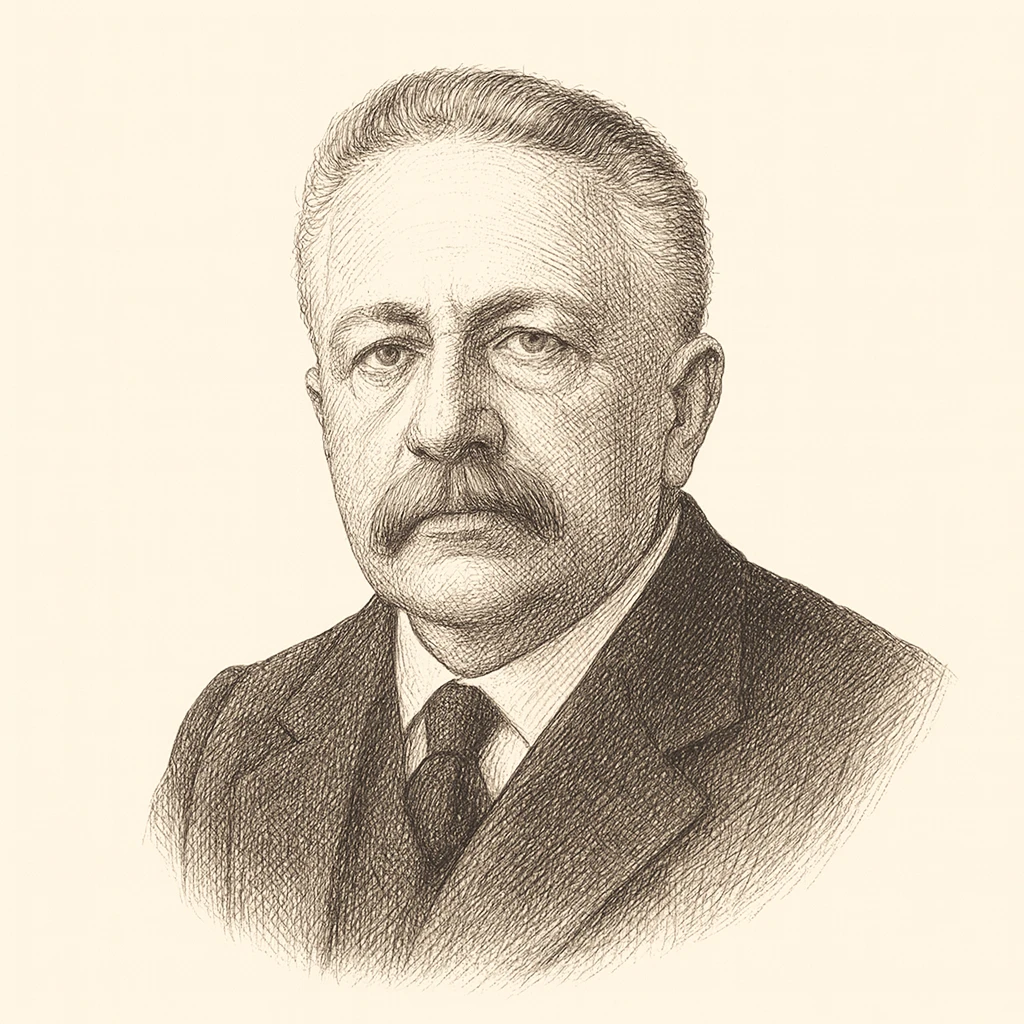
Gaetano Mosca was born in 1858 in Palermo, Sicily, into a bourgeois family in the southern Italian society that was then experiencing the turbulent aftermath of Risorgimento unification. Sicily's particular history -- the centuries of Spanish and Bourbon rule, the persistence of feudal social structures, the gap between formal constitutional arrangements and actual power relations -- gave the young Mosca a native skepticism about the official accounts of how political systems worked that preceded and grounded his subsequent theoretical work. He studied law at the University of Palermo, took his doctorate, and eventually secured a position teaching constitutional law and political science, first at Turin and then at Rome, where he taught for the remainder of his career.
Teorica dei governi e governo parlamentare (Theory of Governments and Parliamentary Government, 1884) was the work in which he first formulated the concept of the "political class" -- the organized minority that in every society, regardless of its formal constitutional arrangements, actually exercised power over the disorganized majority. The argument was both historical and analytical: looking across the range of political systems that history offered, Mosca saw in all of them the same fundamental structure -- a small number of organized people, sharing some quality or set of qualities that gave them cohesion and capacity, exercising political control over the large majority who lacked this organization. In monarchies the political class was the court aristocracy; in democracies it was the party organizations and their professional staff; in military states it was the officer corps. The form changed; the fundamental structure did not.
The Elementi di Scienza Politica (The Ruling Class, 1896, expanded 1923) was the full development of the theory. Mosca's argument was not that democracy was impossible or undesirable -- he was himself a liberal who valued constitutional government and the rule of law -- but that democracy, properly understood, was not the self-governance of the people but the competition between elite factions for popular support. This competition had real value: it prevented the monopolization of power by a single group, introduced accountability through the possibility of losing elections, and created mechanisms for the circulation of elites that prevented the stagnation of a permanently closed ruling class. But it was not, and could not be, what democratic ideology claimed it was: the direct expression of the popular will through representative institutions.
He distinguished his position carefully from Pareto's: Pareto's elite theory was psychological, organized around the residues and derivations that governed individual behavior; Mosca's was organizational, focused on the structural advantages that organization conferred on minorities over unorganized majorities. The distinction mattered because it gave Mosca's analysis a different political implication: if the problem was organizational rather than psychological, then the appropriate response was not to accept elite domination as inevitable but to develop counter-organizations that could challenge it, or to create institutional mechanisms that introduced genuine competition between elites.
He served in the Italian parliament from 1908 to 1919 and in the Senate from 1919 to his death, and he maintained throughout his parliamentary career the liberal constitutionalism that his elite theory might have seemed to undermine. He opposed Mussolini's fascism with genuine clarity -- his 1925 speech in the Senate against the Fascist electoral law, when most of his colleagues either supported it or were silent, was one of the more courageous acts of his political career -- and the tension between his theoretical account of elite domination and his practical commitment to liberal institutions was one he resolved through the distinction between better and worse forms of elite competition rather than by abandoning either the theory or the practice.
His influence ran primarily through the sociological and political science traditions that absorbed elite theory as a corrective to the naivety of democratic theory. Michels's iron law of oligarchy was developed within the framework that Mosca established. C. Wright Mills's Power Elite applied similar concepts to postwar American society. The contemporary literature on oligarchy and democratic backsliding draws on the Moschian tradition even where it does not invoke him directly.
Gaetano Mosca is associated with Pragmatic Centrist. See the archetype