
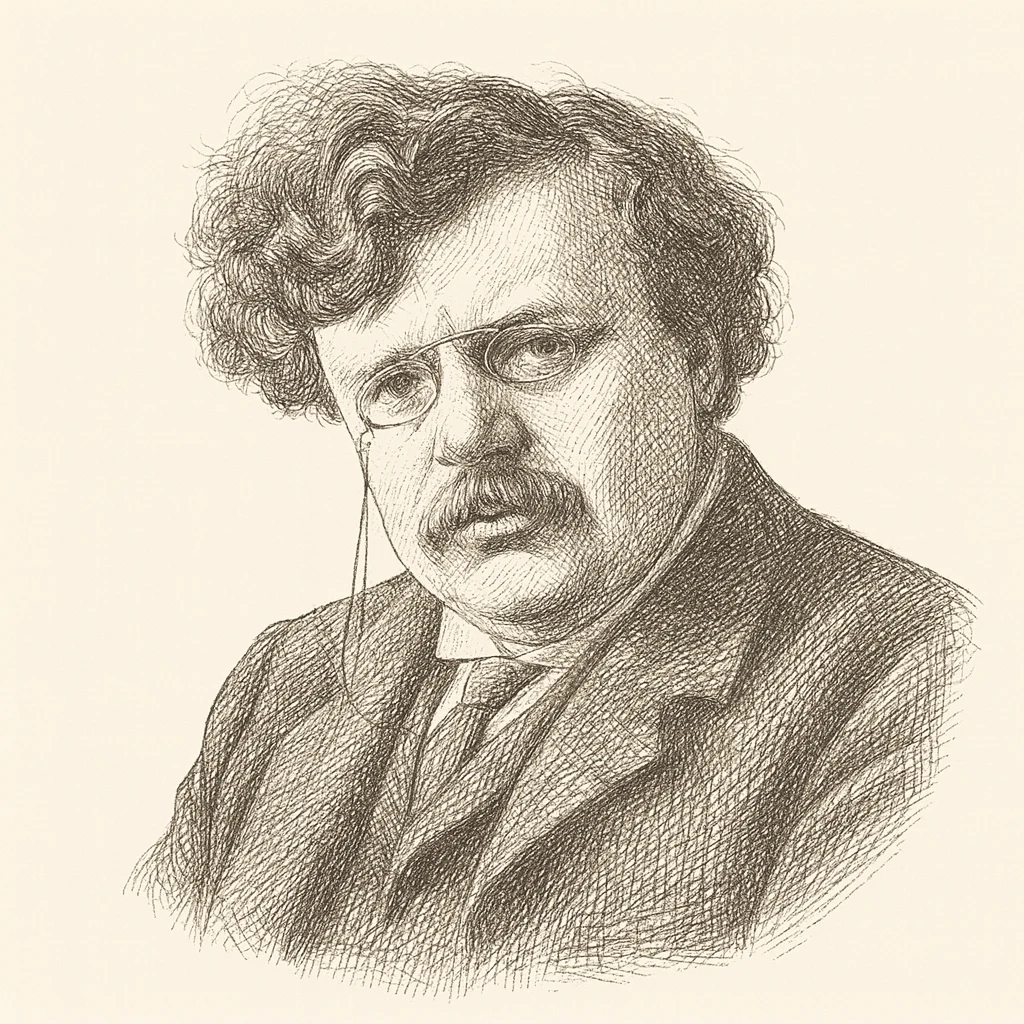
Gilbert Keith Chesterton was born in 1874 in Kensington, London, the son of a house agent and amateur painter, and educated at St. Paul's School before attending the Slade School of Art, where he studied illustration without quite becoming an illustrator. He began writing -- for The Bookman, The Speaker, and eventually The Daily News -- almost by accident, and discovered in his twenties that he had a gift for the contrarian insight delivered with maximum rhetorical effect, the paradox that turned conventional wisdom inside out and revealed something true that the original formulation had concealed. He was large, gregarious, perpetually rumpled, and capable of the sustained journalistic productivity that only people who actually enjoy writing can maintain: he produced around eighty books, several hundred poems, some two hundred short stories, and four thousand essays over a career that lasted until his death in 1936.
He converted to Catholicism in 1922, at forty-eight, after years of increasingly Anglo-Catholic sympathies -- his wife Frances had converted a decade earlier. The conversion was for him the arrival at a position he had been approaching for twenty years: the recognition that Catholic Christianity, properly understood, was not the enemy of reason and joy that its critics assumed but their ground. His Orthodoxy (1908) and The Everlasting Man (1925) were the pre-conversion and post-conversion statements of this position -- arguments not primarily for the specific doctrines of Christianity but for the intellectual coherence of a worldview that took mystery and incarnation seriously rather than dissolving them into rationalist progressivism.
His political thought was organized around distributism -- a position he developed jointly with his friend Hilaire Belloc and which was stated most fully in The Outline of Sanity (1926) and in the pages of G.K.'s Weekly, the periodical he edited from 1925 to his death. Distributism was an attempt to find a third way between capitalism and socialism that neither the liberal nor the Marxist tradition could provide. Both capitalism and socialism, Chesterton argued, concentrated property in too few hands: capitalism in the hands of a small class of owners, socialism in the hands of the state. The problem with modern industrial society was not that it had created private property but that it had created too little of it -- that the vast majority of people had been dispossessed of the productive property that genuine independence required, and were therefore dependent on either employers or the state for their subsistence.
The distributist alternative was the wide dispersal of productive property: land for farmers, tools and workshops for artisans, small businesses for tradespeople. It was explicitly anti-industrial in a way that made it impractical as a mass political program -- Chesterton acknowledged this freely -- but he thought impracticality was a poor reason for failing to state what was actually desirable. He preferred the small guild to the large corporation, the peasant's field to the factory's assembly line, the local community to the national bureaucracy, not because he was sentimental about the medieval past (though his attachment to it was real) but because he thought these forms of organization were better for human beings than their alternatives.
His cultural criticism was as prolific and as effective as his political writing. His biography of Charles Dickens (1906) established his reputation as a literary critic and influenced George Orwell's understanding of Dickens. His biography of St. Francis of Assisi (1923) and his biography of St. Thomas Aquinas (1933) -- which the philosopher Etienne Gilson called the best book on Aquinas ever written by anyone -- showed the range and depth of his engagement with the Catholic intellectual tradition. His Father Brown detective stories, which began appearing in 1910, demonstrated his understanding of Catholic theology through the genre of fiction, in a character whose method of detection was essentially theological: the recognition that the ordinary was miraculous and the miraculous ordinary.
He died in 1936, having spent the last decade of his life defending distributism against the twin alternatives of capitalism and fascism -- he was vigorously anti-fascist at a time when some of his Catholic contemporaries were less clear-sighted -- and watching the world move in directions that vindicated his diagnoses even as it ignored his prescriptions.
G.K. Chesterton is associated with Christian Socialist. See the archetype