
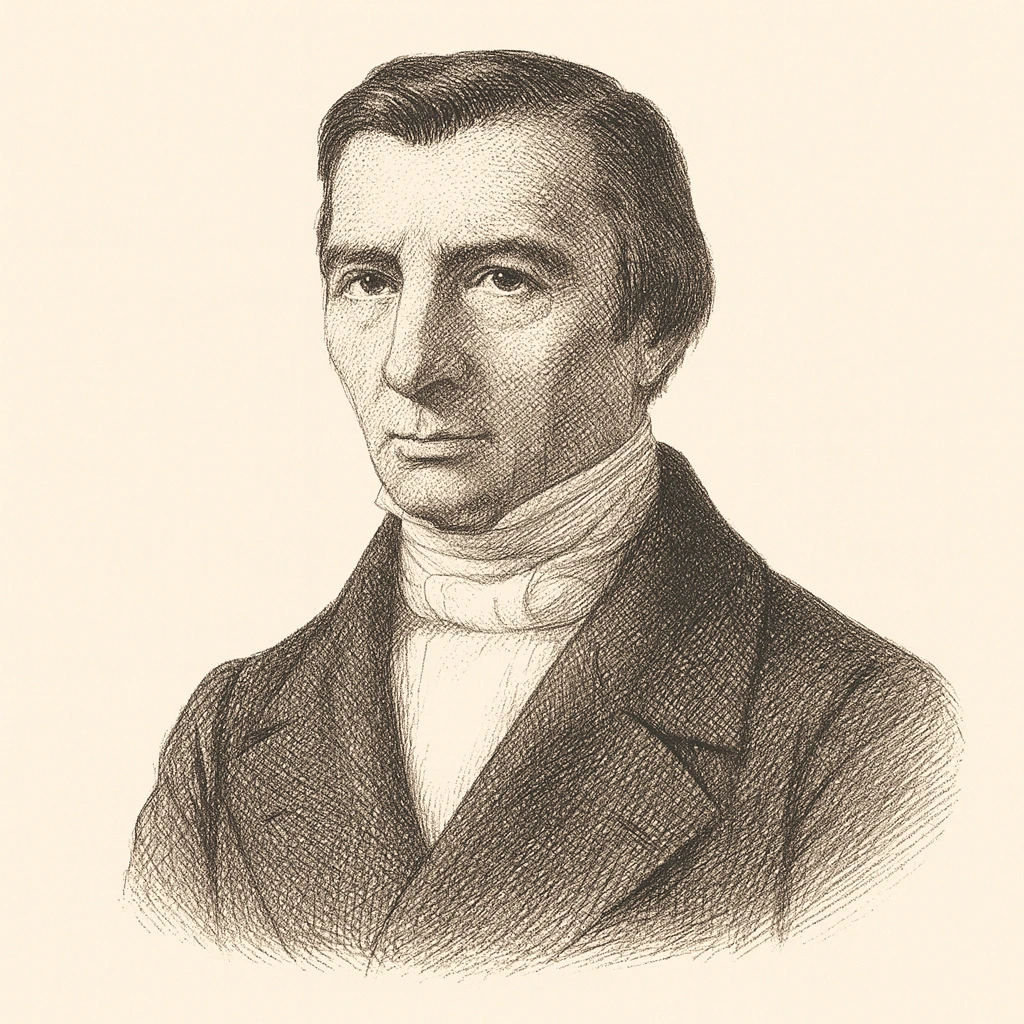
Frédéric Bastiat was the great literary stylist of classical liberal economics and one of the most effective popular defenders of free trade the 19th century produced. He wrote for roughly six years before dying of tuberculosis at forty-nine, and in those six years he produced pamphlets, essays, and a half-finished magnum opus that have kept his reputation alive in libertarian and classical liberal circles ever since. Mises considered him one of the great inspirations for his own work. Henry Hazlitt's Economics in One Lesson (1946), which sold millions of copies and shaped postwar American libertarian thought, was an explicit updating of Bastiat for the 20th century.
Bastiat was born in 1801 in the Basque region of southwestern France, orphaned young, raised by relatives, and educated without much formal direction. He inherited the family's small agricultural estate and spent his young adulthood as a farmer and local notable in a small French town, reading voraciously but publishing nothing. This went on for two decades. He did not begin his writing career until he was forty-four, when he sent a pamphlet on the effects of French and English tariffs to a Paris journal, which published it. The response was so enthusiastic that Bastiat threw himself into political economy as a full-time vocation and moved to Paris to become a writer and eventually a member of the French legislative assembly.
What made Bastiat different from other classical liberal economists was his prose. He wrote with wit, clarity, and a talent for memorable illustration that his more technical contemporaries lacked. His most famous piece, the Petition of the Candlemakers (1845), was a satirical petition supposedly submitted to the French parliament by candle makers demanding protection from unfair foreign competition — from the sun, which flooded the French market with free light and destroyed the candle industry. The petition proposed that parliament mandate the closing of all shutters, windows, and skylights to block sunlight and allow the domestic candle industry to flourish. The satire was devastating because it illustrated, in terms anyone could grasp, the fundamental absurdity of protectionist arguments. Protecting producers from foreign competition meant forcing consumers to pay higher prices for inferior goods in the name of "defending jobs" — exactly what the candlemakers were asking for.
Bastiat's most enduring theoretical contribution was the distinction between "that which is seen and that which is not seen." In his final published essay, written as he was dying of tuberculosis, Bastiat argued that the fundamental error of bad economic reasoning was to focus only on the visible, immediate effects of a policy while ignoring the invisible, long-term, dispersed consequences. A government job-creation program employs visible workers today; the taxes that funded it quietly destroyed an equal or greater number of jobs in the private sector that will never be counted. A protective tariff saves visible domestic jobs in the protected industry; the higher prices consumers pay quietly destroy purchasing power and jobs throughout the rest of the economy. Good economic reasoning, Bastiat insisted, required the discipline to see both.
Bastiat was working on a major systematic treatise, The Economic Harmonies (1850), when he died, leaving the book unfinished. What he did complete argued that free markets produced spontaneous harmony among the interests of different social classes, and that most apparent conflicts between workers, capitalists, and consumers were the product of state interference rather than inherent class antagonism. This optimistic classical liberalism would later be attacked by both Marxist critics and skeptical conservatives, but it has remained one of the most appealing versions of the free-market vision available in the tradition.
Bastiat died in Rome in 1850, age forty-nine, having spent his last months continuing to write against protectionism, socialism, and the statist tendencies of the Second French Republic. His influence grew steadily after his death, particularly in the English-speaking world. He remains one of the most readable figures in the entire tradition of political economy, which is part of why his work has continued to find new audiences for more than 150 years.
Frédéric Bastiat is associated with Classical Liberal. See the archetype