
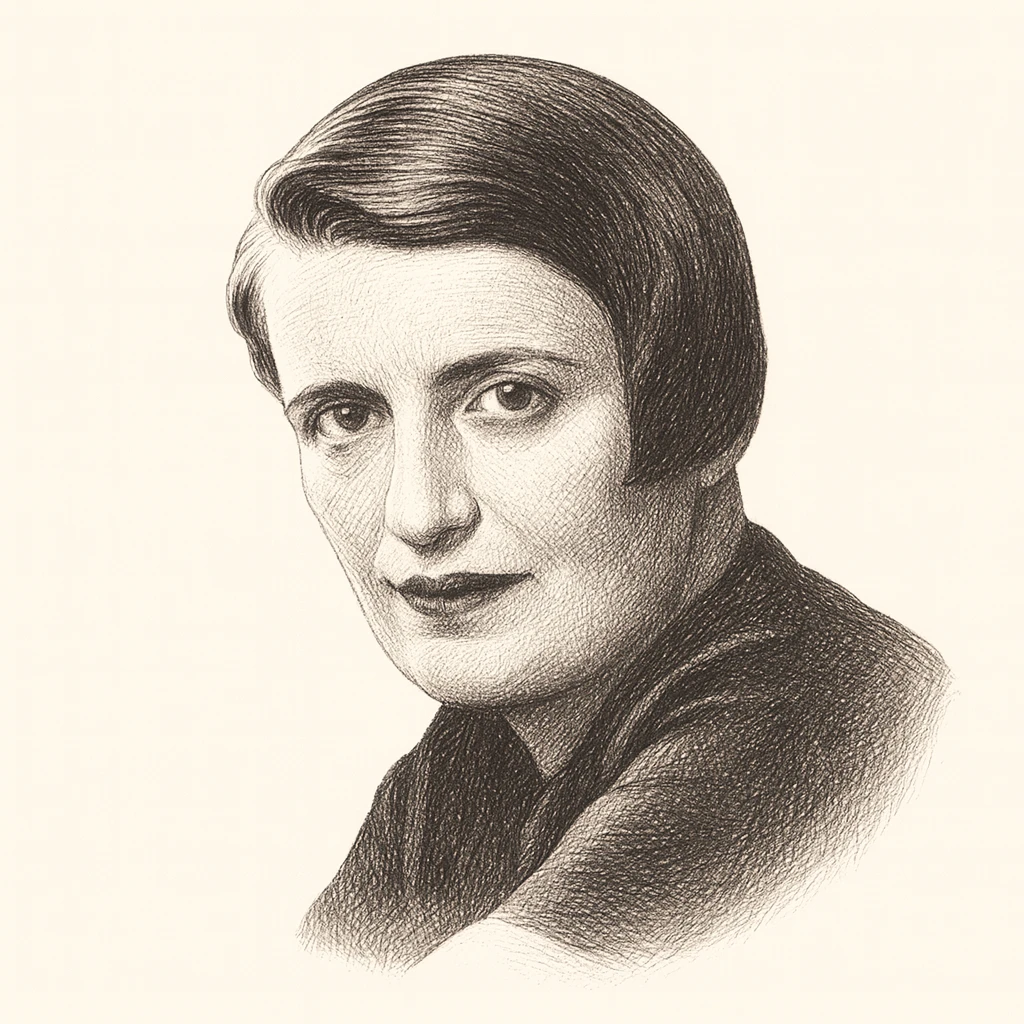
Ayn Rand is one of the most influential American political thinkers of the 20th century, a Russian-born novelist and philosopher whose two major novels and systematic philosophical framework shaped late 20th century American libertarian and conservative thought; academic philosophers have largely dismissed her work, while millions of readers have found it transformative. Her books have sold tens of millions of copies, are still read widely, and continue to influence how American libertarians, classical liberals, and parts of the conservative movement think about capitalism, individualism, the role of the state, and the moral foundations of political and economic life. Her reception reflects one of the deepest tensions in contemporary political thought: between academic philosophical standards that find her work reductive and unsophisticated, and popular political influence that has been undeniable and enduring.
Rand was born Alisa Zinovyevna Rosenbaum in 1905 in St. Petersburg, Russia, into a middle-class Jewish family whose pharmacy business was seized by the Bolsheviks when she was twelve. The experience of watching her family's livelihood confiscated by revolutionaries claiming to act in the name of collective welfare shaped her entire subsequent political philosophy. She studied at Petrograd State University, where she encountered Western literature and philosophy, and emigrated to the United States in 1926 at twenty-one, taking the name Ayn Rand and working her way into Hollywood as a screenwriter. By the 1930s she had begun publishing novels and developing the philosophical framework that would become known as Objectivism.
Her first major novel, We the Living (1936), was drawn from her experience of revolutionary Russia and established her central theme: the individual's struggle against collectivist political systems that sacrifice human beings to abstract ideals. Anthem (1938), a short dystopian novella, extended the theme into imagined futures. But it was her two mature novels that made her reputation and shaped her influence. The Fountainhead (1943) told the story of an idealistic architect named Howard Roark who refuses to compromise his artistic integrity for popular acceptance or institutional approval, and who is persecuted by a society that cannot tolerate genuine individual achievement. Atlas Shrugged (1957), her longest and most important work, imagined what would happen if the productive individuals who keep civilization running decided to go on strike against a society that treated their productivity as a resource to be taxed and redistributed at the whim of politicians and bureaucrats. The novel combined plot with extensive philosophical speeches, including a sixty-page address by the character John Galt that laid out the full Objectivist philosophical system in fictional form.
Rand's philosophical system, which she called Objectivism, combined metaphysical realism (reality exists independently of human consciousness), epistemological rationalism (reason is the only reliable source of knowledge), ethical egoism (rational self-interest is the foundation of morality), and political laissez-faire capitalism (the only just economic system is one in which all relationships are voluntary exchanges between consenting individuals). She developed these positions in a series of nonfiction books and essays during the 1960s and 1970s, including The Virtue of Selfishness (1964) and Capitalism: The Unknown Ideal (1966). Her distinctive philosophical contribution was the argument that altruism — the doctrine that moral action requires sacrificing one's own interests for the sake of others — was not merely mistaken but actively destructive to human life and dignity. Genuine morality, Rand argued, required rational self-interest: the recognition that each person's life is their own highest value and that achieving one's own genuine well-being through productive work and voluntary trade was both morally and politically the right foundation for human society.
Academic philosophers have generally been dismissive of Rand's philosophical work. The standard complaints are that her arguments are rhetorically forceful but logically loose, that her engagement with the history of philosophy is shallow and tendentious, that her caricatures of opposing views (particularly Kant, whom she attacked bitterly without any evidence of having read him carefully) misrepresent the positions she is critiquing, and that her philosophical system is essentially a restatement of classical liberal and Aristotelian themes in dramatic fictional form rather than an original philosophical contribution. Much of this criticism is accurate. Rand's work does not meet the standards of systematic rigor that academic philosophy demands, and her specific arguments are often weaker than more careful formulations of similar positions by thinkers like Nozick or Hayek.
But the academic dismissal misses what Rand actually accomplished. Her influence came through fiction as much as through philosophy, and the power of her novels to shape political and moral sensibilities has been extraordinary. Generations of American readers have encountered Atlas Shrugged in their teens or twenties and come away convinced that individual achievement, free markets, and resistance to collectivist political pressures were morally central in ways they had never been taught to consider. Her influence on American libertarianism is difficult to overstate. Alan Greenspan, the longtime chair of the Federal Reserve, was part of Rand's inner circle in the 1950s and credited her with shaping his economic thinking. Paul Ryan, the Speaker of the House in the 2010s, cited Atlas Shrugged as a formative influence. The entire contemporary American libertarian movement treats Rand as one of its foundational figures, even when its academic wing finds her work philosophically embarrassing. And her popular reach continues: Atlas Shrugged sells hundreds of thousands of copies every year, more than sixty years after publication, and remains one of the most widely read political novels in American history.
Rand's personal life and the movement she built around herself have also shaped her legacy in ways that continue to affect how her work is received. She gathered a small group of devoted followers in the 1950s and 1960s who treated her as an oracle, including the young Alan Greenspan and the psychologist Nathaniel Branden, with whom she had an extended affair that eventually destroyed their collaboration and led to bitter public recriminations. The Objectivist movement she founded split repeatedly after her death in 1982, with competing organizations claiming to represent her true legacy. The economist Murray Rothbard wrote in his 1972 essay "The Sociology of the Ayn Rand Cult" that the main qualification for advancement in her movement was "absolute loyalty to and adoration of the guru," and that any slight difference in wording could be attacked as deviation from the Randian position. Her defenders have treated these criticisms as ad hominem distractions from the substance of her arguments.
Rand died in 1982 at seventy-seven in New York City, having spent her final years continuing to write philosophical essays and correspond with her followers. Her legacy remains contested, and the gap between her academic reputation and her popular influence continues to reflect deep tensions in how contemporary intellectual life evaluates political thinking that operates outside academic frameworks but reaches mass audiences. Her absence from most academic political philosophy syllabi sits alongside her continuing presence on the bookshelves of libertarians, entrepreneurs, and conservative intellectuals across the English-speaking world.
Ayn Rand is associated with Traditional Libertarian. See the archetype