
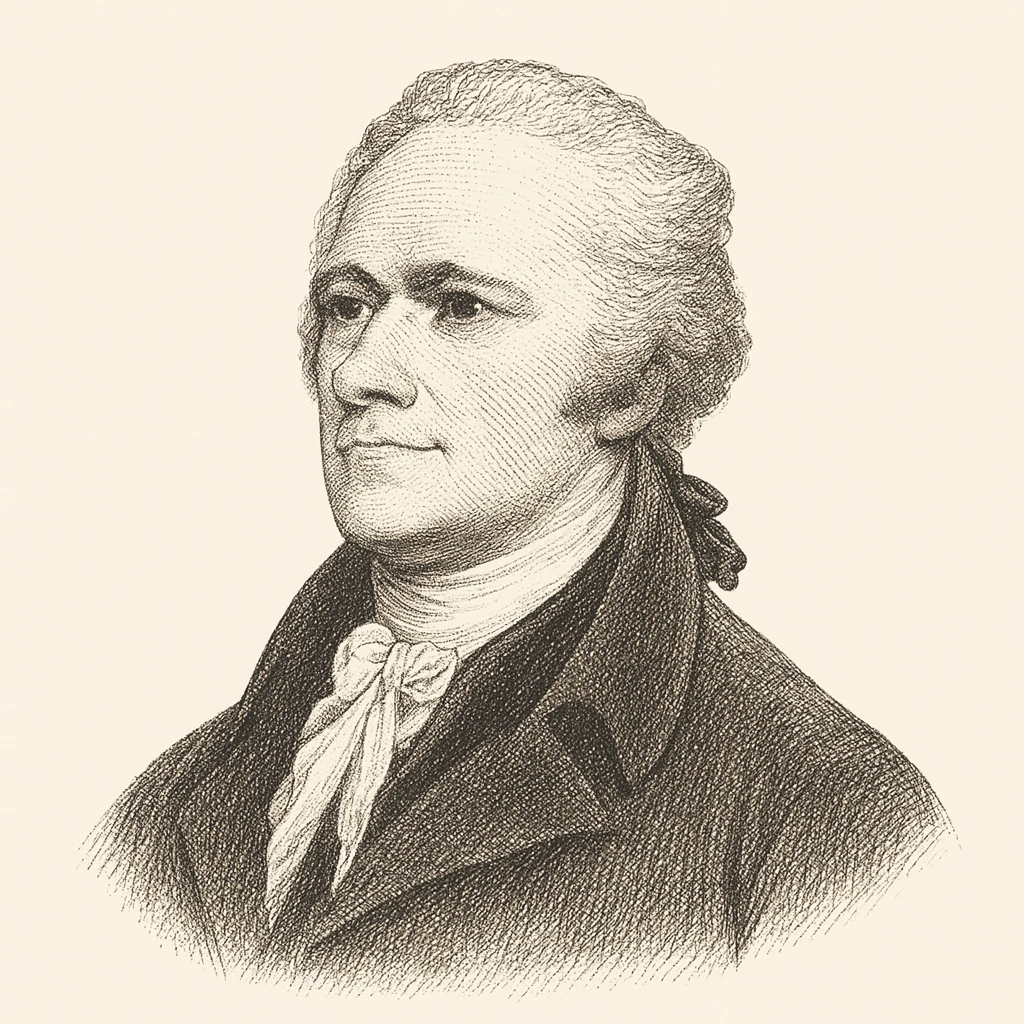
Alexander Hamilton was the most intellectually consequential defender of strong national government in the founding generation of the United States, a figure whose political philosophy, constitutional theory, and practical architecture of early American financial and administrative institutions shaped one half of the fundamental tension that still runs through American political life. Where Jefferson argued for agrarian decentralization, limited federal power, and suspicion of commercial and financial elites, Hamilton argued for a vigorous national government, energetic executive leadership, commercial and manufacturing development, and the integration of the United States into the broader Atlantic economic order. Contemporary debates about federalism, executive power, economic policy, and the proper scope of national government all run through the Hamilton-Jefferson debate that the founding generation bequeathed to their successors.
Hamilton was born in 1755 or 1757 (sources differ) on the Caribbean island of Nevis, into circumstances that were unusual for a founding father. His parents were not legally married, his father abandoned the family when Hamilton was a child, and his mother died when he was eleven, leaving him an orphan of illegitimate birth in a small colonial society that offered few prospects for someone in his situation. He worked as a clerk for a trading firm in St. Croix, showed such precocious ability that his employers and local supporters raised money to send him to the American colonies for an education, and arrived in New York in 1772 at seventeen to attend what would become King's College (now Columbia University). Within three years he had dropped out to join the revolutionary cause, serving as an artillery officer and then as George Washington's aide-de-camp throughout most of the Revolutionary War. Washington became his lifelong mentor and political patron, and Hamilton's rise from obscurity to the center of American political life was one of the most remarkable careers in the founding generation.
After the war, Hamilton practiced law in New York, served in the Continental Congress, and became convinced that the Articles of Confederation under which the American states were operating were fundamentally inadequate and had to be replaced with a stronger national framework. He was one of the key organizers of the Constitutional Convention of 1787, though his own proposals at the convention were more centralizing than what the delegates eventually adopted — Hamilton had argued for a presidency for life and a Senate whose members would serve during good behavior, proposals that the other delegates found too close to monarchy. When the Constitution was finally drafted, Hamilton threw himself into the ratification fight and collaborated with James Madison and John Jay on what would become The Federalist Papers, a series of eighty-five essays defending the proposed Constitution to the New York public. Hamilton wrote fifty-one of the eighty-five essays himself, more than Madison and Jay combined, and several of his contributions rank among the most important works of American constitutional theory ever written.
Hamilton's theoretical contributions in the Federalist focused particularly on the necessity of energetic national government and the design of the executive branch. Federalist 70 is his most famous contribution, defending the unified presidency against those who wanted a plural executive or a weaker executive branch. "Energy in the executive," Hamilton wrote, "is a leading character in the definition of good government." He argued that unity, duration, adequate provision for support, and competent powers were all necessary for the presidency to perform its constitutional functions, and his arguments shaped how later generations understood presidential power within the American constitutional framework. Federalist 78 developed the doctrine of judicial review, arguing that federal courts had the authority and responsibility to declare unconstitutional legislation void — an argument that would later be cited by Chief Justice John Marshall in Marbury v. Madison (1803) when establishing judicial review as a foundational principle of American constitutional practice.
Hamilton's most consequential practical work came during his service as the first Secretary of the Treasury under Washington from 1789 to 1795. In that role, he designed the basic architecture of American economic and financial policy: the federal assumption of state debts from the Revolutionary War, the establishment of a national bank, the funding of the federal debt through bond issues, the creation of a national currency, the encouragement of manufacturing through protective tariffs, and the integration of the United States into international financial markets. These policies were controversial at the time and became the focus of the early American partisan divide between Hamilton's Federalists and Jefferson's Democratic-Republicans, but they laid the institutional foundations for American economic development over the following century. Hamilton's Report on Manufactures (1791) was the first systematic American argument for the use of national economic policy to promote industrial development, and it remained an influential framework for American economic nationalism into the 20th century.
Hamilton's political career ended abruptly in 1804 when he was killed in a duel with Aaron Burr, the sitting Vice President of the United States, who had challenged him over political insults Hamilton had made during the bitter partisan fighting of the early Republic. Hamilton accepted the duel but reportedly did not intend to shoot Burr, and whether he actually fired his gun remains disputed. Burr's shot struck Hamilton in the abdomen, and he died the next day at forty-seven or forty-nine, leaving behind his wife Elizabeth, their seven surviving children, and a political legacy that would take nearly two centuries to be fully appreciated.
For most of American history, Hamilton was the less celebrated of the major founders. Jefferson and Jackson shaped 19th century American political rhetoric, the Civil War was fought partly over the state-centered framework Jefferson had championed, and Hamilton's elitism and pro-commercial politics fit uneasily with the democratic populism that dominated 19th and early 20th century American political culture. His reputation has recovered substantially in recent decades, particularly after the success of Lin-Manuel Miranda's 2015 musical made him a household name once again, and contemporary scholarship has rediscovered the sophistication of his constitutional theory, the prescience of his economic nationalism, and the depth of his influence on the American political tradition. He remains one of the most important theoretical defenders of vigorous national government in American political thought, and his influence continues to shape contemporary debates about the proper role of the federal government in American economic and political life.
Alexander Hamilton is associated with Moderate Conservative. See the archetype