
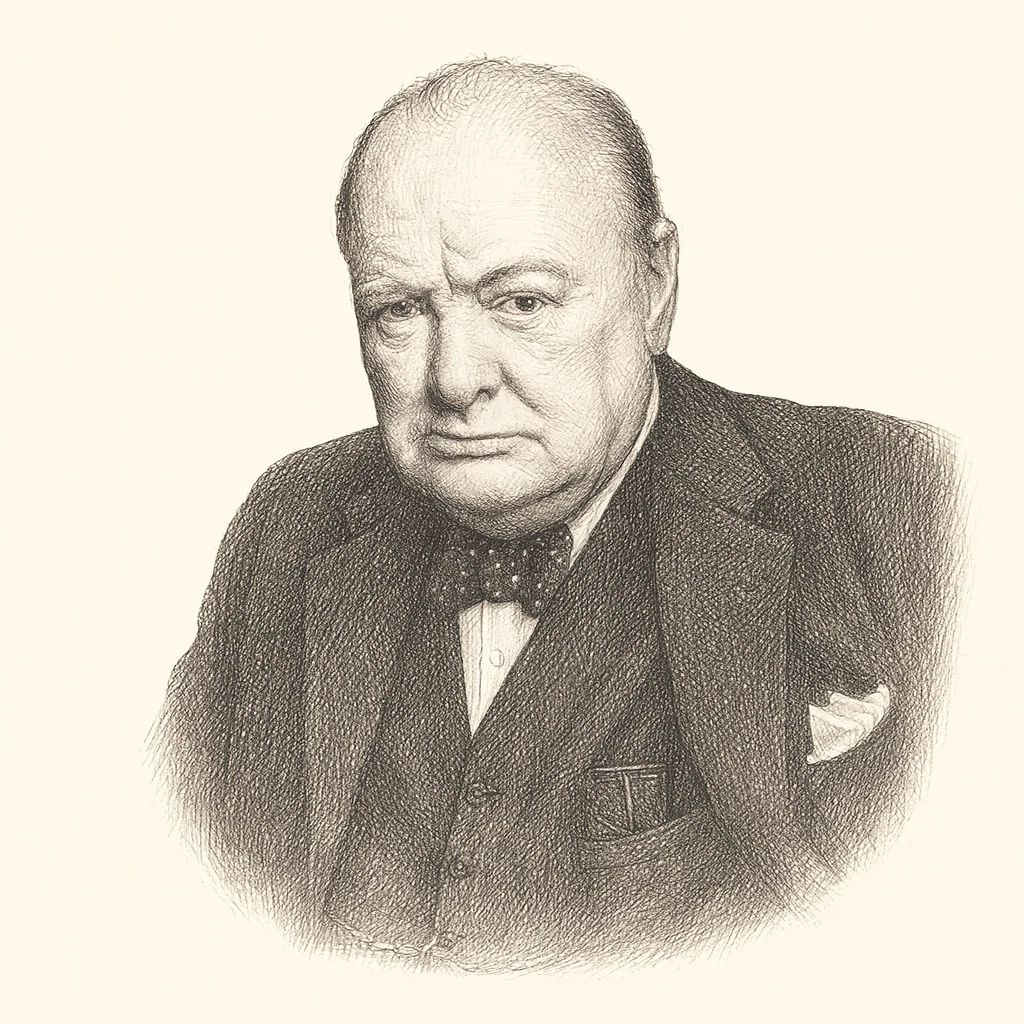
Winston Churchill was a British statesman, soldier, and writer who served as Prime Minister during World War II, rallying his nation against Nazi Germany when defeat seemed certain. Born to an aristocratic family, Churchill had a long political career spanning both major parties, holding numerous cabinet positions before his 'wilderness years' of the 1930s. He crossed the floor from the Conservatives to the Liberals and back again, and as a Liberal minister before the First World War he helped advance early social-insurance measures, while remaining a committed free-trader. As Chancellor of the Exchequer in the 1920s he returned Britain to the gold standard, a decision John Maynard Keynes attacked in The Economic Consequences of Mr. Churchill (1925), arguing that it overvalued sterling and would bring unemployment and industrial unrest.
During the 1930s Churchill argued against the policy of appeasement and called for British rearmament, a message few in politics wanted to hear until the Munich crisis of 1938. His warnings about Hitler went unheeded until the outbreak of war. Becoming Prime Minister in May 1940 as France fell, he offered only 'blood, toil, tears and sweat' but refused to negotiate. His speeches, among them 'We shall fight on the beaches' and 'Their finest hour,' steeled British resolve during the Blitz and inspired the free world.
After the war Churchill turned his warnings eastward. At Fulton, Missouri, in 1946 he declared that an 'iron curtain' had descended across the Continent, warned of the danger from Soviet power, and called for a 'special relationship' between the British Commonwealth and the United States.
He was also an unapologetic imperialist. He resisted Indian self-government, and his imperial policies contributed to suffering in India and elsewhere; the Bengal famine of 1943 occurred under his wartime government. He lost the 1945 election, returned as PM in 1951, and won the 1953 Nobel Prize in Literature 'for his mastery of historical and biographical description as well as for brilliant oratory in defending exalted human values.' His writings include a multi-volume history of the Second World War.
Winston Churchill is associated with National Conservative. See the archetype