
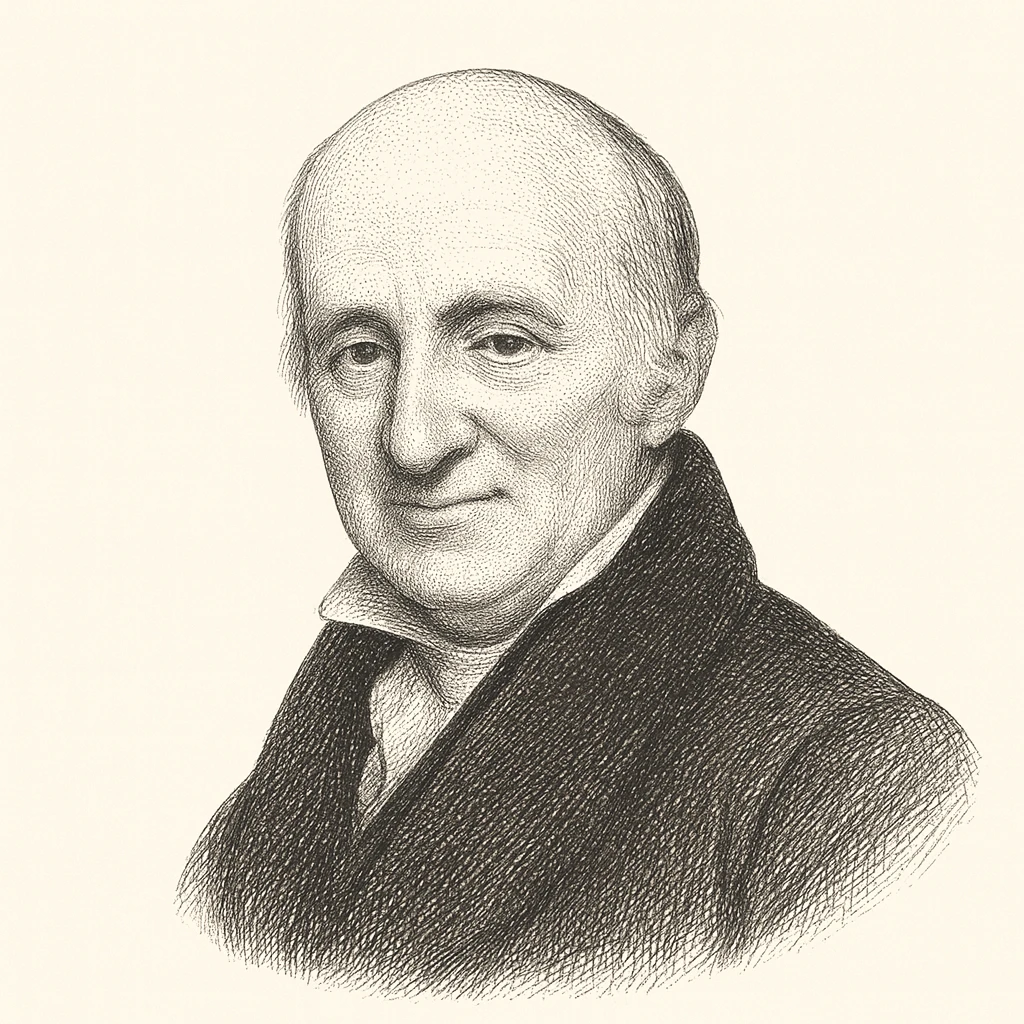
William Godwin was born in 1756 in Wisbech, Cambridgeshire, the son of a Calvinist dissenting minister, and was educated in the rigorous dissenting tradition that produced many of the most intellectually serious radicals of the eighteenth century. He trained for the ministry, served as a minister for a few years, and then lost his faith -- gradually and thoroughly, moving through Socinianism toward deism toward a kind of secular rationalism that retained the ethical seriousness of his religious formation without its theological content. He arrived in London in 1783, having abandoned the ministry, and began building a career as a journalist, novelist, and political philosopher.
Inquiry Concerning Political Justice (1793) was the work that made him the most celebrated radical intellectual in England. It appeared in January 1793, at the height of the debate over the French Revolution, and stated a position more radical than any of the major participants in that debate had ventured: that government itself -- not despotic government or corrupt government, but government as such, as the organization of coercive authority over human beings -- was incompatible with the full development of human reason and virtue, and that its gradual abolition was both desirable and inevitable.
The argument was rational rather than romantic. Godwin was not celebrating primitive spontaneity or natural emotion; he was a thoroughgoing rationalist who believed that human beings were capable of governing their lives by reason if the institutions that corrupted their development were removed. His target was not merely political despotism but all the mechanisms by which established power preserved itself -- law, property, organized religion, marriage, and the institution of government that protected all of them. Each of these was a system of coercion that prevented individual reason from developing to its natural perfection; each would eventually be superseded as reason progressed.
His political economy was as radical as his political theory. He anticipated later socialist arguments against the institution of property -- not because property was unnatural but because the particular property arrangements of his time concentrated resources in the hands of those who produced nothing while those who produced everything received only subsistence. He was not, however, a communist: he favored individual possession of modest property sufficient for genuine independence, while opposing the great concentrations of wealth that enabled the rich to live off the labor of others without contributing anything.
His private life was as unconventional as his philosophical positions. He married Mary Wollstonecraft in 1797, after she became pregnant with their child, though both of them regarded conventional marriage as an institution they had argued against in print. Wollstonecraft died of puerperal fever eleven days after giving birth to their daughter Mary -- who would become Mary Shelley and write Frankenstein. Godwin was devastated, published Wollstonecraft's posthumous Vindication of the Rights of Woman, which she had left incomplete, wrote her biography with the unsparing honesty that his philosophy required even when it exposed details that shocked his contemporaries, and raised their daughter alongside the children from Wollstonecraft's previous relationship with Gilbert Imlay.
His influence was extraordinary in his own time and largely subterranean afterward. Wordsworth, Coleridge, Southey, and the early Romantic poets absorbed his ideas and then retreated from them as the Terror and Napoleon discredited radical politics. Shelley, his son-in-law, remained a committed Godwinian anarchist and transmitted his ideas into the Romantic tradition in a form that survived. Robert Owen's socialism was shaped by Godwinian rationalism. And when Proudhon formulated systematic anarchism in 1840, he was working within a tradition that Godwin had largely established fifty years earlier, though without acknowledging the debt with full clarity.
He spent his later years running a publishing business -- Juvenile Library -- with his second wife, writing prodigiously but without the impact of his early work, and watching his ideas pass underground and resurface in forms he sometimes recognized and sometimes did not. He died in 1836, eighty years old, having lived long enough to see his daughter write one of the most important novels of the nineteenth century and his philosophy discredited, revived, discredited again, and preserved by its subterranean influence on the radical traditions that his more orthodox contemporaries thought they had defeated.
William Godwin is associated with Left Libertarian. See the archetype