
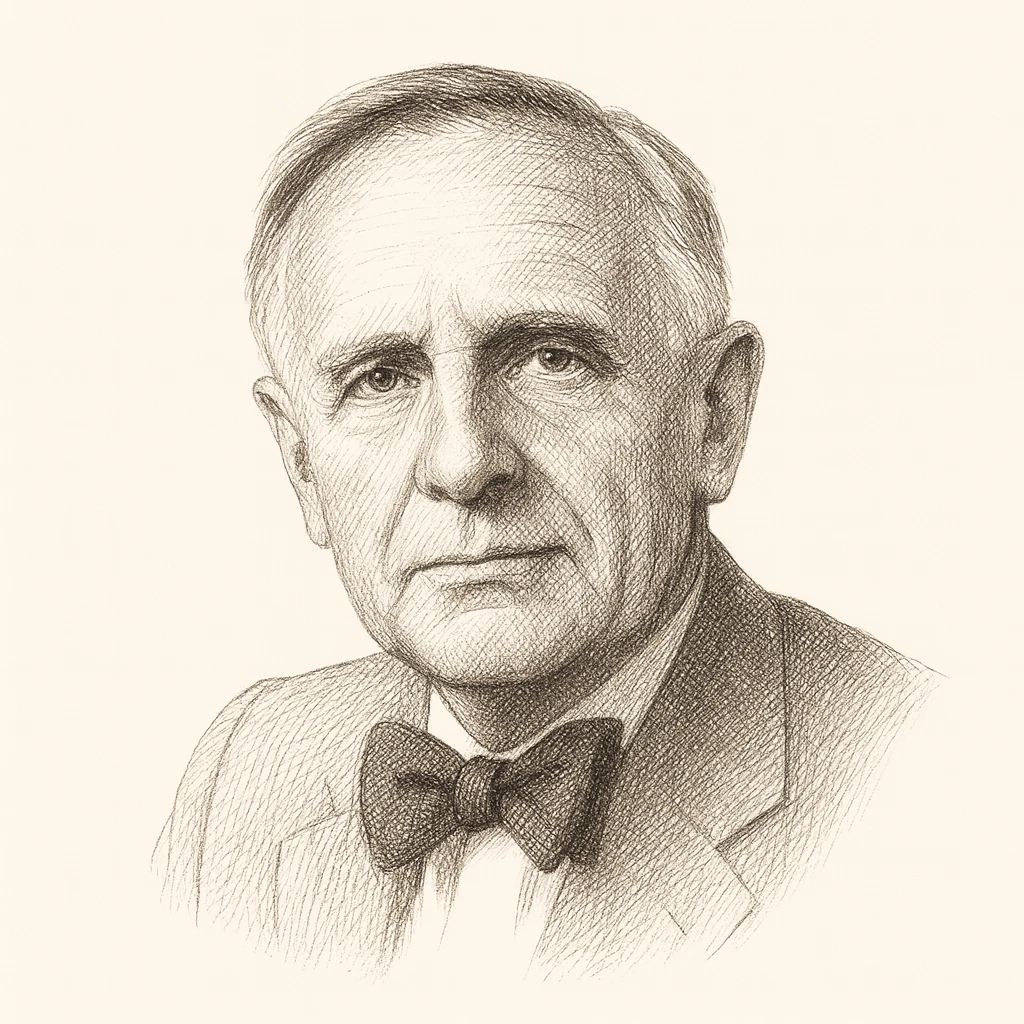
Wilhelm Röpke (1899–1966) was a German economist and one of the leading intellectual architects of the postwar tradition variously called ordoliberalism and the social market economy. Working in the orbit of the Freiburg School and alongside thinkers such as Walter Eucken and Alexander Rüstow, he argued that markets do not sustain themselves automatically but depend on a strong but limited state to establish and enforce a stable framework of rules—protecting competition, sound money, and property while resisting both laissez-faire drift and central planning. For Röpke, the essential political question was how to design institutions that keep economic power dispersed and prevent it from concentrating in either monopolies or the state.
Röpke's distinctive contribution was to embed this economic liberalism within a broader moral, social, and cultural critique. He worried that modern industrial capitalism, mass society, and bureaucratic collectivism eroded the human-scale communities, family life, and personal responsibility on which a free order ultimately rests. His notion of a "humane economy" called for decentralization, small property ownership, and the strengthening of local and intermediate institutions between the individual and the state. In this he drew on conservative and Christian humanist sensibilities as much as on liberal economics, making him a bridge figure between classical liberalism and cultural conservatism.
An early and outspoken critic of National Socialism, Röpke left Germany after the Nazis came to power and spent much of his career in exile, including a long period teaching in Switzerland. From this vantage he became an influential voice in transnational networks of liberal renewal, associated with efforts to rebuild a principled defense of the market economy in the mid-twentieth century. His ideas are widely credited with informing the postwar West German economic reforms associated with Ludwig Erhard, helping to give practical shape to the social market economy that combined competitive markets with a concern for social order.
Röpke's political thought continues to resonate among those who seek a middle path between unregulated capitalism and collectivism, emphasizing that economic freedom is inseparable from moral and civic foundations. He is invoked by ordoliberals, market-oriented conservatives, and communitarian critics of both socialism and libertarianism alike, precisely because he insisted that the health of a free economy depends on cultural and institutional conditions that markets themselves cannot supply.
Wilhelm Röpke is associated with Compassionate Libertarian. See the archetype