
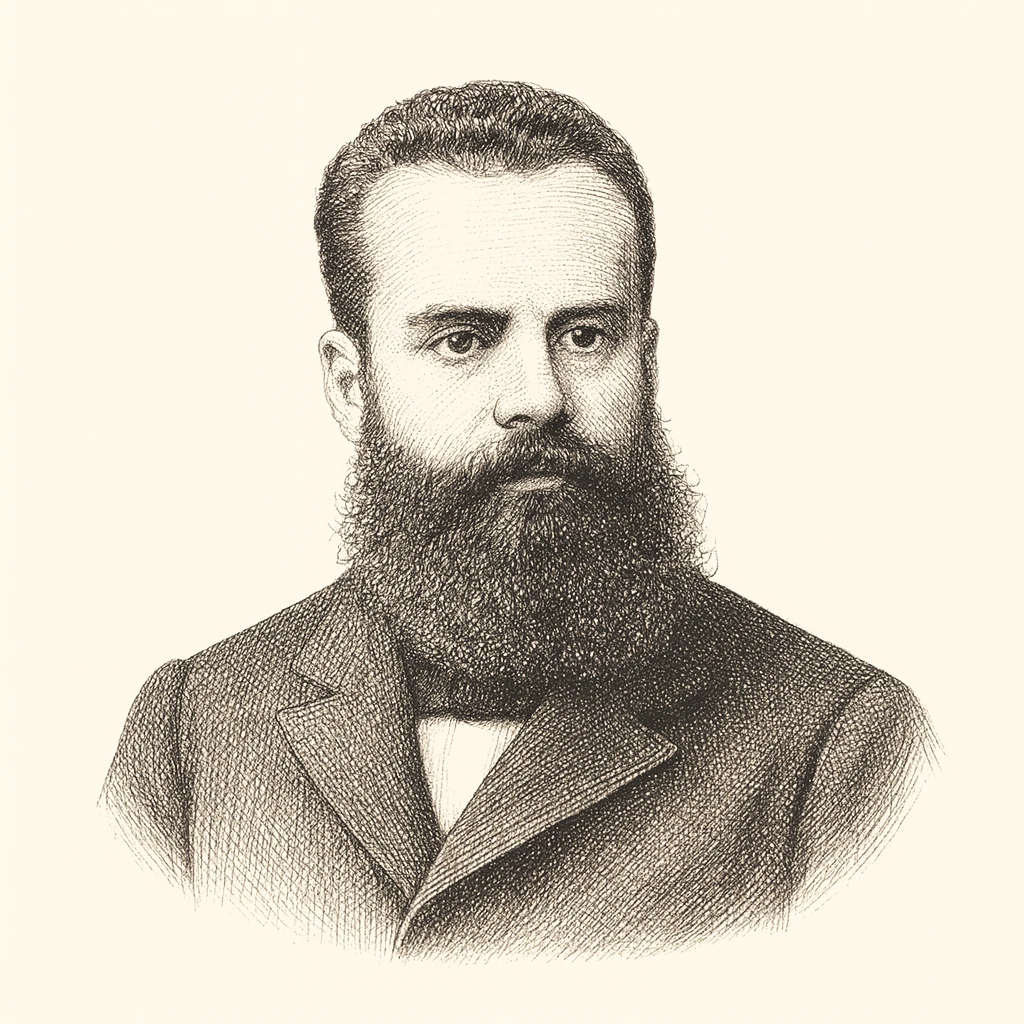
Vilfredo Pareto was born in 1848 in Paris, the son of a Genoese nobleman who had gone into exile for his liberal and Mazzinian politics, and a French mother. The family returned to Italy after amnesty in 1858, and Pareto was educated at the Polytechnic of Turin, studying engineering and mathematics with the rigor that would characterize his subsequent work in economics. He worked for twenty years as a civil engineer for the Italian railways and a Florentine iron company before entering academic life in his forties, having published enough on economic and social questions to attract Léon Walras's attention and eventually succeed him at Lausanne.
His early economics was orthodox and mathematical — he developed the concept of Pareto optimality, the condition in which no one can be made better off without making someone else worse off, that became a cornerstone of welfare economics, and the Pareto distribution, the observation that roughly 80 percent of consequences come from 20 percent of causes, that has been applied to income distributions, business outcomes, and a remarkable range of other phenomena. This mathematical precision coexisted with an increasingly acidic view of political life that he was developing in parallel: the more he studied social systems, the more convinced he became that the formal mechanisms of liberal democracy were a facade over the permanent reality of elite domination.
The turn from economics to sociology produced the Trattato di Sociologia Generale, published in Italian in 1916 and translated into English as The Mind and Society. It was a work of more than two thousand pages, written with a combination of mathematical precision about methodology and sardonic contempt for the ideologies it anatomized, and it advanced arguments that have never been entirely comfortable for any political tradition. Its central claims were: that most political and social action was governed by sentiment rather than rational calculation; that ideologies — what Pareto called "derivations" — were rationalizations that the sentiment-driven residues generated, changing their verbal form while the underlying emotional drives remained constant; and that all societies were in practice governed by elites, with the relevant question being not whether an elite ruled but what kind.
The elite theory was his most politically consequential contribution. Pareto distinguished between two types of elite: "lions" who ruled through force and direct assertion of power, and "foxes" who ruled through cunning, manipulation, and the manufacture of consent. Healthy societies required both: foxes who accumulated power through cleverness eventually faced decay and replacement by lions who would restore vitality through force, which in turn would be succeeded by another generation of foxes as the new order consolidated and softened. Democratic politics, in this account, was a phase of fox dominance — the management of populations through propaganda, economic incentives, and the manipulation of sentiment — that would eventually generate either decline or the assertion of a new leonine elite. This was not a prescription for fascism, but it provided a vocabulary that fascism found useful, and Mussolini, who had studied sociology at Lausanne, claimed Pareto as a teacher.
He lived to see the March on Rome in 1922 and expressed qualified approval — not as a fascist ideologue but as someone who thought that the leonine reaction against fox decadence was inevitable and that Mussolini at least had the virtue of clarity about what he was doing. He died in 1923, shortly after accepting an appointment as Italian delegate to the League of Nations that the new Fascist government had offered him — an appointment that Mussolini found politically useful as evidence of intellectual respectability. His endorsement of fascism, however qualified and however rooted in his general theory rather than its specific ideology, damaged his posthumous reputation.
What endured was the elite theory, which proved far more durable than either his supporters or his critics anticipated. His analysis that all political systems were governed by minorities who circulated through history, that ideologies were rationalizations rather than drivers of political change, and that the distinction between lions and foxes captured something real about the different strategies through which elites maintained power — these insights were absorbed into political science, sociology, and political commentary in ways that operated independently of any specific political program. The concept of the "elite" as the relevant unit of political analysis, and the circulation of elites as the engine of political change, runs through twentieth-century political thought from Burnham's Managerial Revolution to Gaetano Mosca's political class to the contemporary social scientific literature on oligarchy and elite capture of democratic institutions.
Vilfredo Pareto is associated with National Populist. See the archetype