
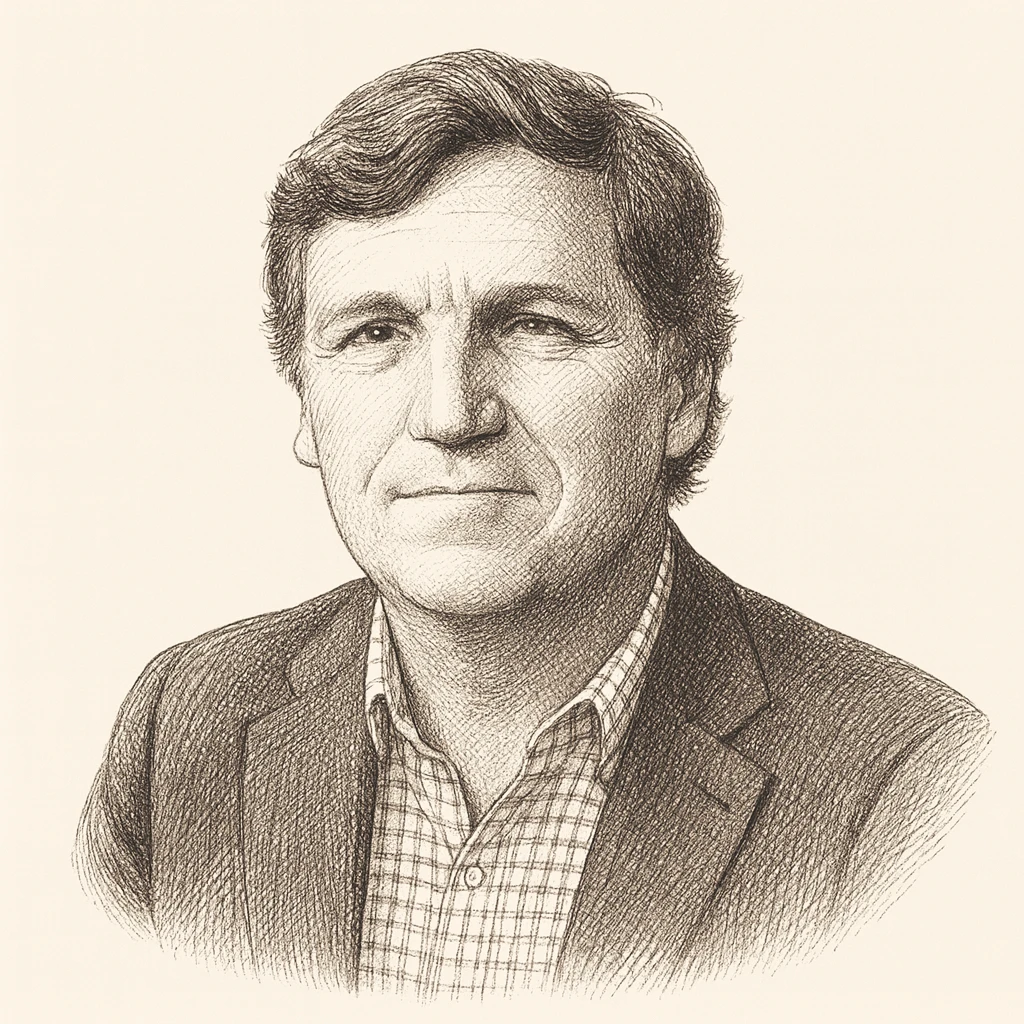
Tucker Carlson is an American journalist and commentator who became one of the most prominent voices of the American right in the twenty-first century. He began his career in print journalism and moved through cable news, co-hosting programs on CNN and MSNBC before hosting a widely watched prime-time program on Fox News for several years. After his departure from Fox, he continued producing commentary through his own online and social media ventures, maintaining a large audience independent of traditional broadcast networks.
Carlson's political thought is associated with a nationalist and populist reorientation of American conservatism, often described as part of the broader realignment on the right during and after the Donald Trump era. He has argued that the interests of ordinary working- and middle-class Americans have been subordinated to those of a cosmopolitan governing class, encompassing both political parties, large corporations, and cultural institutions. In this framing he has criticized free-trade orthodoxy, mass immigration, and foreign military interventions, positions that mark a departure from the free-market, internationalist consensus that dominated the Republican Party in earlier decades. This economic populism, combined with cultural traditionalism and skepticism toward established institutions, places him within a strain of thought sometimes labeled national conservatism.
His influence lies less in systematic theory than in his ability to frame and popularize arguments for a mass audience, translating academic and intellectual currents on the populist right into accessible television and media commentary. In 2021 the Anti-Defamation League called on Fox News to fire him after on-air remarks it said promoted the "great replacement" theory, and his commentary on race, immigration, and demographic change has drawn sustained controversy. Supporters see him as a rare mainstream figure willing to challenge bipartisan orthodoxies on war, trade, and the power of institutions. Either way, he functions as a significant node in contemporary right-wing discourse, shaping how a large segment of the public frames questions of national identity, elite accountability, and America's role in the world.
Tucker Carlson is associated with National Populist. See the archetype