
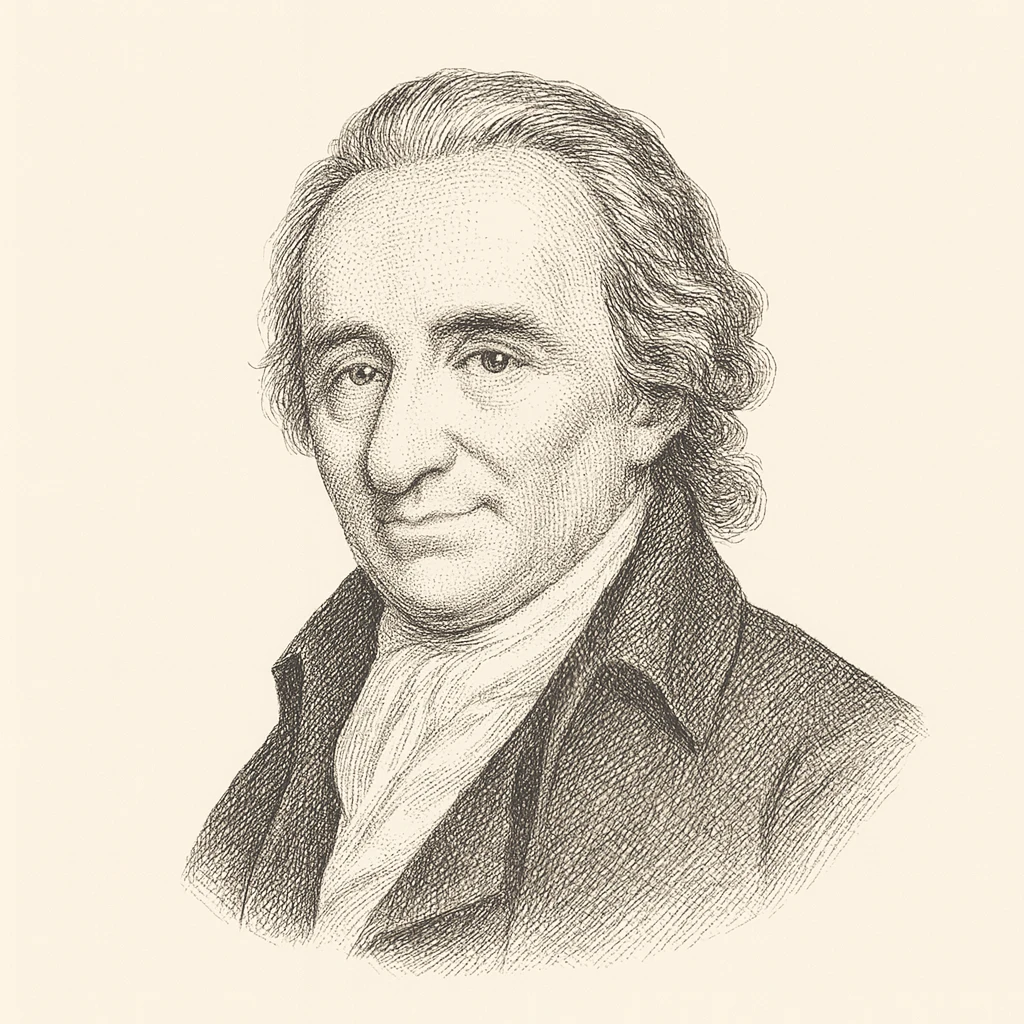
Thomas Paine was the most politically consequential writer of the late 18th century, a self-taught English staymaker who arrived in America at thirty-seven, wrote one pamphlet that changed the course of the American Revolution, returned to Europe, wrote another pamphlet that nearly got him killed during the French Revolution, and spent his final years in obscurity and poverty, rejected by both countries he had helped liberate. His prose was plainer, angrier, and more accessible than any political writing that had come before, and it made democratic republican ideas available to audiences who had never been expected to participate in political debate at all.
Paine was born in Thetford, England in 1737, the son of a Quaker corset-maker. He received a basic education, worked as a staymaker, failed at several careers, and at thirty-seven decided to emigrate to the American colonies. He arrived in Philadelphia in late 1774 with letters of introduction from Benjamin Franklin, found work as a journalist, and within a year was watching colonial discontent with British rule escalate toward open conflict. In January 1776, he published Common Sense, a forty-seven-page pamphlet arguing not for redress of colonial grievances but for outright independence from Britain and the creation of a democratic republic. The pamphlet sold an estimated 500,000 copies in a colonial population of roughly three million, making it proportionally one of the most widely read political documents in American history. It did more than any other single text to transform colonial discontent into a revolutionary movement, and it gave the American Revolution its philosophical justification in terms anyone could understand.
Common Sense worked because Paine refused to write in the Latinate, classical style that marked serious political argument in his era. He wrote in plain English, with short sentences, vivid metaphors, and a directness that his more educated contemporaries found shocking. "Society in every state is a blessing, but government even in its best state is but a necessary evil." "These are the times that try men's souls." "The cause of America is in a great measure the cause of all mankind." Lines like these did not sound like political philosophy to readers trained on Cicero and Locke, and that was precisely the point. Paine's argument was that political questions belonged to ordinary people, that ordinary language could carry them, and that the British monarchical tradition of deference to inherited authority was a superstition that free men should shake off.
Paine served briefly in the Continental Army during the Revolution and published a series of Crisis pamphlets that Washington had read aloud to his troops at Valley Forge to sustain morale. After the war ended, he returned to Europe and found himself in the middle of another revolution. The French Revolution broke out in 1789 and immediately provoked Edmund Burke's famous conservative critique, Reflections on the Revolution in France. Paine's response, Rights of Man (1791-1792), was the most widely read defense of the French Revolution in the English-speaking world and a systematic argument for democratic republicanism against Burke's defense of inherited institutions. The book sold hundreds of thousands of copies across Britain, was banned, and got Paine charged with seditious libel. He fled to France before he could be arrested.
In France, Paine was initially welcomed as a revolutionary hero, granted French citizenship, and elected to the National Convention. But his moderation made him enemies among the Jacobins. He opposed the execution of Louis XVI. He was arrested during the Terror, imprisoned for nearly a year, and barely escaped the guillotine. While in prison he wrote The Age of Reason (1794-1796), a deist attack on organized Christianity that would destroy his reputation in America almost as thoroughly as it had been destroyed in Britain. When he finally returned to America in 1802, he found that his religious views had made him a pariah even among the people who had once read Common Sense. He died in 1809 in New York, largely forgotten, buried on his farm because no church would accept him.
His rehabilitation took most of the 19th century. By the end of that century Paine was being read again as a foundational figure of democratic political thought, and his influence on later democratic and radical traditions is difficult to overstate. His insistence that political questions belong to ordinary people in ordinary language remains one of the most democratic commitments in the history of political writing.
Thomas Paine is associated with Civil Libertarian. See the archetype