
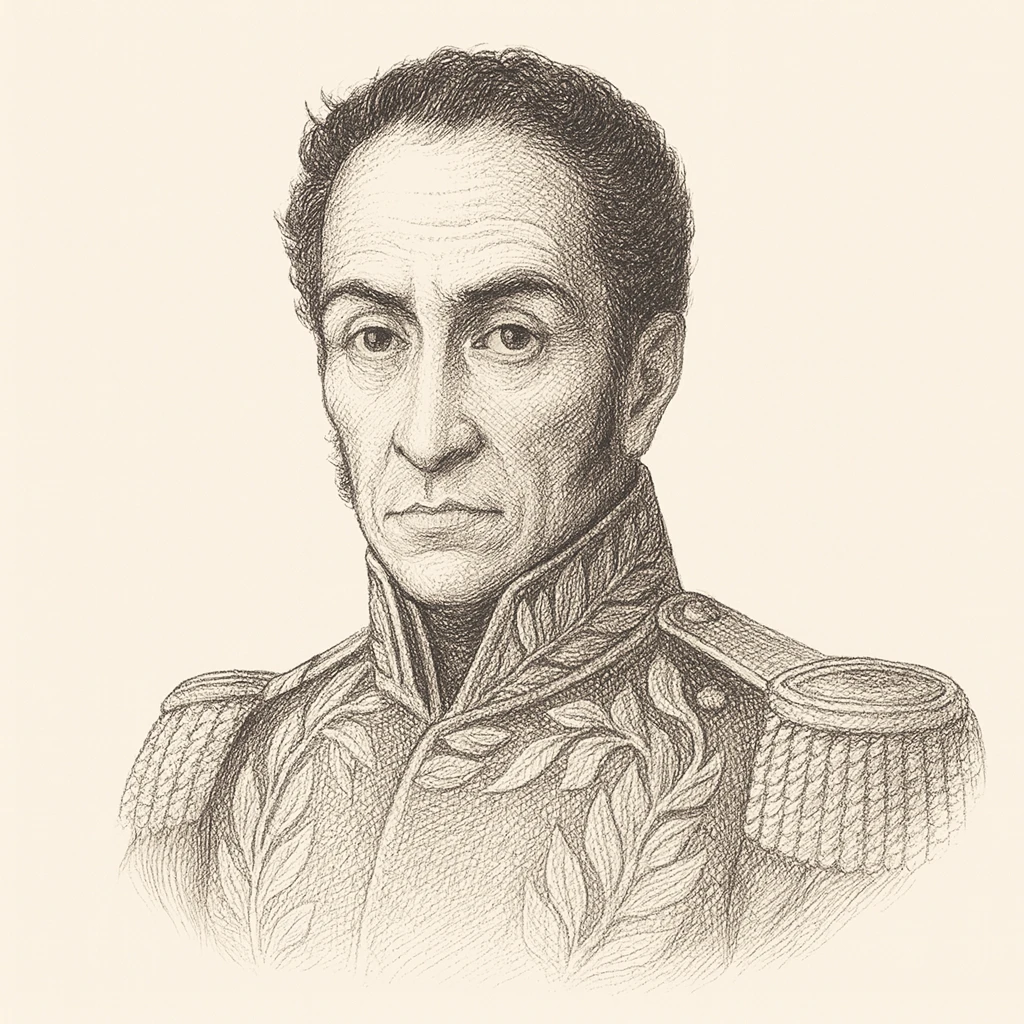
Simón Bolívar was the 'Liberator' of South America, who led the wars that freed six nations from Spanish colonial rule. Born to Venezuelan aristocracy, Bolívar was educated in Europe, where Enlightenment ideas and Napoleon's example shaped his revolutionary ambitions.
Bolívar's military campaigns included crossing the Andes and defeating Spanish forces across Venezuela, Colombia, Ecuador, Peru, and Bolivia (named for him). He had a leading role in the independence of Venezuela, Colombia, Ecuador, and Peru, and a part in the founding of Bolivia and Panama. In 1813 he issued the Decree of War to the Death, declaring that Spaniards and Canary Islanders who did not actively support independence would be killed. His vision extended beyond liberation to continental unity—Gran Colombia united Venezuela, Colombia, Ecuador, and Panama under his leadership.
Bolívar's political philosophy combined republican ideals with authoritarian tendencies. He believed Latin America needed strong executive power to prevent chaos. In writings such as the Cartagena Manifesto and the Jamaica Letter, he argued that the wars had failed partly because they imitated foreign models, especially federalism, that were unsuited to peoples with no experience of self-government. He judged that centuries of colonial rule had left the population unprepared for pure democracy, and that stability required concentrated authority rather than the dispersal of power. In his Angostura Address he proposed a hereditary senate and a powerful president, drawing on his admiration for the British constitution; the constitution he drafted for Bolivia went further, providing for a president serving for life with the power to name a successor.
Francisco de Paula Santander, his vice-president in Gran Colombia, led the liberal opposition to strengthening presidential authority. In 1828, amid mounting disorder, he assumed dictatorial powers and survived an assassination attempt in Bogotá, after which Santander was implicated and exiled. Haiti's president Alexandre Pétion had given him money and weapons, and in his addresses at Angostura and to Bolivia's constituent congress he called for the abolition of slavery.
Gran Colombia collapsed amid regional rivalries; Bolívar's dream of continental federation died with him. In an 1830 letter to Juan José Flores he wrote that 'he who serves a revolution plows the sea.' He is commemorated as the Liberator across the countries he freed, and his vision of Latin American unity is still invoked by leaders across the political spectrum. In Venezuela, Hugo Chávez named his political movement after him, and the 1999 constitution renamed the country the Bolivarian Republic of Venezuela.
Simón Bolívar is associated with Classical Liberal. See the archetype