
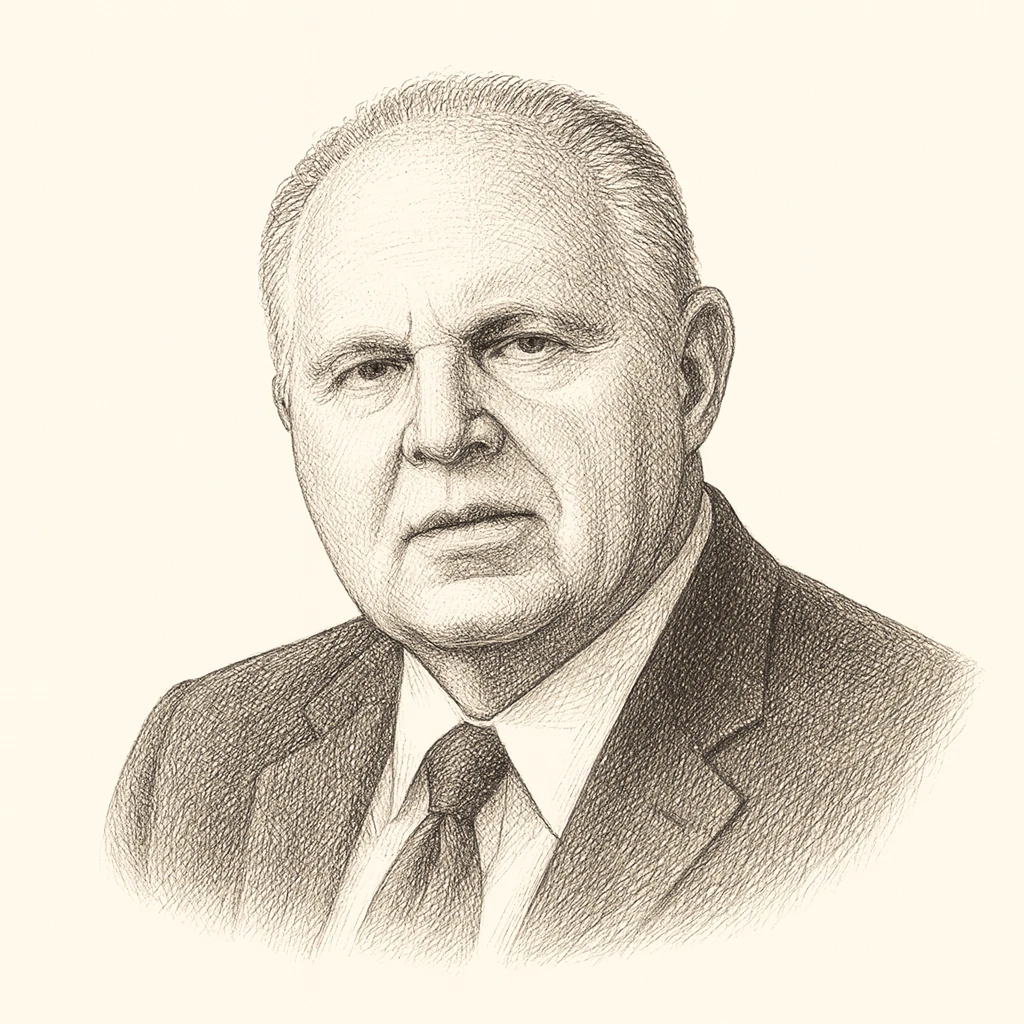
Rush Limbaugh was the dominant figure in American conservative talk radio for more than three decades, and his nationally syndicated program, launched in the late 1980s, effectively created the format's mass audience. His rise coincided with the deregulation of broadcasting and the disappearance of the Fairness Doctrine, and he demonstrated that unabashedly partisan opinion could command enormous listenership. In doing so he built an entire ecosystem of imitators and helped make talk radio a central organ of the American right.
Limbaugh's political thought was less a systematic philosophy than a sustained populist argument: that a coastal, liberal establishment—concentrated in the news media, universities, government bureaucracy, and Hollywood—held cultural power out of proportion to ordinary Americans and treated conservative, religious, and working-class citizens with contempt. He fused free-market economics, hostility to taxation and regulation, strong nationalism, and cultural traditionalism into a combative style that treated politics as a running conflict against internal elites. He popularized derisive coinages and framings—mocking feminism, environmentalism, and multiculturalism—that shaped a generation of conservative rhetoric and made adversarial media a marker of movement loyalty.
His influence ran deep in Republican politics. He is widely credited with helping mobilize the base behind the 1994 Republican congressional gains, and his approach anticipated the grievance-driven populism that later defined the Tea Party and the Trump era; he received the Presidential Medal of Freedom in 2020. He left a long record of statements attacked as racist, sexist, and inflammatory, and his style was blamed for coarsening public debate and rewarding outrage over deliberation. Supporters countered that he gave voice to Americans who felt unheard by institutions dominated by the left.
Whether regarded as a tribune of the forgotten or a purveyor of division, Limbaugh reshaped how mass audiences consume political argument. He proved that ideology could be entertainment, that media could be openly tribal, and that a single broadcaster could function as a movement's agenda-setter—an insight that migrated into cable news, podcasting, and the broader architecture of partisan media.
Rush Limbaugh is associated with National Conservative. See the archetype