
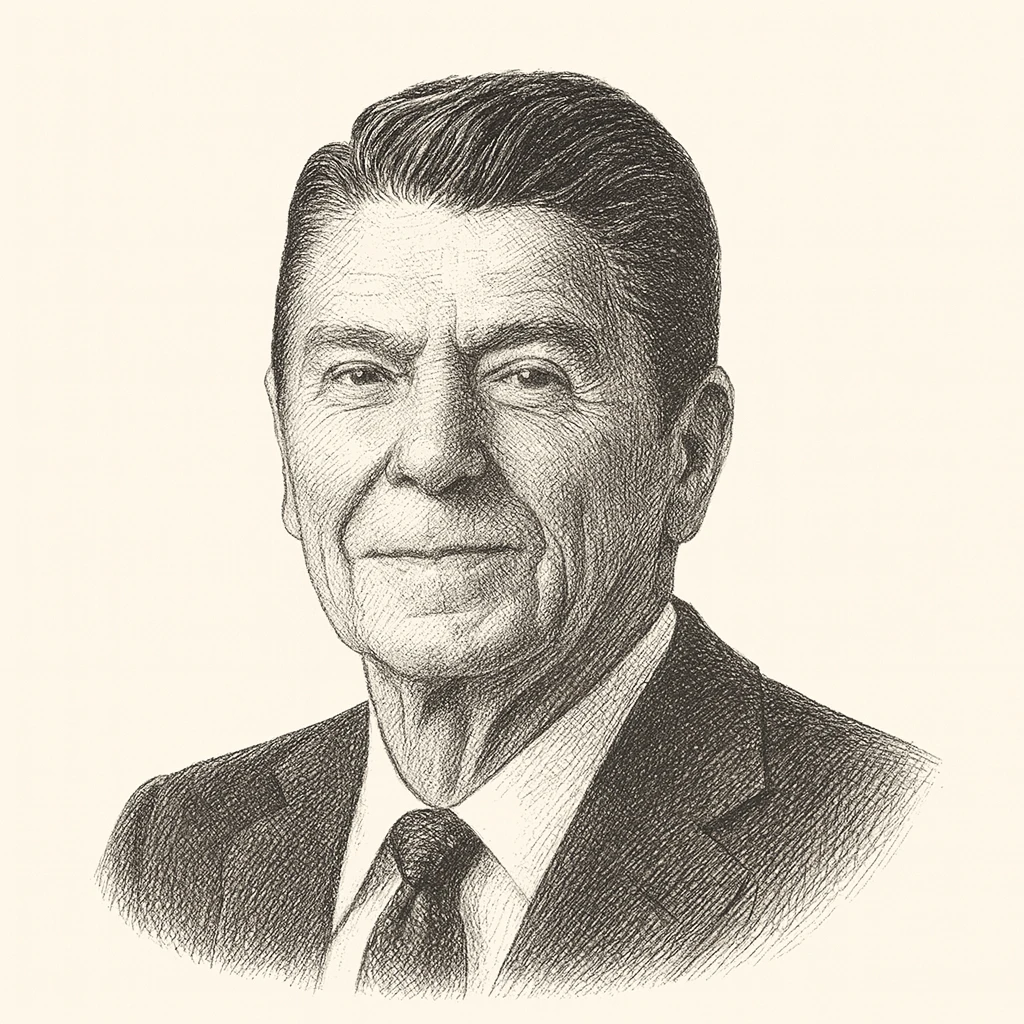
Ronald Reagan transformed from Hollywood actor to conservative icon, serving as the 40th President and reshaping American politics for a generation. After leading the Screen Actors Guild and hosting General Electric Theater, Reagan entered politics as a spokesman for Barry Goldwater's 1964 campaign, then served two terms as California's governor. Once a New Deal Democrat and admirer of Franklin Roosevelt, Reagan moved rightward through the 1950s and registered as a Republican in 1962.
Reagan's presidency marked a decisive turn from New Deal liberalism. His economic program, dubbed 'Reaganomics,' combined tax cuts, deregulation, and anti-union policies that reversed decades of progressive economic policy. The intellectual case drew on supply-side economics, which held that lower marginal tax rates would spur work, investment, and growth, alongside monetarist concern with inflation and a broader conviction that free markets allocated resources better than central planners. His declaration that 'government is not the solution to our problem; government is the problem' became the conservative movement's creed. Inflation fell sharply and the economy expanded after the 1981-82 recession, while federal deficits grew and the national debt roughly tripled over his two terms.
In foreign policy, Reagan pursued aggressive anti-communism, dramatically expanding military spending and supporting anti-Soviet forces worldwide. He framed the contest with the Soviet Union in explicitly moral terms, casting it as a struggle between freedom and tyranny rather than a mere balance of power. His partnership with Mikhail Gorbachev helped end the Cold War peacefully. His second term also brought the Iran-Contra affair, in which proceeds from secret arms sales to Iran were diverted to the Nicaraguan Contras despite a congressional ban on such aid. Reagan's optimistic patriotism and communication skills earned him the title 'Great Communicator.'
Reagan's combination of free-market economics, muscular anti-communism, and appeals to traditional values and national confidence set the terms of Republican politics for decades. Later conservatives repeatedly invoked him, and his emphasis on limiting government and cutting taxes became standing reference points in American policy debate.
Ronald Reagan is associated with Classical Liberal. See the archetype