
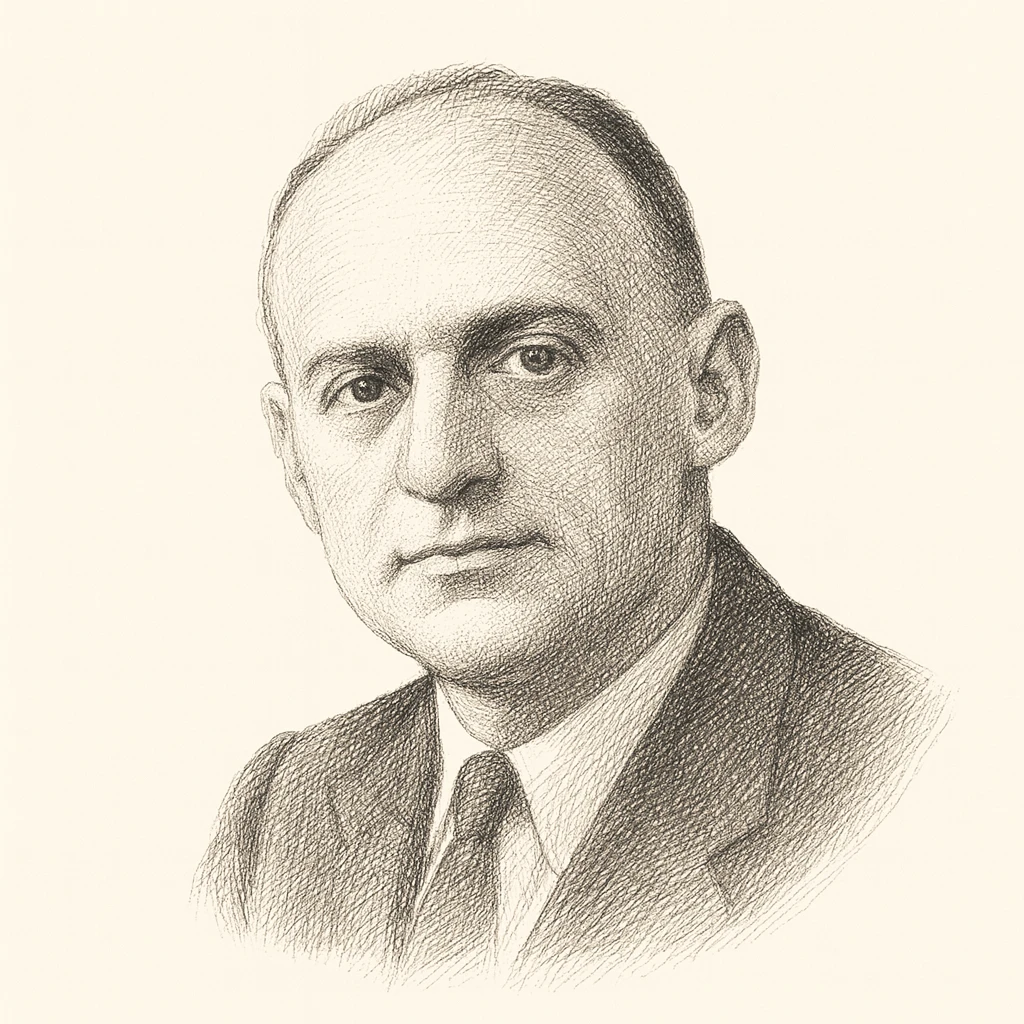
Karl Paul Reinhold Niebuhr was born in 1892 in Wright City, Missouri, the son of Gustav Niebuhr, a German immigrant pastor in the German Evangelical Synod — a Protestant denomination that maintained German-language worship and a distinctive theological culture well into the twentieth century. The family moved to Lincoln, Illinois, where Gustav Niebuhr served a congregation and where Reinhold and his younger brother Helmut Richard (who would himself become one of the most important American theologians of the twentieth century) grew up in the atmosphere of a German immigrant church community: serious about theology, engaged with questions of faith and public life, shaped by the German Protestant tradition's insistence that Christianity had intellectual as well as spiritual content.
Reinhold studied at Elmhurst College and Eden Theological Seminary, both denominational institutions, before going to Yale Divinity School for his bachelor of divinity — the most intellectually demanding Protestant theological education available in America at the time. Yale exposed him to the liberal Protestant theology that was then dominant in American seminaries, the Social Gospel tradition that Rauschenbusch had founded and that held that the Kingdom of God could be progressively realized through human effort and social reform. He graduated in 1915, was ordained, and was appointed to Bethel Evangelical Church in Detroit — a small congregation that grew, under his ministry, into a significant institutional presence.
Detroit in the 1910s and 1920s was the Ford Motor Company's city, and the Ford Motor Company was in those years perhaps the most powerful argument in existence against the Social Gospel's optimism. Niebuhr watched the five-dollar workday attract rural workers from across the South and Midwest, watched them absorbed into the brutal discipline of the assembly line, watched the speed-up and the constant threat of dismissal destroy men's bodies and spirits over the course of a working life. He visited workers' homes, attended labor organizing meetings, and began to understand that the Social Gospel's faith in goodwill and education as instruments of social transformation was inadequate to the realities of industrial power. You could not appeal to Henry Ford's better nature because his better nature, whatever it was, had no traction against the competitive pressures that shaped his decisions.
He left Detroit for Union Theological Seminary in New York in 1928, where he taught Christian ethics for the rest of his career, and spent the 1930s working out the theological politics that would make him famous. He was a socialist in this period — a member of the Socialist Party, a supporter of Norman Thomas, deeply skeptical of the New Deal as insufficient — and he understood himself as engaging with Marxist analysis of class power and economic structure even as he rejected Marxism's philosophical materialism and its eschatological confidence. Moral Man and Immoral Society (1932) drove the central insight with maximum force: individuals were capable of genuine moral achievement, but collectivities — nations, classes, racial groups — were governed by a much cruder logic of interest and power, and the pretense that they could be morally reformed through reason and goodwill was not merely naïve but dangerous. Genuine justice required power, and the struggle for justice required the willingness to use it.
The theological foundation he developed through the 1930s and early 1940s was his doctrine of original sin — not understood literally but as an anthropological insight that pride, the attempt to make oneself the center of all things, was a permanent feature of human existence that no education or social arrangement could eliminate. In The Nature and Destiny of Man (1941-43), his major theological work, he argued that this insight was Christianity's most important contribution to political philosophy: the recognition that all human achievement was tainted by self-interest, that all political programs were corrupted by the pride of those who implemented them, and that the appropriate political response was humility about one's own righteousness combined with vigilance about the pretensions of others.
The Irony of American History (1952) was his most influential popular work, and it found the audience it deserved. America's greatest dangers, Niebuhr argued, came not from its vices but from its virtues: its confidence in its own righteousness, its belief that its particular history represented universal values, its tendency to mistake its own interests for the interests of humanity. This ironic self-awareness — the recognition that the pursuit of good intentions regularly produced consequences that mocked the intentions — was the appropriate American political disposition in the Cold War world. He was simultaneously anti-Communist and skeptical of American messianism, positions that made him invaluable to the Cold War liberal establishment and that shaped figures ranging from George Kennan and Arthur Schlesinger Jr. to Martin Luther King Jr. and, decades later, Barack Obama.
He suffered a stroke in 1952 that limited his physical activity but not his intellectual output. He continued writing and teaching through the 1960s, becoming increasingly troubled by American policy in Vietnam — the messianism that his analysis had long warned against, now producing its predictable consequences — and increasingly skeptical about the civil rights movement's ability to achieve its goals without confronting the deeper structural inequalities that formal legal equality would not address. He died in 1971 in Stockbridge, Massachusetts, having seen the irony of American history confirmed more fully than he had anticipated in 1952.
Reinhold Niebuhr is associated with Conservative Democrat. See the archetype