
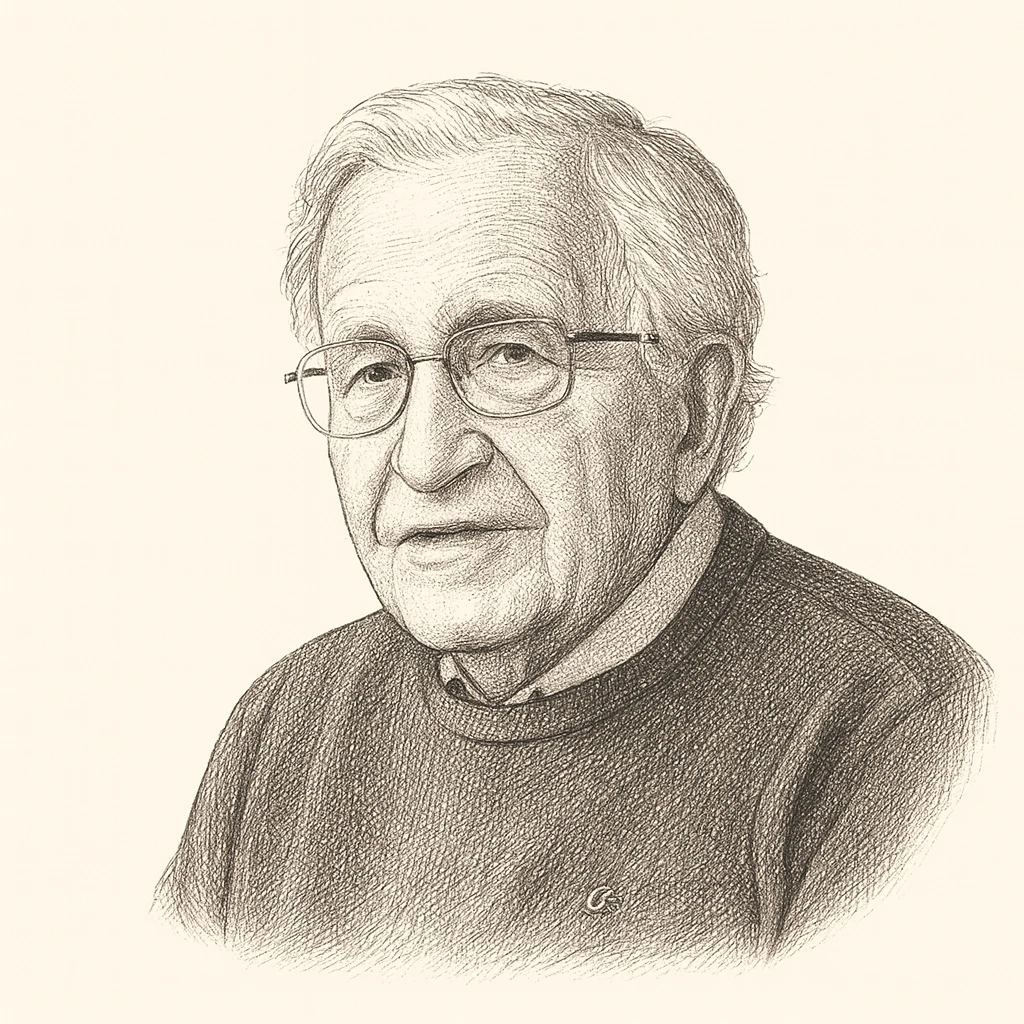
Noam Chomsky is best known in political circles as a persistent radical critic of concentrated power, whether corporate, state, or military. Though his academic reputation rests on his revolutionary work in linguistics, he has spent decades as a public intellectual advancing an anarchist and anarcho-syndicalist tradition. He draws on thinkers like Bakunin, Kropotkin, and Rudolf Rocker, and identifies with libertarian socialism, arguing that hierarchies of authority bear the burden of justifying themselves and that most fail the test. His politics center on maximizing individual liberty through participatory, decentralized institutions rather than through either capitalist markets or centralized state socialism.
Much of Chomsky's political influence flows from his critique of American foreign policy, which he began articulating prominently during his opposition to the Vietnam War. He has argued across many books that the United States behaves as an imperial power, applying moral standards to adversaries that it exempts itself from, and that intellectuals often serve to rationalize state violence. In his analysis of the media, developed with Edward Herman, he advanced the "propaganda model," contending that ostensibly free press systems filter information in ways that serve elite and corporate interests, producing a manufactured consent that narrows the range of acceptable debate.
Chomsky's positions have provoked serious controversy. His defense of free-speech principles in the case of a French Holocaust denier drew lasting criticism, as did his commentary on atrocities in Cambodia and the Balkans, where detractors accused him of minimizing crimes committed by parties he saw as targets of Western propaganda. Supporters counter that he was interrogating how such events were reported rather than condoning the underlying violence. These disputes remain a live part of assessments of his record.
Across this work runs a consistent method: skepticism toward official narratives, insistence on holding one's own government to the standards it demands of others, and faith in ordinary people's capacity for self-organization. Whatever one makes of his specific judgments, Chomsky has shaped how generations of activists and readers on the left think about power, media, and dissent, and remains among the most widely read political voices of his era.
Noam Chomsky is associated with Left Libertarian. See the archetype