
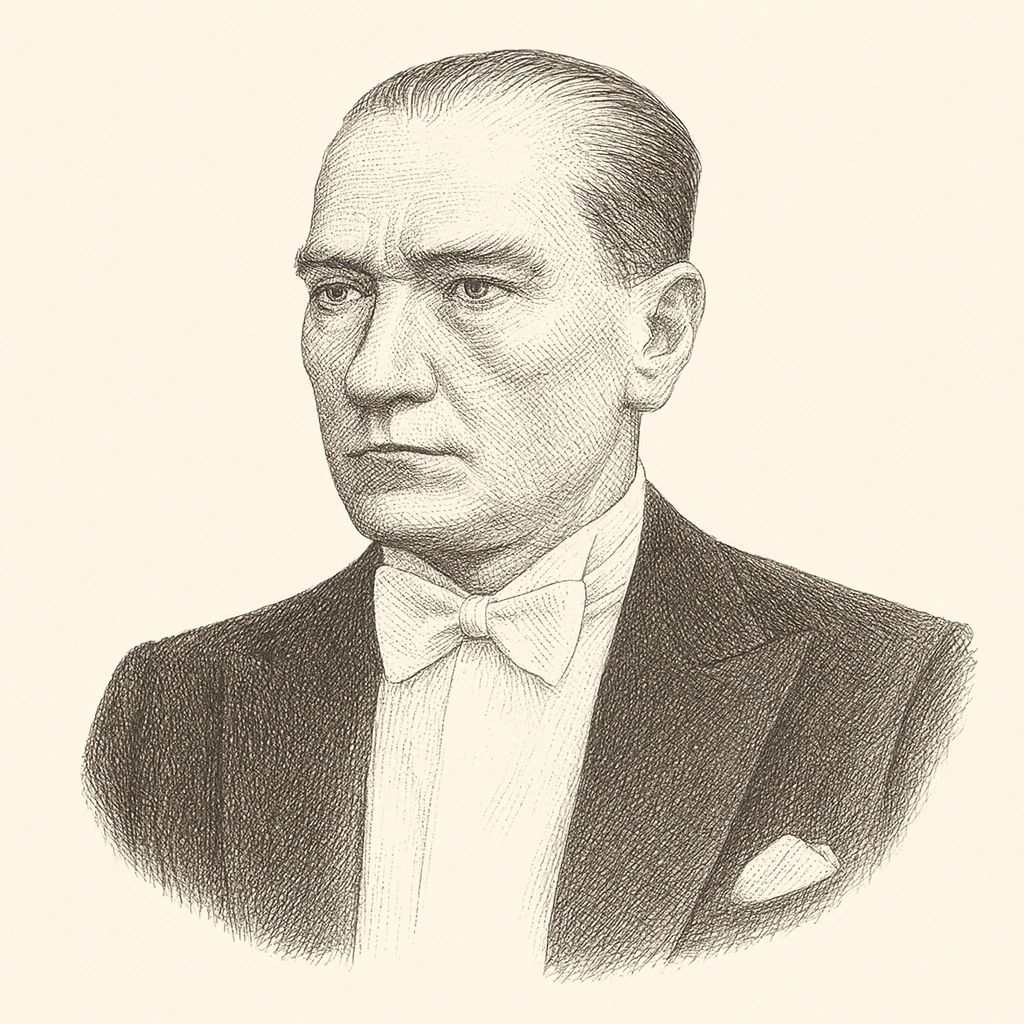
Mustafa Kemal Atatürk founded the Republic of Turkey from the ruins of the Ottoman Empire and led it through a program of secularizing, Westernizing reform. A military hero at Gallipoli, Kemal led Turkish resistance against the post-WWI partition and drove out Greek forces in the War of Independence. That victory allowed him to reject the Treaty of Sèvres and secure recognition of a sovereign Turkish state, replacing the multi-ethnic, dynastic Ottoman order with a nation-state defined by Turkish identity.
Atatürk's reforms transformed Turkey. He abolished the Caliphate, replaced Islamic law with a civil code modeled on Switzerland's, granted women's suffrage, banned the fez, and replaced Arabic script with the Latin alphabet. His secularism (laiklik) separated mosque and state more completely than anywhere else in the Muslim world. The guiding conviction was that religion belonged to private observance, not to law or the organization of the state. This top-down revolution treated culture, dress, language, and script as instruments of political transformation, aiming to reorient Turkey westward and sever it from Ottoman-Islamic precedent.
These positions crystallized into an ideology later codified as Kemalism, conventionally summarized in six principles: republicanism, nationalism, populism, statism (etatism), secularism, and reformism. Statism meant a leading role for the state in directing economic development. Populism held that all Turkish citizens were equal and that all of them were Turks.
Atatürk's authoritarianism was justified as necessary for modernization: one-party rule, suppression of opposition, and a cult of personality. The regime's approach is often summed up as rule for the people, despite the people. Experiments with a permitted opposition party were short-lived, and Kurdish and religious revolts, including the Sheikh Said rebellion and the Dersim uprising, were put down by force. His legacy includes Turkish nationalism, the military's role as guardian of secularism, and a lasting tension between democratic form and authoritarian practice.
Kemalism became the defining framework of the Turkish state. In later decades the Turkish military intervened in politics several times in its name, and restrictions on Kurdish identity and on public religious expression became recurring sources of political conflict.
Wondering where you land? Take the 4-minute assessment