
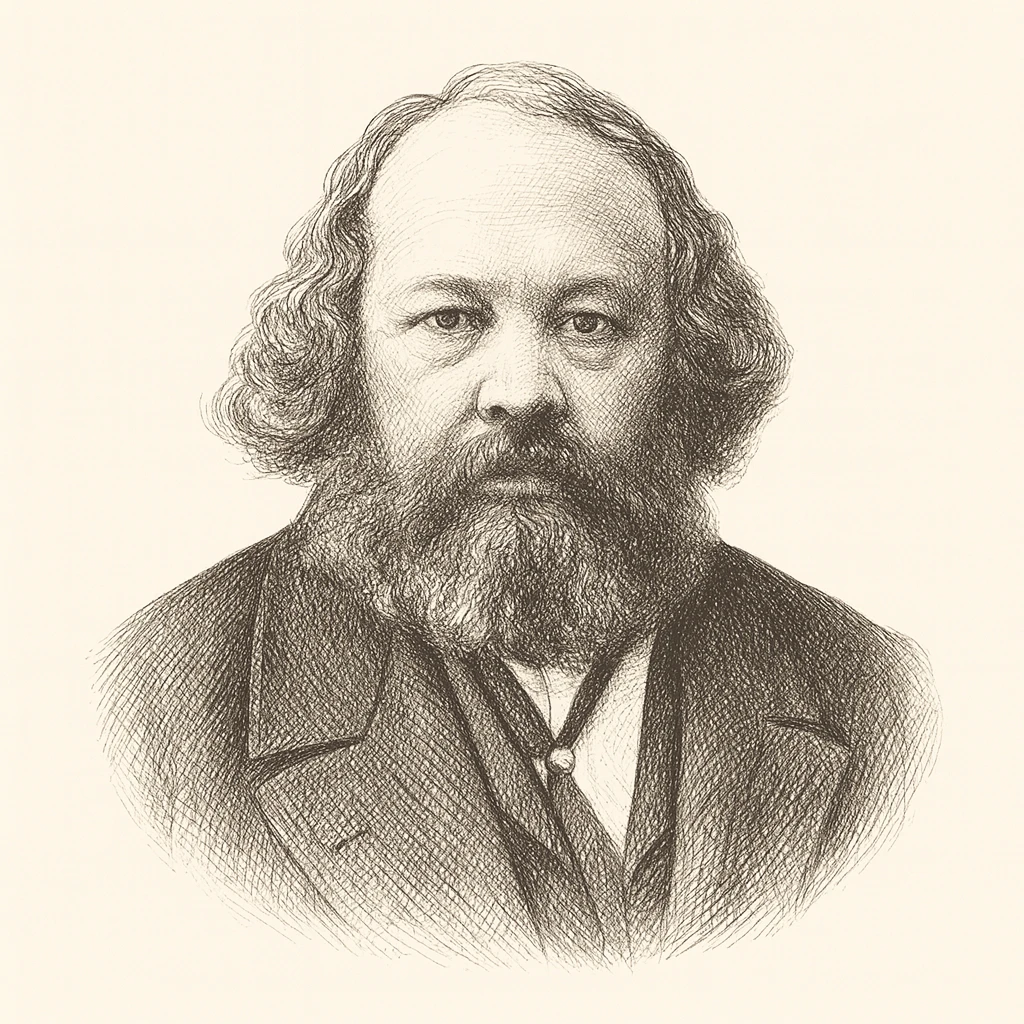
Mikhail Bakunin was a nineteenth-century Russian revolutionary and political theorist who became the most forceful early exponent of anarchism as a mass movement. Emerging from the ferment of Left Hegelianism and the revolutionary upheavals of 1848, in which he participated across Europe, he moved from a broadly democratic and Pan-Slavist radicalism toward a thoroughgoing rejection of the state as such. For Bakunin, the state was not merely a tool that could be captured and redirected for good ends; it was an inherently dominating apparatus that would reproduce oppression regardless of who held it. This conviction shaped his lasting contribution: the argument that genuine emancipation requires abolishing centralized political authority rather than seizing it.
Bakunin's positive doctrine is usually labeled collectivist anarchism. He held that the means of production should be owned in common and controlled by federations of workers' associations organized from the bottom up, coordinated through voluntary federation rather than a governing center. He combined this with a passionate defense of individual liberty, arguing famously that liberty without equality is privilege and injustice, while equality imposed from above without liberty is servitude. This attempt to fuse the two commitments places him squarely within the libertarian-socialist tradition and marks him as a crucial link between Pierre-Joseph Proudhon, whom he admired, and Peter Kropotkin, who would develop anarchist communism after him.
His political significance was sharpened by his conflict with Karl Marx within the First International. Bakunin warned that the Marxist program of a workers' state and a transitional dictatorship of the proletariat would, in practice, entrench a new ruling class of administrators and experts — a prediction anarchists have long cited against later authoritarian socialism. The dispute split the International and helped define anarchism as a distinct current opposed to state-centered Marxism.
Bakunin's record is genuinely contested. He was drawn to conspiratorial secret societies and revolutionary dictatorship in his organizing methods, a tension with his anti-authoritarian principles that critics stress. His writings also contain antisemitic passages, especially in his polemics against Marx, which are indefensible and are part of the honest picture. He wrote prolifically but left much unfinished, so his influence rests less on a single systematic book than on the enduring anarchist argument that freedom and equality must be won together, and against the state.
Mikhail Bakunin is associated with Left Libertarian. See the archetype