
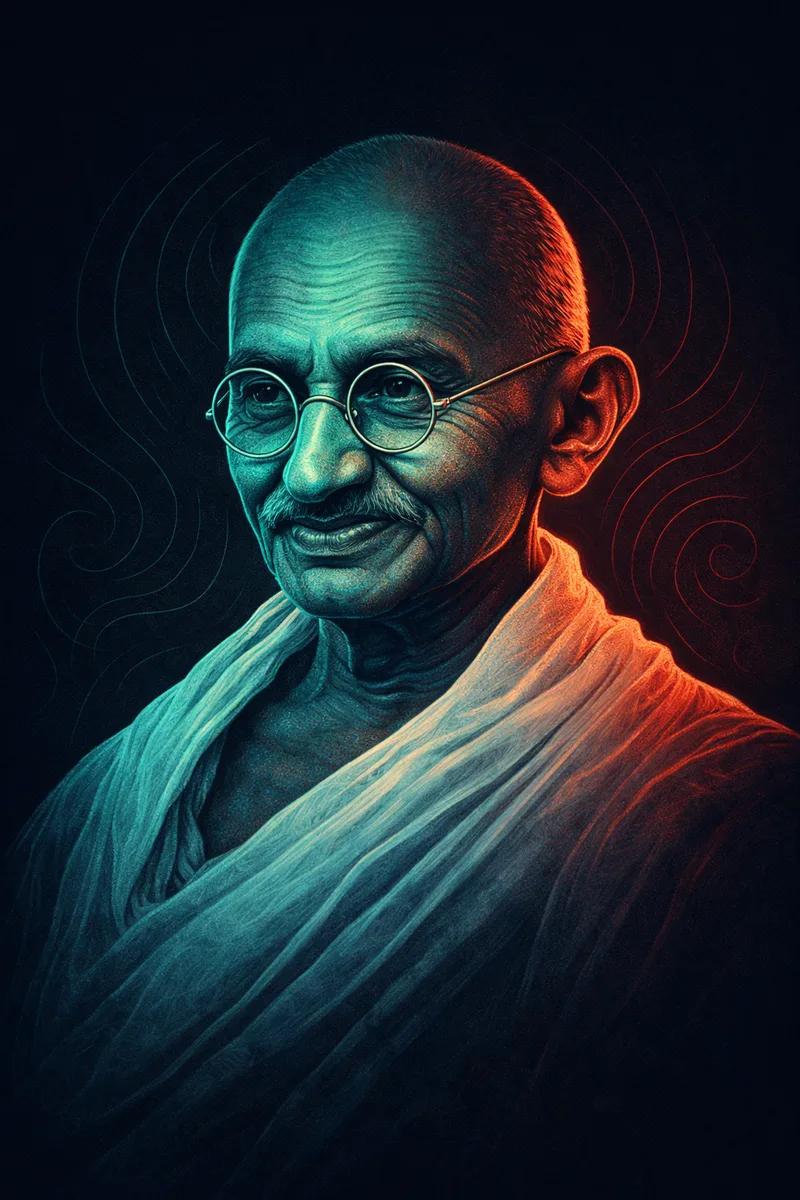
Mohandas Karamchand Gandhi was born in 1869 in Porbandar, a coastal town in the Kathiawar peninsula of what is now Gujarat, into a family of the Vaishya caste — the merchant and administrative class of Hindu society — that had produced several generations of local officials and ministers in the small princely states of the region. His father Karamchand served as diwan, or chief minister, of Porbandar and then Rajkot, a position of modest but real local authority, and Gandhi grew up in a household where political responsibility was a family tradition rather than a distant abstraction. His mother Putlibai was a devout Vaishnava Hindu of the Pranami sect, deeply committed to fasting, prayer, and the Jain practice of ahimsa — noninjury to all living beings — that shaped Gandhi's understanding of what genuine religiosity looked like from childhood.
He went to London at eighteen to study law, a journey that required him to take vows before his mother that he would abstain from meat, alcohol, and women while abroad. He kept the vows, joined the London Vegetarian Society, and read widely in the tradition he was temperamentally suited to absorb: Tolstoy's essays on nonresistance and the Kingdom of God, the Bhagavad Gita (in Edwin Arnold's translation, which he encountered first in English before reading it in Sanskrit), the New Testament's Sermon on the Mount. He was called to the bar in 1891, returned to India, failed to establish a practice, and accepted a one-year contract from an Indian trading firm to handle a lawsuit in South Africa. He arrived in Natal in 1893 and stayed for twenty-one years.
The South Africa years made him politically. The specific incident of his removal from a first-class railway carriage at Pietermaritzburg despite holding a valid ticket — his refusal to comply, his ejection, his night spent in the cold station — is the emblematic moment of his transformation. He had come to South Africa as a relatively conventional Victorian professional, deferential to British institutions and confident that the Empire could be appealed to on its own principles of justice. What he encountered was a system of racial subordination so comprehensive and so casually brutal that appealing to its principles was futile. He had to develop a different political method.
Satyagraha — truth-force or soul-force, the term he coined in 1907 to describe the organized nonviolent resistance he was developing — was not merely a tactic but a philosophy. Its premises were: that the oppressor's power ultimately depended on the cooperation of the oppressed; that withdrawing that cooperation while maintaining absolute nonviolence converted suffering from an instrument of submission into a form of witness that could change the moral climate of an entire society; that the goal was not to defeat the oppressor but to transform him; and that the practitioner of satyagraha had to be willing to absorb unlimited suffering without retaliation, because retaliation both undermined the moral claim and restored the cycle of violence. He organized strikes, boycotts, and mass refusals of registration throughout his South Africa years, developing the method through practice and learning from its failures as well as its successes.
He returned to India in 1915, at the invitation of Gokhale and under his guidance, spent a year traveling and listening before engaging in politics, and then led the campaign against the indigo plantation system in Champaran (1917) that established his authority in the Indian independence movement. The Non-Cooperation Movement of 1920-22, the Salt March of 1930, the Quit India Movement of 1942 — these were the successive campaigns through which he applied satyagraha to the project of Indian independence, each one expanding the movement's mass base and deepening its philosophical clarity. The Salt March in particular — 240 miles from Ahmedabad to the sea coast at Dandi, to make salt in violation of British monopoly law — was a masterpiece of political theater and philosophical consistency: an act that dramatized the absurdity of colonial law, engaged the entire population's experience of an everyday necessity, and invited mass participation at minimal risk.
His political philosophy was stated most fully in Hind Swaraj (Indian Home Rule), written in 1909 on the steamship returning from London, in the form of a dialogue between a Reader representing the conventional nationalist position and the Editor representing Gandhi's own. Its central argument was that swaraj — self-rule — could not mean simply replacing British rule with Indian rule while maintaining the industrial civilization, the railways, the legal system, and the parliamentary machinery that the British had introduced. A civilization organized around machinery, individual competition, and the endless expansion of desires was a civilization hostile to genuine human flourishing, and importing it under Indian management would not constitute independence. The truly self-governing India would be a decentralized civilization of self-sufficient villages, organized around hand-spinning, nonviolence, and the dignity of manual labor — a vision that his critics, including Nehru, found romantic and impractical.
He was shot by Nathuram Godse, a Hindu nationalist who blamed him for the partition of India and the concessions made to Pakistan, on January 30, 1948, at Birla House in New Delhi, while walking to his evening prayer meeting. He was seventy-eight. India had been independent for five months. The partition whose violence he had spent his last months trying to stop through personal fasting and interfaith prayer had killed hundreds of thousands of people. His assassination was in some sense the measure of how seriously people took his moral authority: Godse killed him because he believed that Gandhi's nonviolence was preventing the Hindu nationalism that Godse thought India's survival required.
Mahatma Gandhi is associated with Progressive Activist. See the archetype