
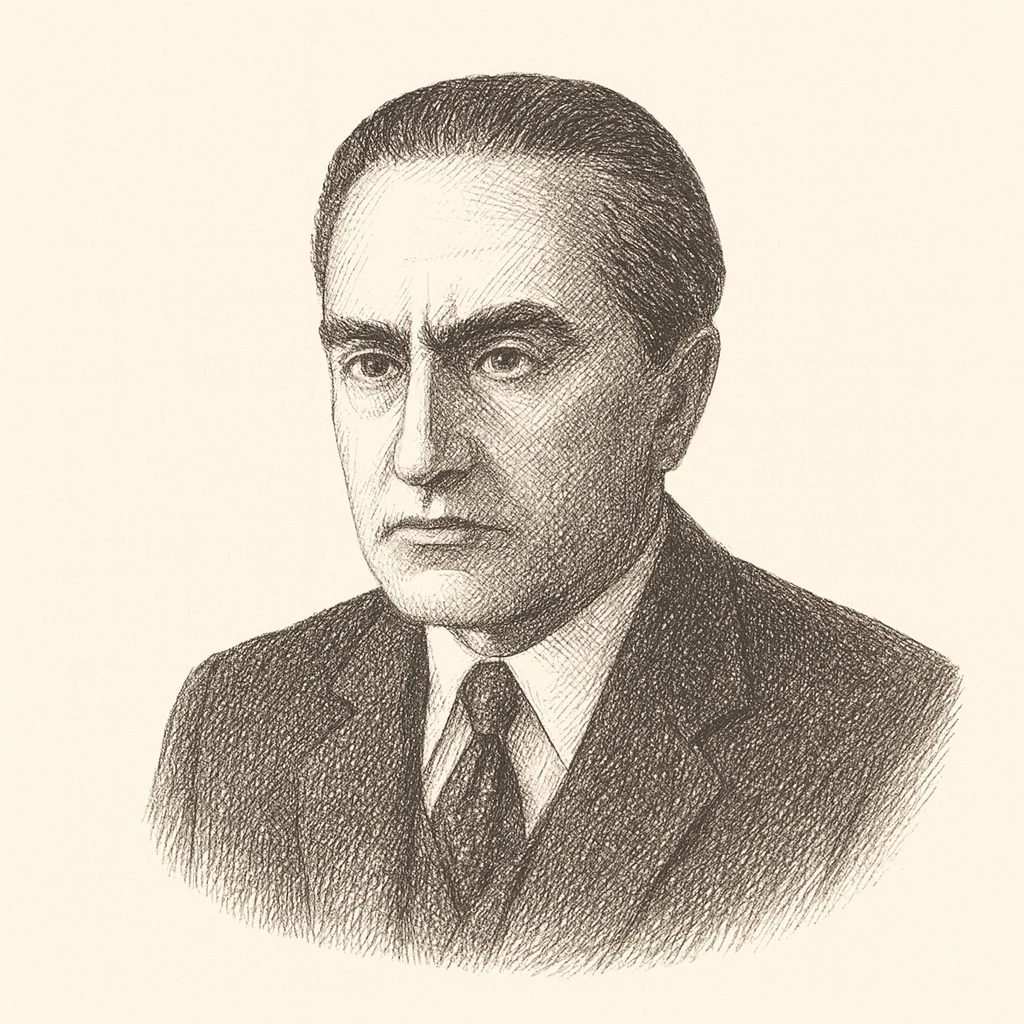
Julius Evola (1898–1974) was an Italian philosopher, esotericist, and cultural critic whose work became one of the principal intellectual reference points for the postwar radical right. Beginning as a painter and poet associated with Dadaism and Futurism, he turned toward metaphysics and the philosophy of "Tradition," drawing on the Traditionalist school associated with René Guénon. Evola argued that history represents a process of spiritual decline—an idea he framed through the Hindu concept of the Kali Yuga, or dark age—in which sacred hierarchies and higher forms of authority have progressively decayed into materialism, egalitarianism, and mass democracy.
At the center of Evola's political thought is a radical anti-egalitarianism. He rejected liberalism, democracy, socialism, and the entire trajectory of modernity as symptoms of degeneration, and he championed instead a rigidly hierarchical order crowned by a spiritual or warrior aristocracy—an elite defined by inner qualities rather than birth or wealth alone. He idealized traditional, sacral forms of authority and empire over the modern nation-state, and he distinguished his own vision from ordinary nationalism, which he considered too rooted in the masses and materialism. His relationship to Fascism and National Socialism was ambivalent: he engaged with both regimes and was drawn to their anti-democratic and hierarchical aspirations, yet he criticized them for being insufficiently spiritual and too populist, positioning himself as a critic "from the right."
Evola's influence has been most durable through his later reflections on how one should live amid irreversible decline, counseling an interior discipline and detachment for those he called men who stand apart from the crumbling modern world. This posture of aristocratic resistance to modernity helped make his writings foundational to sectors of the European New Right and to militant far-right and identitarian currents in the decades after his death, where he is frequently invoked alongside other Traditionalist thinkers.
He remains a controversial and contested figure. Admirers treat him as a profound critic of modern nihilism and spiritual emptiness, while critics emphasize the elitist, anti-democratic, and at times racially charged dimensions of his thought and its ongoing appropriation by extremist movements. His work is studied today less for a systematic political program than for its enduring role in shaping a metaphysically framed rejection of liberal democracy and equality.
Julius Evola is associated with Reactionary Strongman. See the archetype