
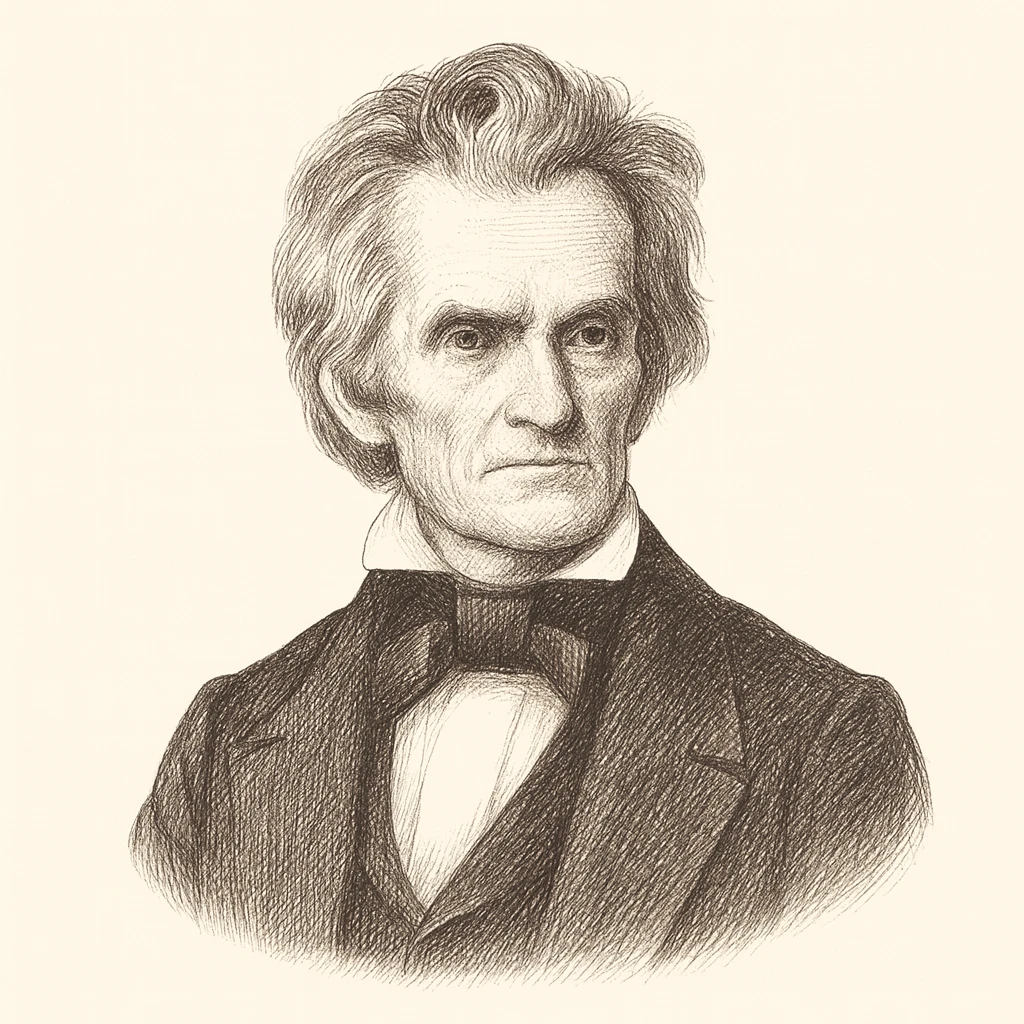
John C. Calhoun ranks among the most influential American political theorists of the antebellum era, a South Carolina statesman who served as a congressman, secretary of war, vice president under two administrations, secretary of state, and senator. Though he began his career as a nationalist associated with an assertive federal role, he moved decisively toward a doctrine of state sovereignty as the sectional conflict between North and South sharpened. His mature political thought became the intellectual arsenal of the slaveholding South.
Calhoun's central contribution was a theory of constitutional structure built around what he called the "concurrent majority." He argued that a numerical majority acting through ordinary democratic channels could tyrannize distinct interests and regions, and that legitimate government required the assent of the major sections or interests, each holding an effective veto over measures that touched its vital concerns. From this reasoning he developed and defended the doctrine of nullification—the claim that a state could refuse to enforce a federal law it judged unconstitutional—which he advanced during the tariff crisis of the early 1830s. He understood the Union as a compact among sovereign states rather than a single consolidated nation, and he sought institutional checks that would protect minority interests against consolidation of power.
These arguments cannot be separated from the cause they served. Calhoun deployed his constitutional theory explicitly to protect slavery, and he defended the institution not as a regrettable necessity but as, in his phrase, a "positive good"—a stance that placed him among the era's most forthright apologists for human bondage. His concurrent-majority framework was designed to shield the slave South from a national majority that might move against it. This is the plain and central fact of his legacy.
Calhoun's influence endured well beyond his death. His warnings about majority tyranny and his search for mechanisms to protect regional and minority interests have been read by later thinkers concerned with pluralism, federalism, and constitutional limits on centralized power. Yet his reputation remains deeply and rightly contested, because the sophistication of his political science was harnessed to the perpetuation of slavery and, ultimately, to the constitutional logic that would fuel secession.
John C. Calhoun is associated with Traditionalist. See the archetype