
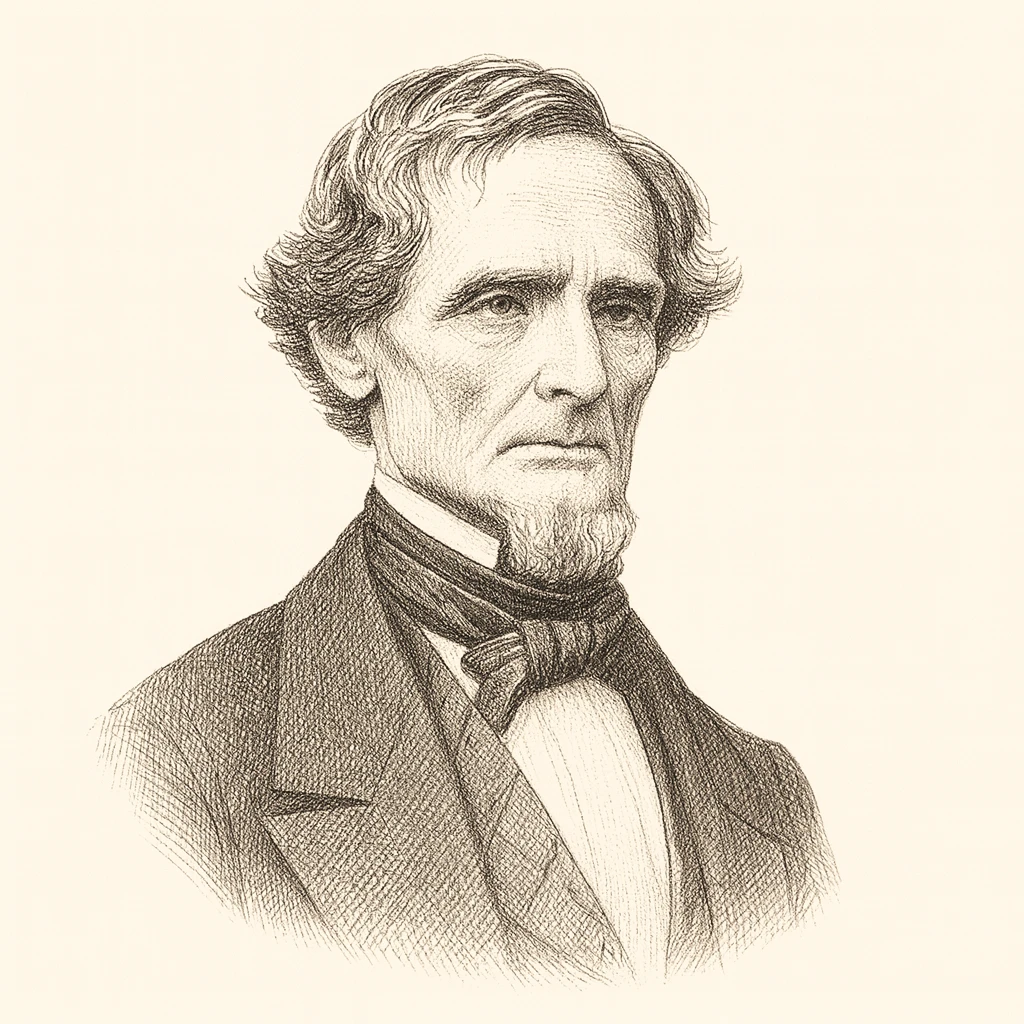
Jefferson Davis was the President of the Confederate States of America, leading the South's attempt to establish an independent slaveholding nation. A Mississippi planter, West Point graduate, Mexican War hero, and U.S. Senator, Davis was chosen to lead the Confederacy when Southern states seceded in 1861. He had also served as U.S. Secretary of War under President Franklin Pierce, and entered the secession crisis as an experienced national figure rather than a regional outsider.
Davis's political thought drew directly on the states'-rights tradition associated with John C. Calhoun. He held to a compact theory of the Union, arguing that the Constitution was an agreement among sovereign states that retained the right to withdraw. On this reasoning, secession was a lawful constitutional act rather than rebellion, and coercion of a departing state was itself the true violation of the founding order. This strict-constructionist framing let him present the Confederacy as the faithful heir of 1776 and the original constitutional bargain, and it shaped his farewell address to the Senate as he left to join the new government.
Davis proved a capable but difficult war leader—strong on military matters, poor at politics, unable to delegate, and prone to feuds with generals and governors. The Confederacy's defeat owed much to Northern advantages in men and industry, but Davis's rigidity and micromanagement contributed to Southern failure. His insistence on centralizing authority for the war effort also generated friction with the very states'-rights principles the Confederacy claimed to embody.
Davis never apologized for the Confederacy. Imprisoned for two years after the war, he later wrote The Rise and Fall of the Confederate Government, defending states' rights and denying that slavery had caused secession. This recasting of the conflict as a constitutional dispute over sovereignty, rather than a war to preserve human bondage, became a cornerstone of the 'Lost Cause' mythology that dominated Southern memory for generations and long shaped how the war was taught and commemorated.
Davis represents that mythology in its most authoritative form, and his postwar writings gave it intellectual respectability. Yet his legacy is inseparable from slavery's defense and the Civil War's 620,000 dead. Historians widely regard his constitutional arguments as a retrospective justification designed to obscure the centrality of slavery to the cause he led, and his reputation has declined as that reframing has been dismantled.
Wondering where you land? Take the 4-minute assessment