
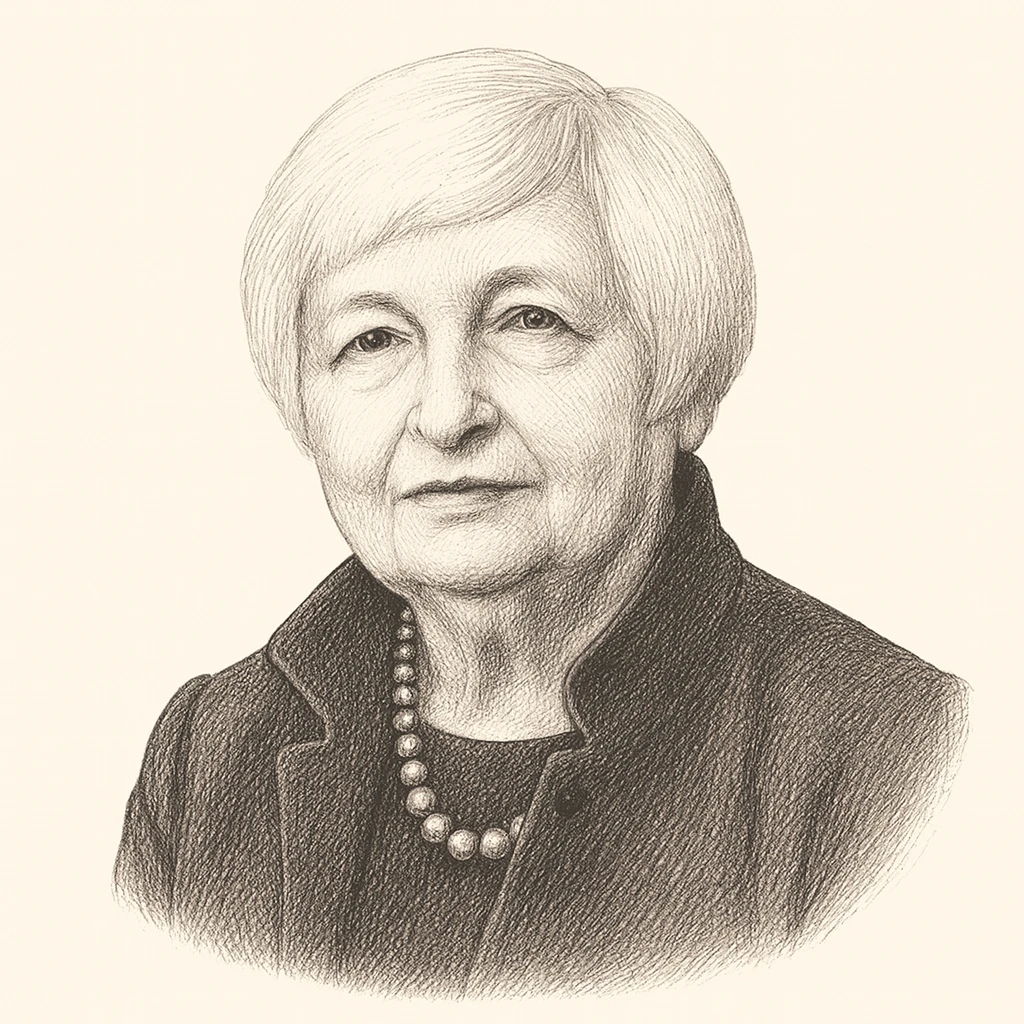
Janet Yellen is an American economist whose career bridges academic research, monetary policymaking, and fiscal governance. Trained in the Keynesian tradition, her early scholarly work focused on the labor market—particularly efficiency-wage theory, which she developed with her husband, economist George Akerlof, to explain why unemployment persists and wages do not simply clear markets. This intellectual grounding shaped a lasting conviction that involuntary unemployment carries real human and social costs, and that policymakers bear responsibility for pursuing full employment alongside price stability.
As an economic thinker, Yellen is associated with a pragmatic, data-driven strand of macroeconomics that treats the Federal Reserve's dual mandate—maximum employment and stable prices—as a pairing of equals rather than subordinating employment to inflation control. During her tenure as Fed chair, she was widely seen as favoring a gradual, cautious approach to raising interest rates, emphasizing that the labor market could run somewhat hotter to draw marginalized workers back into employment. Her attention to the distributional dimensions of monetary policy, and to indicators beyond headline unemployment, reflected a broader argument that economic policy should be evaluated by its effects on ordinary households, not merely aggregate measures.
In her role as Treasury Secretary, Yellen advanced ideas about the state's active role in stabilizing and steering the economy. She became a prominent advocate for coordinated international efforts to establish a global minimum corporate tax, framing tax competition among nations as a race to the bottom that erodes public revenue and fairness. She also articulated a vision sometimes described as "modern supply-side economics," arguing that public investment in infrastructure, workforce development, and productive capacity expands long-term growth—contrasting this with older supply-side theories centered on tax cuts and deregulation.
Yellen's influence lies less in a single doctrine than in her embodiment of a mainstream, institutionalist liberalism that trusts empirical evidence and expert governance while remaining attentive to inequality and labor. As the first woman to chair the Fed and lead the Treasury, she also carries symbolic weight regarding the changing composition of economic authority. Her thought represents a centrist, technocratic response to debates over the proper scope of government intervention, positioning her within a tradition that seeks to harness markets while correcting their failures.
Janet Yellen is associated with Cosmopolitan. See the archetype