
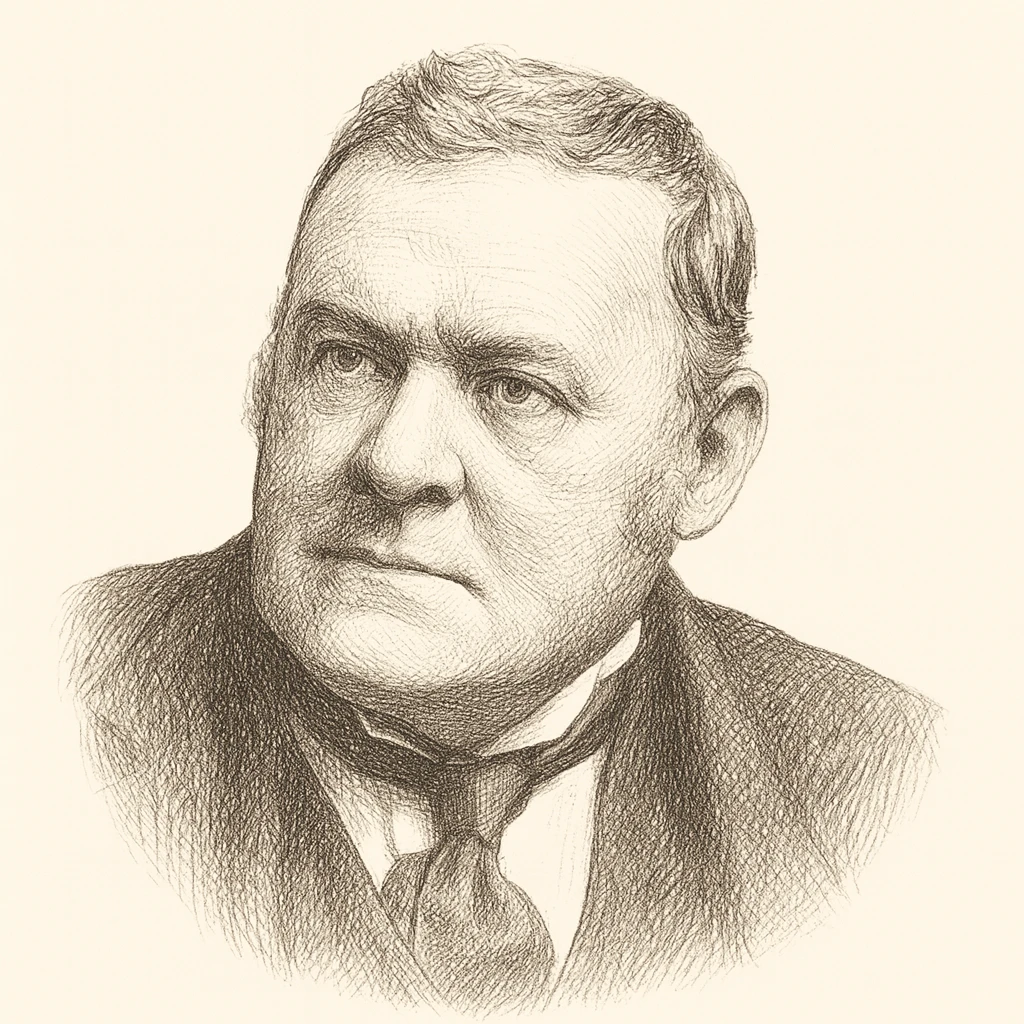
Hilaire Belloc was a prolific British writer—essayist, poet, historian, and polemicist—whose political thought grew out of a combative Catholicism and a suspicion of both industrial capitalism and collectivist socialism. His most influential political work argued that modern economies were converging on what he called the 'servile state': an arrangement in which the propertyless mass accepts security and regulation in exchange for surrendering genuine independence, while ownership and real power remain concentrated in few hands. For Belloc, welfare reforms and socialist schemes alike, however well-intentioned, tended to entrench this condition rather than dissolve it, because they left the underlying concentration of property untouched.
His alternative was distributism, a program he developed and popularized alongside his friend G. K. Chesterton, with whom his name is so closely linked that the outlook was sometimes dubbed the 'Chesterbelloc.' Distributism held that liberty depends on the wide dispersal of productive property—land, tools, small businesses—so that ordinary families possess a material base for self-governance rather than depending on either the state or large employers. Drawing on Catholic social teaching, especially the tradition of subordinating economic arrangements to human dignity, Belloc argued for a society of small proprietors, guilds, and local institutions against both the trust and the bureaucratic state. This vision was consciously backward-looking in inspiration, appealing to a pre-industrial, pre-Reformation ideal of ordered community.
Belloc also served briefly as a Member of Parliament and was a restless critic of party politics, which he depicted as a managed collusion between nominal opponents. His historical and polemical writing was shaped by a strong Catholic partisanship, and this same current fed the aspect of his legacy that is now most seriously contested: his writing contained recurrent anti-Semitic themes, expressed in tracts that treated Jews as a distinct and problematic presence in European life. That record is a genuine stain on his reputation and is inseparable from any honest account of him.
His enduring influence lies less in any practical policy achievement than in supplying a durable vocabulary for critics of large-scale concentration—corporate and governmental alike—who suspect that centralized systems erode ordinary independence. Distributist and communitarian thinkers, and later small-is-beautiful and localist movements, have continued to draw on his framing.
Hilaire Belloc is associated with Traditionalist. See the archetype