
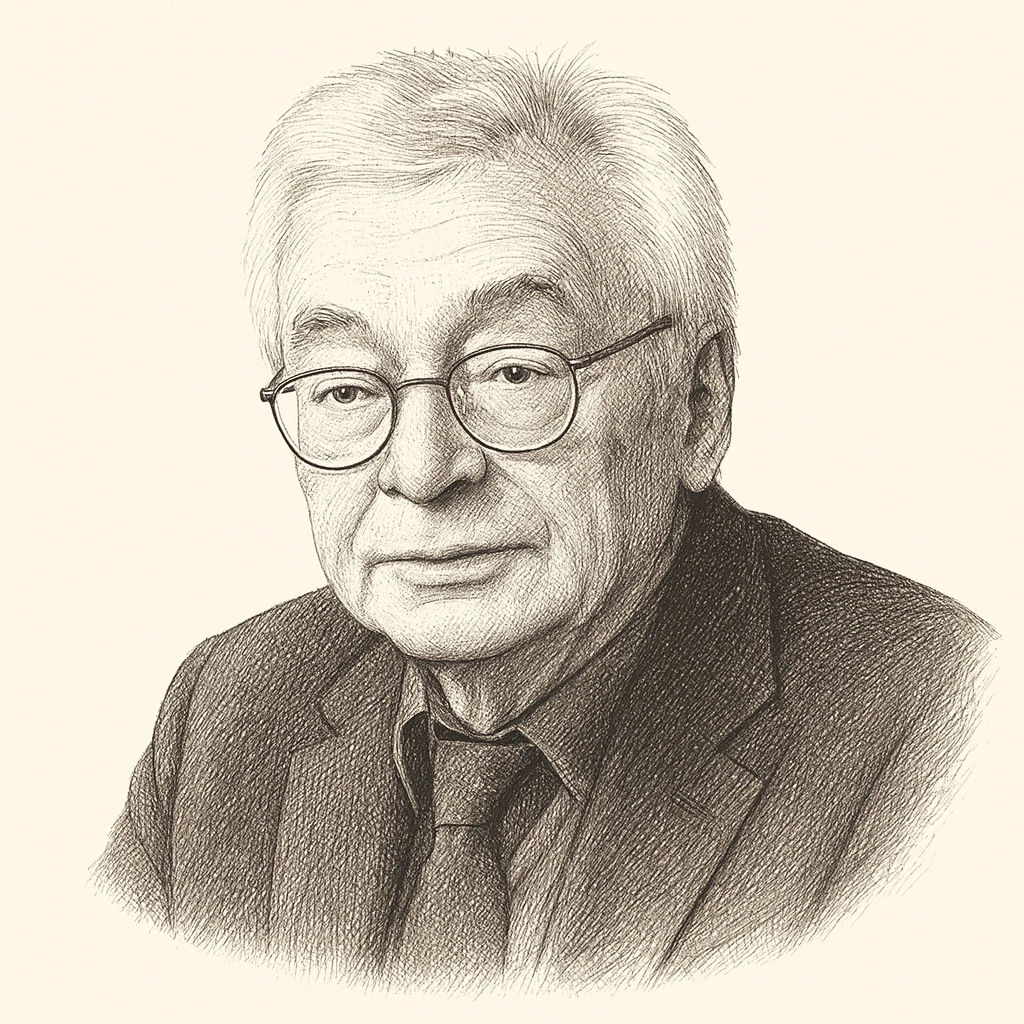
Hans-Hermann Hoppe is a German-born economist and political philosopher associated with the Austrian school of economics and the radical libertarian, or anarcho-capitalist, tradition. Trained in Germany, where he studied under the sociologist and philosopher Jürgen Habermas, he later relocated to the United States and became a close associate of the economist Murray Rothbard. For many years he taught economics in the United States and became a leading figure at the Ludwig von Mises Institute, positioning himself as one of the principal intellectual heirs to Rothbard's project of grounding a stateless private-property order in economic theory and moral philosophy.
Hoppe is best known for his attempt to provide an a priori, or purely rational, justification for private property rights through what he calls argumentation ethics. The argument holds that anyone engaged in the act of arguing or debating necessarily presupposes exclusive control over their own body and, by extension, the legitimacy of self-ownership and property acquisition; to deny these norms in argument is, on this account, to fall into performative contradiction. Drawing on Habermasian discourse theory but turning it toward libertarian conclusions, Hoppe presents this as a demonstration that the ethics of private property cannot be coherently disputed, thereby offering a foundation for a market anarchist order without a state.
Hoppe is equally known for a sustained critique of democracy, which he treats not as a corrective to monarchy but as a further stage of decline in the security of property. He argues that democratic rulers, lacking ownership of the state, have incentives toward short-term exploitation and expanding public debt, whereas hereditary rulers at least treat their domain as capital to be preserved. In place of the state he envisions a society of competing private jurisdictions and voluntary, contract-based communities, an idea he has developed alongside the notion of covenant communities that could set their own membership rules. These positions, particularly his views on immigration, cultural homogeneity, and exclusion, are the most disputed part of his work: in Democracy: The God That Failed (2001) he wrote that in a libertarian covenant order "there can be no tolerance toward democrats and communists," who "will have to be physically separated and expelled from society."
Through his writings, his teaching, and the international society he founded to bring together like-minded scholars, Hoppe has become an influential voice on the libertarian right, admired by anarcho-capitalists and paleolibertarians and opposed by egalitarian and mainstream liberal thinkers.
Hans-Hermann Hoppe is associated with Anarcho-Capitalist. See the archetype