
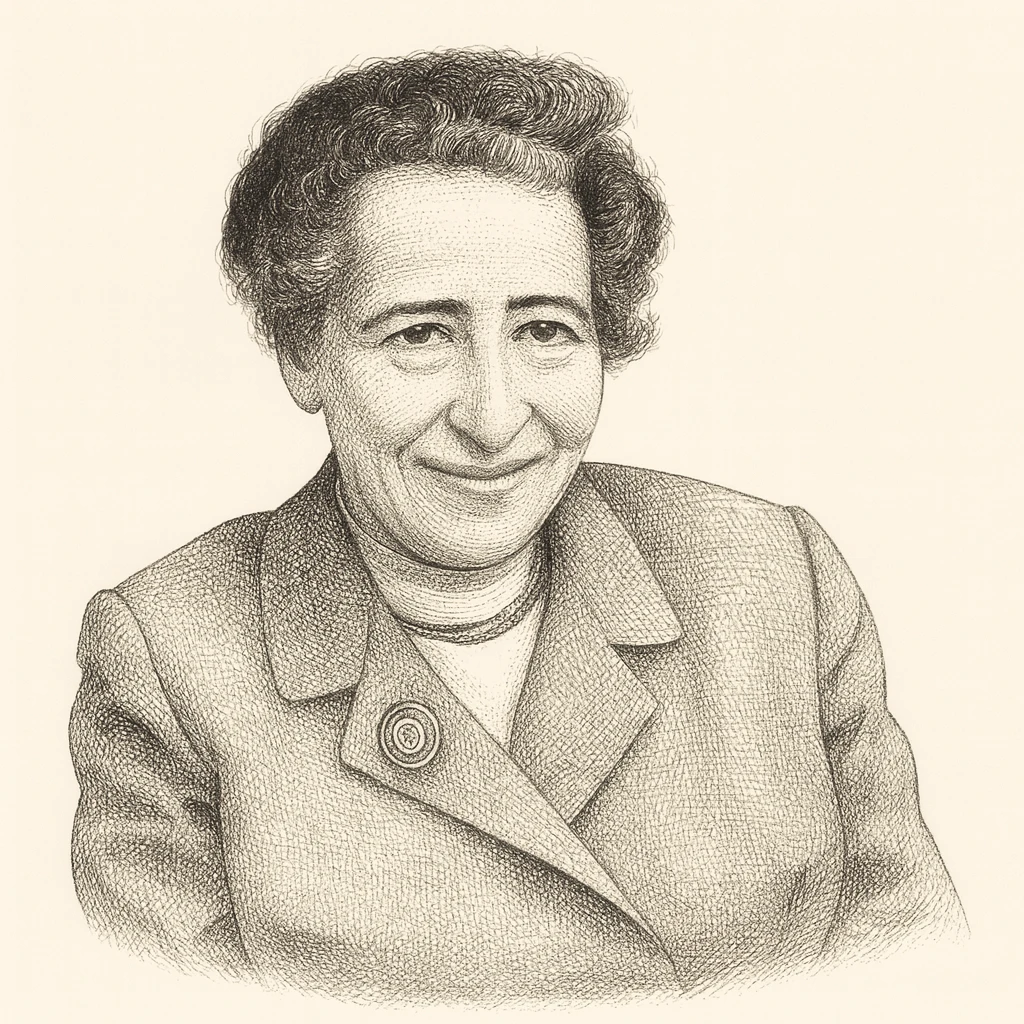
Hannah Arendt didn't fit. She was a German-Jewish intellectual who had to flee her homeland twice — first from Nazi Germany in 1933, then from Vichy France in 1941 — and she spent the rest of her life trying to understand how the political world she had known could collapse so completely into something monstrous. The result was a body of work that doesn't sit comfortably in any of the standard categories. Liberals find her too suspicious of liberal individualism. Conservatives find her too suspicious of tradition and authority. Marxists find her too suspicious of revolution. Existentialists find her too political. She is one of the rare 20th century political thinkers who cannot be claimed by any contemporary movement, which is part of what makes her so worth reading.
Arendt was born in 1906 in Hanover, raised in Königsberg (then part of Germany, now Russian Kaliningrad), and trained as a philosopher at the Universities of Marburg, Freiburg, and Heidelberg, where she studied with Martin Heidegger and Karl Jaspers. Her relationship with Heidegger — both intellectual and romantic, beginning when she was a young student and he was her married professor — became one of the most discussed and debated friendships in 20th century intellectual history, especially after Heidegger's compromised relationship with Nazism became fully known. Arendt continued to engage with him intellectually long after the war, while also doing more than perhaps any other thinker of her generation to understand what had gone wrong in Germany.
Her first major book, The Origins of Totalitarianism (1951), was an attempt to do something almost no one else was trying to do: take Nazism and Stalinism seriously as the same kind of political phenomenon, rather than treating one as right and the other as left. Arendt argued that totalitarianism was a new form of government altogether, distinct from older forms of tyranny and dictatorship, and that it grew from specific historical conditions — mass loneliness, the collapse of class structures, the rise of ideological movements that promised total explanations of history. The book was controversial when it appeared and remains so today, but it established Arendt as one of the most original political thinkers of her century.
Her second major book, The Human Condition (1958), turned away from totalitarianism and toward a positive vision of what politics could be at its best. Arendt drew on the ancient Greek polis to argue that genuine political action — what she called "the space of appearance" — was a distinctive human activity in which people came together to deliberate and act in concert about their common life. She thought modern societies had largely lost this space, replacing it with administration, economic management, and private consumption. Her diagnosis of modernity was bleak, but her vision of what politics could be was unusually inspiring.
Arendt is probably most famous today for the phrase "the banality of evil," which she coined in Eichmann in Jerusalem (1963), her account of the trial of Adolf Eichmann, the Nazi bureaucrat who organized the logistics of the Holocaust. Watching Eichmann in the dock, Arendt was struck not by his monstrousness but by his ordinariness — his cliché-ridden language, his absence of any real thought about what he was doing, his ability to participate in genocide while seeing himself as a conscientious civil servant doing his job. She concluded that the deepest evil might come not from demons but from people who had simply stopped thinking. The book provoked enormous controversy, especially within the Jewish community, and Arendt was denounced for what was perceived as a softening of moral judgment. Whether the controversy was fair or not, the underlying claim — that the worst political crimes are often committed by people who refuse to think — remains one of the most haunting insights in 20th century political thought.
Arendt died in New York in 1975, in the middle of writing what was to be her final work, The Life of the Mind. She left behind a body of work that has only grown in influence as the 20th century has receded — read today by scholars across the political spectrum, by activists trying to think about civic engagement, and by anyone struggling to understand how political evil happens and what political freedom requires. Her refusal to fit into any camp is what makes her work feel newly relevant in moments when the existing camps seem inadequate to the situation.
Hannah Arendt is associated with Independent Localist. See the archetype