
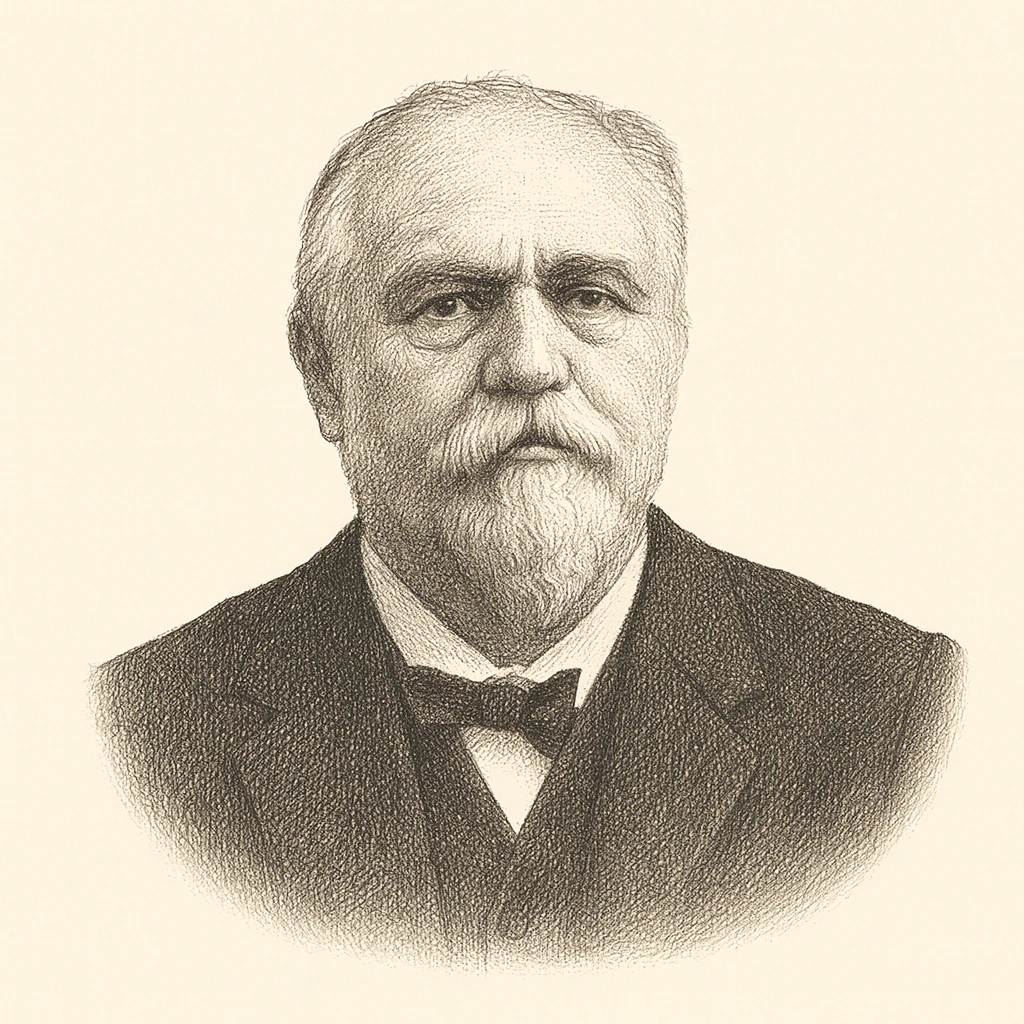
Georges Sorel was born in 1847 in Cherbourg, in Normandy, and spent the first half of his adult life as a civil engineer for the French Highways Department, working on road and bridge projects across France and Algeria before retiring in 1892 at forty-five with a modest pension to devote himself entirely to writing. This trajectory — a man of middle age, with an engineering career rather than an academic one, turning to social theory — shaped everything about his intellectual style: he was self-taught in philosophy and political theory, eclectic in his sources, impatient with academic convention, and willing to follow ideas to conclusions that more professionally socialized thinkers would have pulled back from. He was also, uniquely among the major political thinkers of his era, a man who had spent his career building things, and his preference for the productive work of construction over the parasitic claims of finance and management ran through his political thought.
He arrived at Marxism in the late 1880s, drawn by what he saw as its scientific claim to understand the laws of historical development, and became associated with the revisionist current in French Marxism — closer to the independent socialist tradition than to either the reformist Second International or the emerging revolutionary vanguardism. His first significant contributions were to the debate between evolutionary and revolutionary socialism, and he initially sided with neither, finding both too mechanical in their assumptions about historical development. What he was searching for was an account of social transformation that could explain why some movements generated explosive creative energy and others dissipated into parliamentary accommodation and bureaucratic routine.
He found part of his answer in Bergson's philosophy of creative evolution — the argument that life was characterized by élan vital, a creative surge that could not be reduced to mechanical causes — and part of it in his own observation of the French syndicalist movement, which was organizing workers in autonomous unions committed to direct action rather than parliamentary politics. Reflections on Violence (1906-08), the work that made him famous and controversial in equal measure, was his synthesis. Its central argument was about the social function of what he called myths: not myths in the sense of false beliefs, but myths in the sense of images of decisive action that mobilize the will and organize behavior in ways that rational calculation could not. The myth of the general strike — the image of a total, final confrontation between the working class and the capitalist order — was not a prediction about what would actually happen on some specific future date, but an image of total commitment that gave the syndicalist movement its moral seriousness, its rejection of compromise, and its refusal to be absorbed into the parliamentary machine.
Violence, in his account, was not something to be deplored but to be understood functionally: the violence of strikes and direct action was a form of moral assertion that maintained the purity of the proletarian ethic against the corruptions that parliamentary politics inevitably produced. Bourgeois society had become decadent — soft, hedonistic, unwilling to fight for anything — and the proletariat's willingness to struggle was the only remaining source of the heroic virtues that civilization required. This was not a comfortable argument for a socialist to make, and Sorel was aware that it put him in uncomfortable proximity to critics of decadence who were coming from the right.
The discomfort proved warranted. His trajectory after Reflections on Violence was erratic in ways that disturbed everyone who had claimed him. He moved toward the French monarchist right, associating briefly with Action Française and sharing its contempt for parliamentary democracy, before returning toward the left. Mussolini acknowledged him as an influence — the productive myth of Fascism, its contempt for parliamentary accommodation, its celebration of will and violence, its organization of heroic virtues against bourgeois decadence all bore Sorel's stamp. Gramsci read him carefully and absorbed the concept of hegemony partly from the Sorelian account of how myths organized collective will. Lenin dismissed him. The American political philosopher Hannah Arendt later identified Sorel as one of the intellectual sources of the glorification of violence that found its fullest expression in totalitarianism.
He died in 1922, having expressed sympathy for the Bolshevik Revolution in his last years — another of the shifts that made his trajectory so difficult to characterize. He was seventy-five, had never held a university position, had managed to be associated with virtually every major political tendency of his time without being fully claimed by any of them, and had produced in Reflections on Violence one of the most original and most dangerous works of political thought of the twentieth century.
Georges Sorel is associated with National Populist. See the archetype