
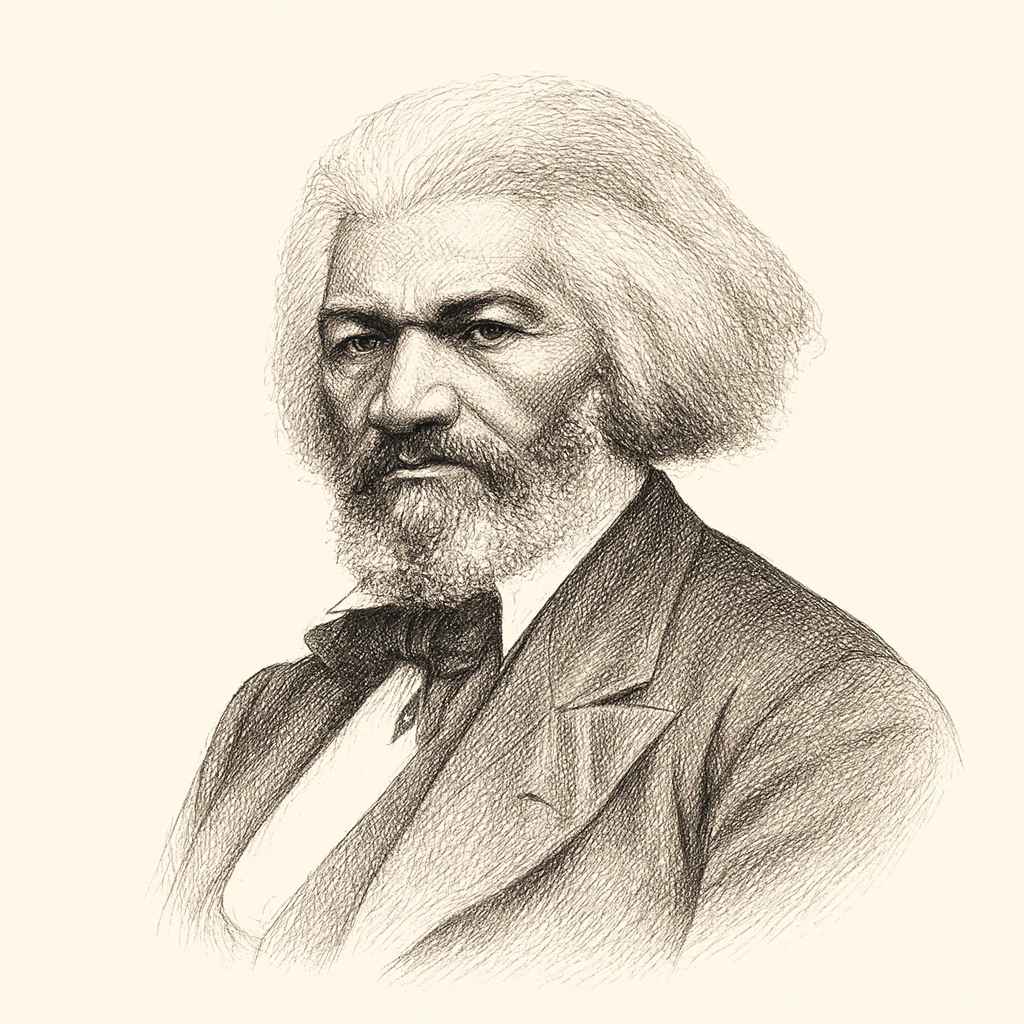
Frederick Douglass occupies an unusual place in the history of political theory. He is primarily remembered as an abolitionist, orator, and autobiographer, and some contemporary scholars have questioned whether his work rises to the level of systematic political philosophy in the way that figures like Locke, Mill, or Du Bois clearly do. But this framing undersells what Douglass actually accomplished. His three autobiographies, particularly My Bondage and My Freedom (1855), contain sustained philosophical arguments about freedom, slavery, natural rights, and the moral foundations of political community that rank among the most important contributions to 19th century American political thought. His constitutional theorizing, developed across decades of speeches and essays, made him one of the most important defenders of what would come to be called "political abolitionism" — the argument that the Constitution could be read as an anti-slavery document and that political engagement rather than Garrisonian withdrawal was the right strategy for ending slavery. And his later arguments about Reconstruction, citizenship, women's rights, and the meaning of American democracy shaped the political development of the postwar United States in ways whose full significance was only recognized a century later.
Douglass was born into slavery in Maryland in February 1818, the son of an enslaved woman named Harriet Bailey and a white father whose identity was never definitively established. He spent his childhood and early adolescence in slavery on the Eastern Shore of Maryland, where he learned to read through a combination of deception, persistence, and the temporary kindness of a slaveowner's wife who began teaching him before being ordered to stop. He taught himself to write by copying letters from discarded books. In 1838, at twenty, he escaped from Baltimore by taking a train north dressed as a free sailor, made his way to New York and then Massachusetts, changed his name to Douglass, and threw himself into the abolitionist movement that was then the most vital political cause in the American North.
His first autobiography, Narrative of the Life of Frederick Douglass, an American Slave (1845), was a literary and political sensation that sold tens of thousands of copies in the United States and Europe. The book was an immediate contribution to the abolitionist cause because it refuted the standard pro-slavery argument that enslaved people were incapable of the kind of intellectual and moral agency that would make them suitable for freedom. Douglass's prose was clear, powerful, and analytically sharp, and the detailed account of his own experience of slavery made undeniable what pro-slavery writers had spent decades denying. The book was so successful that Douglass had to flee to Britain for two years to avoid being captured and returned to his former owner, and British supporters eventually raised money to purchase his legal freedom so that he could return to the United States without risking re-enslavement.
Douglass's political theory developed most clearly in his second autobiography, My Bondage and My Freedom (1855), which expanded the narrative of the first book into a more reflective meditation on the philosophical significance of his experience. The sections on the psychology of slavery, on the gradual recognition of his own humanity and personhood, and on the intellectual and moral development that made his escape possible are works of political philosophy in the mode of experiential argument rather than abstract theorizing. Douglass was making a case that no abstract argument could make as forcefully: that enslaved people were fully rational moral agents whose humanity was demonstrated by their capacity to recognize and resist the injustice of their condition. The book's account of his fight with the slave-breaker Edward Covey, when Douglass was sixteen, is one of the most theoretically important passages in 19th century American political writing. Douglass describes the physical fight as the moment when "I was a changed being after that fight. I was nothing before; I was a man now." The claim was that the experience of resisting unjust violence, even when resistance was objectively futile, was itself constitutive of genuine moral selfhood. Freedom was not just the absence of external constraint but the active assertion of one's own dignity in the face of attempts to deny it.
On the constitutional question, Douglass began his abolitionist career as a Garrisonian, accepting William Lloyd Garrison's framing of the Constitution as a pro-slavery document. In the late 1840s and early 1850s, through extensive reading of legal and political theory including the work of Lysander Spooner, Douglass began to change his mind. By 1851 he had publicly broken with the Garrisonians and adopted the position that the Constitution, properly interpreted, was actually an anti-slavery document whose principles committed the federal government to the eventual elimination of slavery. This was not just a tactical shift. It represented a fundamentally different theory of political engagement: where the Garrisonians had argued for principled withdrawal from a corrupt political system, Douglass argued that the political system could be used as an instrument of liberation if its principles were properly understood and its institutions properly pressed. The shift put Douglass into close alliance with the political abolitionists of the Liberty Party and later the Republican Party, and it positioned him to play a significant role in the political events that led to the Civil War and emancipation.
During and after the Civil War, Douglass's political work focused on the meaning of emancipation and the challenges of Reconstruction. He met with Abraham Lincoln on several occasions and pressed for the recruitment of Black soldiers into the Union Army (eventually successful) and for the extension of full citizenship rights to Black Americans after the war. His post-war writings developed arguments about citizenship, suffrage, and the structural conditions necessary for genuine freedom that anticipated much of what Du Bois and later civil rights theorists would develop in the 20th century. His 1883 speech "The Civil Rights Case," delivered after the Supreme Court struck down the Civil Rights Act of 1875, was a prophetic warning about the dangers of the federal government's retreat from Reconstruction — a warning that was tragically vindicated by the subsequent collapse of Black political rights in the South under Jim Crow.
Douglass also took unconventional positions throughout his career that set him apart from many of his abolitionist contemporaries. He was a consistent supporter of women's suffrage from the Seneca Falls Convention of 1848 onward, one of the few prominent male abolitionists who refused to subordinate women's rights to other causes. He argued for the full integration of Black and white Americans rather than for racial separation or emigration, opposing both colonization schemes and the later Black nationalism that emerged after Reconstruction. His second marriage, to the white abolitionist Helen Pitts in 1884 after his first wife's death, was controversial even among his supporters but consistent with his lifelong commitment to human universalism over racial categorization.
Douglass died in 1895 at seventy-seven, having just returned from a meeting of the National Council of Women in Washington. He was by then the most celebrated Black public figure in American life, a former U.S. Marshal for the District of Columbia, a former U.S. Minister to Haiti, and a living link between the abolitionist movement of the 1840s and the early civil rights movement that was taking shape in the decade before his death. His influence on subsequent African American political thought is profound, and his arguments about freedom, citizenship, and the moral foundations of political community remain essential reading for anyone trying to understand the American political tradition.
Frederick Douglass is associated with Progressive Activist. See the archetype