
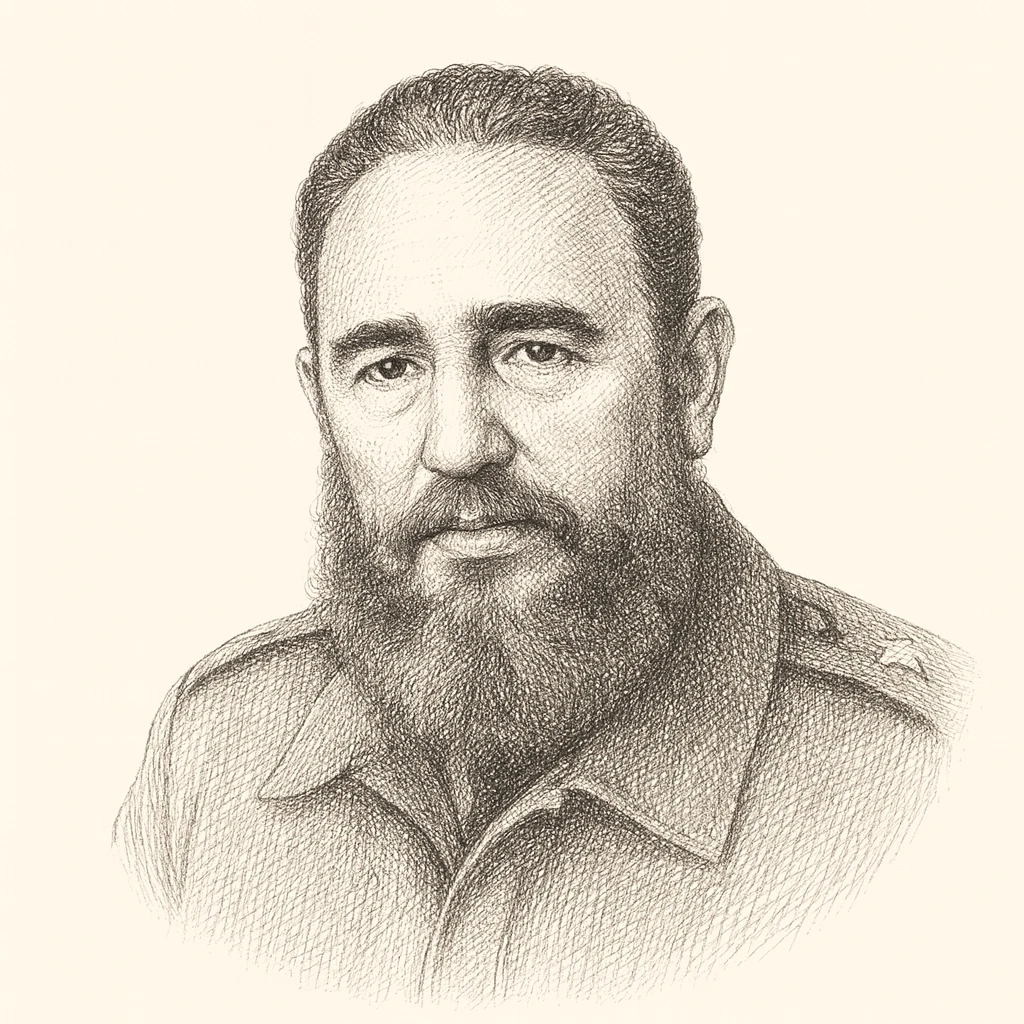
Fidel Castro was the Cuban revolutionary who overthrew the Batista dictatorship in 1959 and ruled Cuba for nearly fifty years, surviving numerous CIA assassination attempts and outlasting ten American presidents. Son of a wealthy landowner, Castro was radicalized at the University of Havana and began his revolutionary career with the failed Moncada Barracks attack in 1953. Trained as a lawyer, he invoked the nationalist, anti-imperialist heritage of José Martí, most famously in his trial defense speech after Moncada, 'History Will Absolve Me.'
Castro's guerrilla campaign from the Sierra Maestra, supported by Che Guevara and other revolutionaries, succeeded when Batista fled on New Year's Day 1959. Initially ambiguous in ideology, Castro declared Cuba socialist in 1961 after the Bay of Pigs invasion and aligned with the Soviet Union, nearly triggering nuclear war during the 1962 missile crisis. His government nationalized foreign-owned companies and consolidated a one-party state under a Marxist-Leninist Communist Party.
Castro's political thought fused Marxism-Leninism with Third World anti-colonialism. He served as secretary-general of the Non-Aligned Movement, and in the mid-1970s Cuba sent direct military aid to Marxist governments in Angola and Ethiopia.
Castro's Cuba made large gains in healthcare and education, including near-universal literacy after a 1961 campaign, while suppressing political freedom and sending thousands to prison and exile. The state controlled the press, imprisoned dissidents, and persecuted gay men. The United States maintained a trade embargo against the island from the early 1960s on. The economy stagnated, especially after the Soviet collapse ended Cuba's Soviet subsidies, forcing austerity during the 1990s "Special Period."
Castro stepped down in 2008 due to illness, handing power to his brother Raúl, and died in 2016. Later Latin American leftists, among them Venezuela's Hugo Chávez, cited him as an inspiration.
Fidel Castro is associated with Vanguard Collectivist. See the archetype