
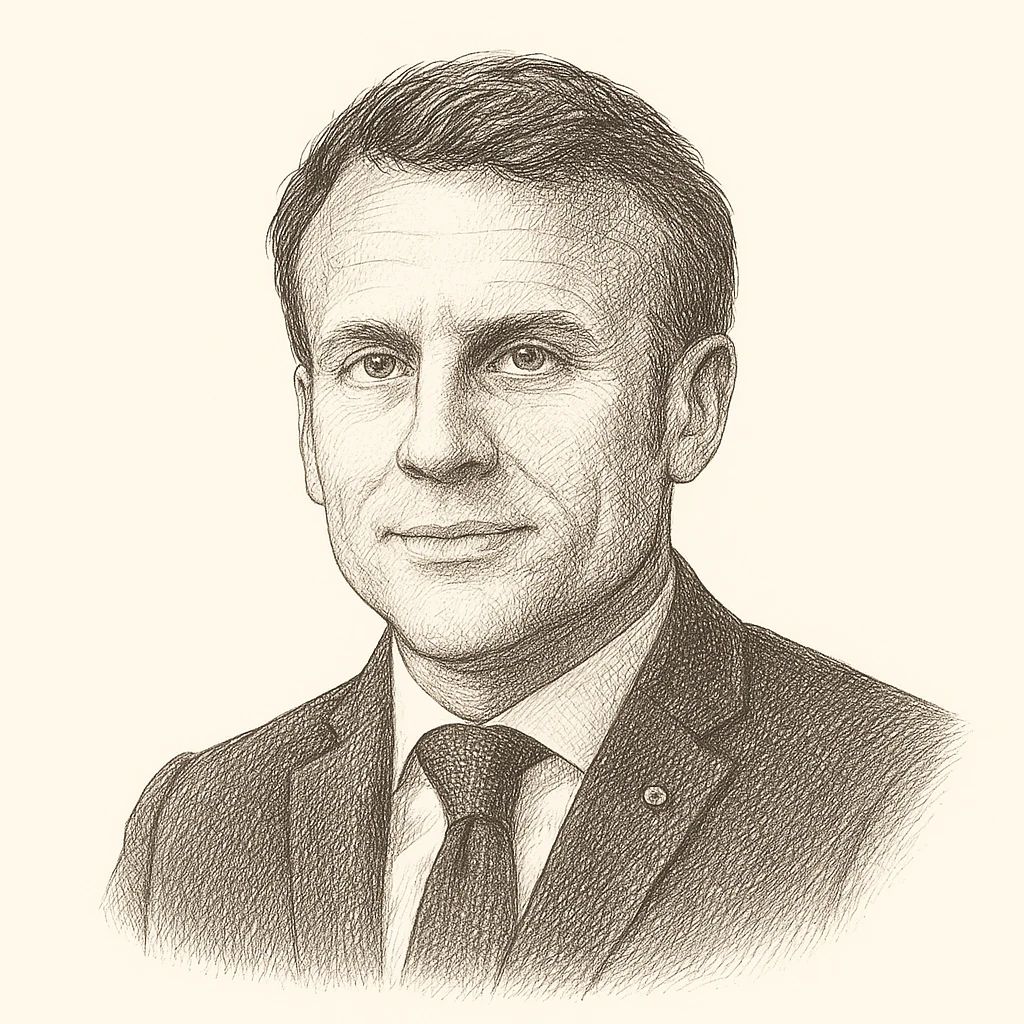
Emmanuel Macron rose to the French presidency in 2017 as the founder of a new political movement that sought to transcend the traditional left-right divide. Trained as a philosopher and an official at the Inspectorate of Finance before entering government, he built his political identity around the claim that the old cleavages of French politics had become obsolete. His centrism—sometimes described by the label "progressive" and sometimes by critics as technocratic—combines pro-market economic liberalism, an emphasis on entrepreneurship and labor-market flexibility, with a defense of social protection and public investment. This synthesis, positioning himself as neither socialist nor conservative, marked an attempt to reconstitute a governing center at a moment of fragmentation across Western democracies.
At the heart of Macron's political thought is a robust defense of liberal internationalism and, above all, European integration. He has argued repeatedly for a more sovereign and strategically autonomous Europe—one capable of acting as a coherent power in defense, technology, and economic policy rather than depending on others. His speeches on European renewal frame the Union as a project requiring deeper cooperation and reform to survive the pressures of nationalism, and he has positioned himself as a champion of multilateralism and the rules-based order against both isolationism and authoritarian rivals.
Macron's governing style reflects a Gaullist-inflected belief in a strong, decisive executive, and he has often invoked the need for vertical, reforming leadership. This has generated persistent criticism that his politics are elitist and detached from ordinary citizens, a charge crystallized by the Yellow Vests protests and recurrent disputes over pension and labor reform. His approach also frames much European debate as a contest between liberal openness and nationalist closure, a framing that both supporters and opponents have adopted.
As a political figure, Macron matters less as an original theorist than as an emblematic practitioner of a particular contemporary project: the effort to rebuild a liberal, pro-European center capable of competing with resurgent populist and nationalist movements. His career has become a reference point in debates about whether centrism can offer a durable alternative to polarization, and about what a reformed, more assertive Europe might look like in a multipolar world.
Emmanuel Macron is associated with Cosmopolitan. See the archetype