
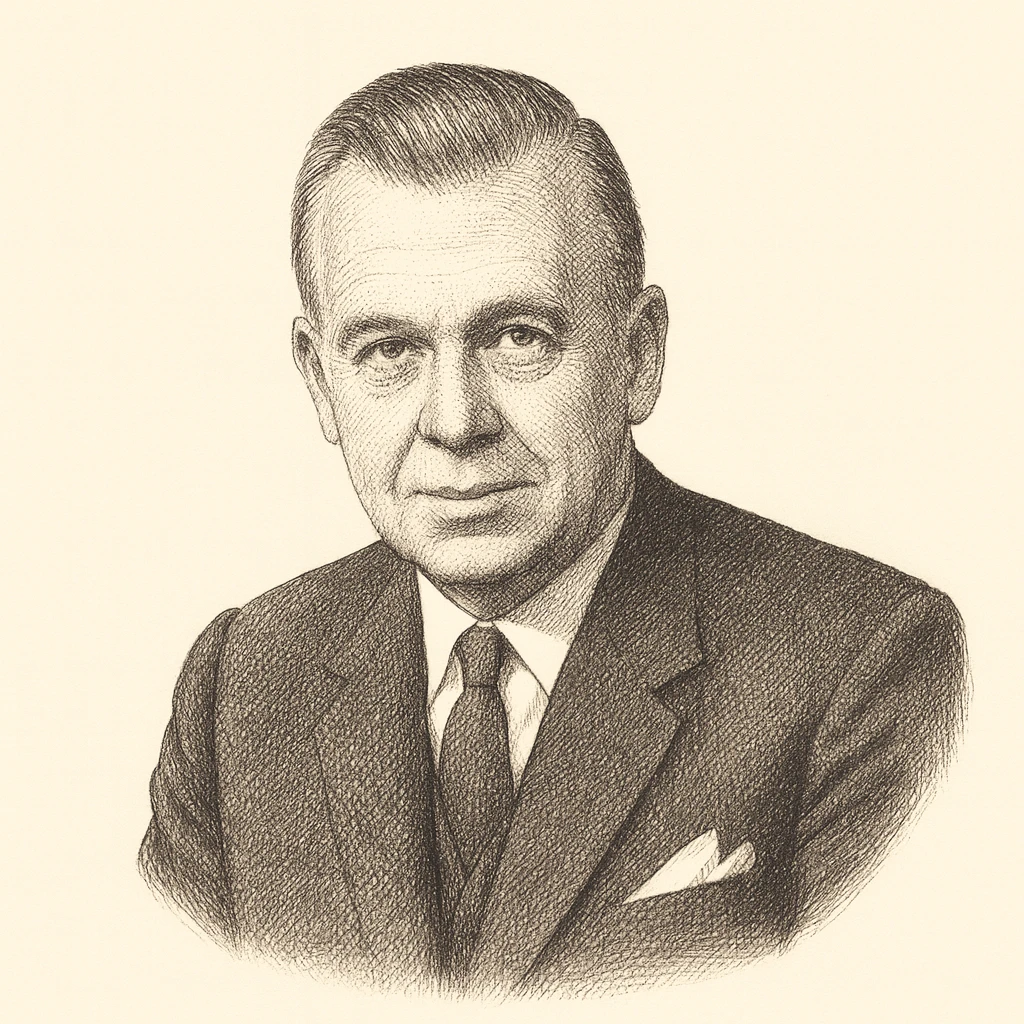
E.F. Schumacher was an economist whose critique of industrial gigantism made him one of the most influential dissenting voices in twentieth-century economic thought. Trained in the conventional economics of his day and shaped by decades of work as an economic adviser—including a long tenure with Britain's National Coal Board—he grew skeptical of the assumption that ever-larger scale, higher productivity, and unbounded material growth reliably served human welfare. His 1973 collection Small Is Beautiful: A Study of Economics as if People Mattered gathered these arguments into a wide-ranging challenge to mainstream growth economics.
Schumacher's central political claim was that scale is a moral and human question, not merely a technical one. He argued that vast, centralized organizations and capital-intensive technologies tend to alienate workers, concentrate power, and treat both people and nature as expendable inputs. Against this he championed decentralization, local self-reliance, and what he called "appropriate" or "intermediate" technology—tools and production methods matched to the resources, skills, and needs of ordinary communities, especially in poorer countries. He founded the Intermediate Technology Development Group to put these ideas into practice, promoting small-scale, labor-intensive techniques as an alternative to importing large Western industrial models.
This outlook placed him at an unusual crossroads. His emphasis on ecological limits, the finitude of natural resources, and the folly of treating fossil-fuel capital as income made him a foundational figure for environmentalism and the later degrowth and green movements. His stress on human-scale institutions, meaningful work, and suspicion of both concentrated corporate and state power resonated with decentralist and communitarian traditions, while his later writings drew increasingly on spiritual and ethical concerns, including Buddhist thought and Catholic social teaching. He was skeptical of grand ideological systems and preferred practical, situated judgment over abstract maximization.
Schumacher's influence has been broad but diffuse. He is invoked by ecologists, appropriate-technology advocates, localists, and critics of consumerism across the political spectrum, and the phrase "small is beautiful" entered common usage as shorthand for resisting bigness for its own sake. Whether his prescriptions scale up, or romanticize small-scale life, is still argued over, but his reframing of economics around human ends rather than aggregate output remains a durable touchstone for those who doubt that growth alone measures the good.
E.F. Schumacher is associated with Left Libertarian. See the archetype