
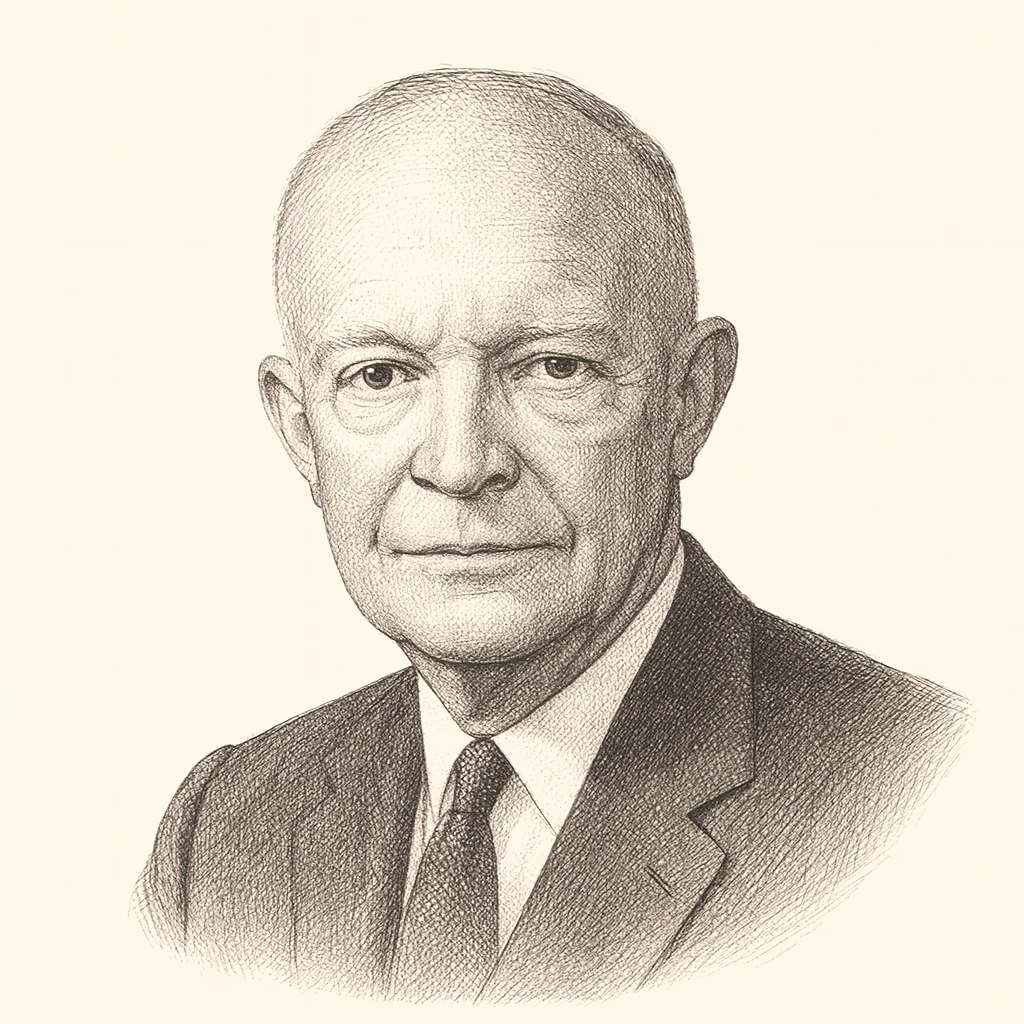
Dwight David Eisenhower was the Supreme Commander of Allied Forces in Europe during World War II and the 34th President of the United States. A career military officer from Kansas, Eisenhower rose through the ranks on organizational ability rather than combat leadership, emerging as the general who held together the fractious Allied coalition. In politics he described his course as a middle road between the unfettered power of concentrated wealth and the unbridled power of statism.
As president (1953-61), Eisenhower practiced "modern Republicanism"—accepting New Deal programs while pursuing fiscal conservatism. Against the conservative wing of his own party, which hoped to roll back the welfare state built under Roosevelt, Eisenhower argued that programs like Social Security had become a permanent part of American life; he signed legislation expanding it. He paired this with a commitment to balanced budgets and restraint on federal spending, seeking a middle path he thought both economically responsible and politically sustainable. He ended the Korean War, built the Interstate Highway System, enforced school desegregation at Little Rock, and managed Cold War tensions with a combination of nuclear deterrence and covert operations.
His foreign policy rested on the "New Look," which leaned on nuclear deterrence and intelligence operations to contain the Soviet Union at lower cost than large conventional forces. His administration used the CIA to help overthrow the governments of Iran in 1953 and Guatemala in 1954. The New Look reflected his conviction that sustained military spending could distort the domestic economy and society, a concern that culminated in his farewell address warning against the "military-industrial complex," a phrase that entered lasting use in American debates over defense spending.
Eisenhower's reputation has risen with time. Contemporaries often portrayed him as passive, a golfing figurehead who delegated to subordinates. Revisionist scholarship, notably Fred Greenstein's The Hidden-Hand Presidency (1982), instead presented him as a skillful leader who kept America out of war while managing great power rivalry, deliberately exercising power through indirection. He governed as a moderate conservative, frustrating both right-wingers who wanted rollback and liberals who wanted expansion.
Dwight D. Eisenhower is associated with Moderate Conservative. See the archetype